
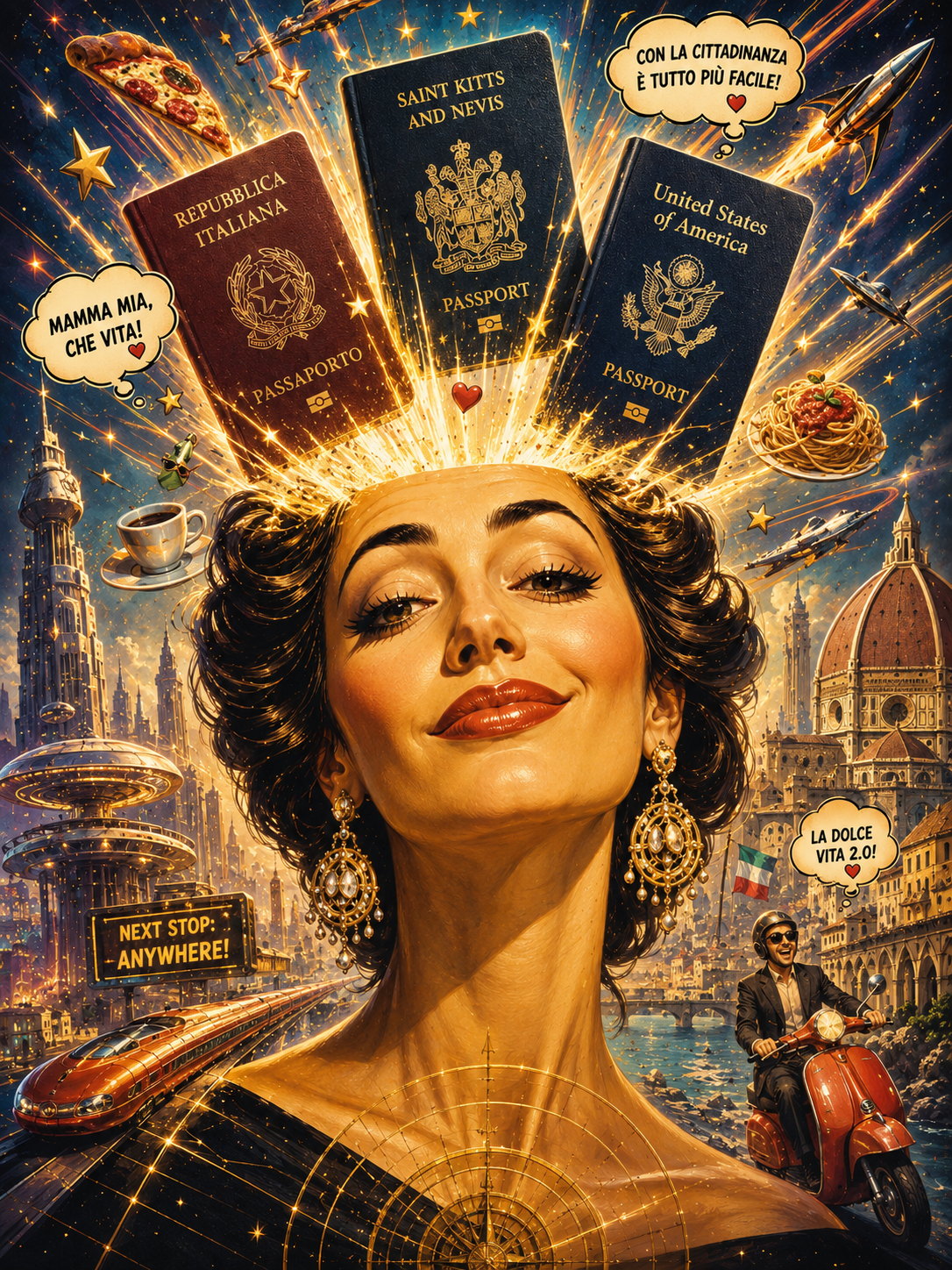
Sarah Mancini, twenty-nine, had spent four years steaming oat milk at the Starbucks off I-71 in Columbus, Ohio. She could make a Butterbeer Frappuccino with her eyes closed, which was good, because her eyes were usually open on her phone, scrolling for a way out of Ohio.
One rainy Tuesday, while wiping caramel drizzle off the cold bar, she found it: a TikTok by a woman in a sun hat on a Vespa. “How I got Italian citizenship by descent and changed my life,” the woman said, sipping an Aperol spritz in Positano. “If your great-great-grandparent was Italian, you could be an EU citizen too. Free healthcare, work anywhere, la dolce vita!”
Sarah dropped the rag. Her great-great-grandfather, Giuseppe Mancini, had left Naples in 1904 after allegedly punching a goat in the snoot. The family had always maintained he ran over the goat with a cart, though the goat had always maintained otherwise, and since goats are not known for their litigation skills, the family version prevailed.
Now, suddenly, that goat legend felt like an inheritance.
She spent $4,300 on a genealogist named “Ancestry Angelo,” who found a baptismal record in a church basement, a ship manifest, and a grainy photo of Giuseppe frowning at a lemon. She spent another $1,200 on a language app, but after three months she could only say “Dov’è il bagno?” and “Un altro spritz, per favore.” She called that fluency. The app congratulated her on a 47-day streak and told her she was ready to discuss Italian philosophy; she was ready to find the bathroom and order another spritz, which, she reasoned, was the entirety of Italian philosophy.
At the Italian consulate in Detroit, Sarah wore an “Italia” sweatshirt and carried a binder labeled— MY DESTINY.
The consular officer, Signora Ferrara, a woman with the exhausted face of someone who had processed ten thousand dreams, flipped through the paperwork.
“Miss Mancini,” she said, “citizenship is a legal status. It is not a winning lottery ticket.”
Sarah winked. “Sure, sure. So when do I get the EU stipend?”
Signora Ferrara stared. “There is no stipend.”
“Uh-huh,” Sarah said, tapping her nose. “The monthly cultural dividend. I get it. Discretion.”
Signora Ferrara closed the folder. “No. There is no monthly cultural dividend. There is no Vespa voucher. There is no Aperol allowance.”
Sarah leaned in and whispered, “You have to say that, don’t you?”
Signora Ferrara did not have to say that. She said it because it was true, but Sarah knew that in the world of TikTok, legal status and lottery tickets were often the same thing, and if you couldn’t tell the difference, that was because you weren’t supposed to.
Eighteen months later, her Italian passport arrived. It was burgundy and beautiful. Sarah held it to her chest and wept. She quit Starbucks with a flourish, threw her green apron in the trash, then pulled it out again because “you never know.”
She sold her Honda Civic for $3,000 to a man named Dwayne, maxed a Chase Sapphire card, and flew one-way to Rome. The airline lost her luggage, which she decided was the universe telling her to travel light, though the universe had actually just sent her luggage to Cleveland.
Rome, as it turned out, was not waiting with a check.
Sarah rented a “quaint” studio near Termini station for €950 a month. It was a former broom closet with a hot plate, a bed that folded into the wall like a bear trap, and a bidet inexplicably located inside the shower. The bidet was inside the shower, which meant that to use the bidet, one had to stand in the shower, which defeated the purpose of the bidet and also the shower, creating a sort of Catch-22 of hygiene in which one could never be both clean and dry.
She thought she would become a “brand consultant” or a “global lifestyle curator.” She applied to fashion houses, tech startups, even an embassy.
“I have an Italian passport,” she said at every interview.
“Bene,” they said. “What skills do you have?”
“I can make a flat white,” she said.
“Arrivederci.”
At one fashion house, they asked if she had a portfolio. She showed them her passport, which she thought was a portfolio, but they meant a portfolio of work, and she had none, because her work had been steamed milk, which does not photograph well unless you are very good at latte art, and she was not.
Within three months, Sarah discovered that her Italian citizenship did not come with a monthly allowance, a Vespa, or a trust fund. It came with a very nice shade of burgundy and the right to stand in shorter lines at Fiumicino Airport, which was a right she could not exercise because she could not afford a plane ticket, which was a Catch-22: the passport gave her the right to travel, but travel required money, and the passport did not give her money, and without money she could not travel, and without travel the passport was just a very nice bookmark.
Her savings evaporated.
She tried to get Italian unemployment benefits, but she learned those were based on contributions, not vibes. To get Italian unemployment benefits, she needed to have contributed to the Italian social security system. To contribute, she needed a job. To get a job, she needed skills. Her only skill was making Butterbeer Frappuccino, which was a skill, but not one that Italian employers considered worth paying for, because Italians already knew how to make coffee, and they did it better, and they did not need an American to steam oat milk at them. She tried to use the healthcare system, but the tessera sanitaria covered actual medical problems, not “glow up” or “financial anxiety.”
One afternoon, hungry and broke, she saw the familiar green siren near Piazza della Repubblica. She went inside. The manager, a bald Roman named Massimo, eyed her.
“You have experience?” he asked.
“Four years in Ohio,” Sarah said.
Massimo shrugged. “Benvenuta. But here, we do not put whipped cream on a cappuccino after eleven in the morning. The customers will report us to the carabinieri.”
Whipped cream after eleven was not just frowned upon; it was considered a crime against the state. Massimo had once seen a tourist arrested for asking for a cappuccino after dinner, though the tourist had been released after agreeing to apologize to the entire café.
So Sarah became a barista again. In Rome. Same green apron, same “grande” and “venti,” same impossible mobile orders. Only now the milk was better, the customers were ruder in Italian, and her monthly pay was €1,200. Her rent was €950. She survived on leftover cornetti and the free espresso she could sneak during her shift. She was, in every economic sense, exactly where she had been in Ohio—except now the weather was nicer and the pigeons were more aggressive.
The pigeons in Rome were not just aggressive; they had formed a union, and they demanded a cut of every focaccia crumb, and they were not above filing grievances with the carabinieri if they felt underpaid.
Then she saw another ad.
This one was on YouTube, and it featured a man in a linen shirt standing on the deck of a yacht. “Get a second citizenship in the Caribbean!” he said. “St. Kitts and Nevis, Grenada, Dominica—tax optimization, global mobility, true wealth. Wealthy people don’t rely on one passport. They build a passport portfolio.”
Sarah’s ears perked up like a cat hearing a can opener. That’s what I’m missing, she thought. One passport isn’t enough. Rich people have many. I need a Caribbean passport.
Then I’ll be a global elite!
The man on the yacht did not mention that he was not actually on the yacht, or that the yacht was rented for the day, or that the passport he was selling cost more than the yacht, but Sarah did not notice these things, because she was too busy noticing that the man had a very nice shirt, and she reasoned that a man with a very nice shirt could not possibly be lying.
There was only one catch, and that was Catch-22, which specified that a person who needed a second passport to become wealthy was precisely the person who could not afford a second passport, and a person who could afford a second passport was precisely the person who didn’t need one. Therefore, the only way to build a passport portfolio was to already be rich, and if you were already rich, you didn’t need a passport portfolio, but you got one anyway, which was why the rich had so many passports and the poor had so many debts.
Sarah ignored the part about the $150,000 investment. Instead, she found a “discount citizenship consultant” on Instagram named Preston, who wore a Panama hat and used the word “synergy” a lot. He offered her a “special Grenada package” for only $18,000 if she referred three friends. She had no friends to refer, so she paid the $18,000 by taking out a high-interest personal loan from a company called LoanShark Lite and maxing out three credit cards. LoanShark Lite was not a real loan company, but it was real enough to charge 29 percent interest and call her every day, and it had a slogan: “When banks say no, we say maybe, but at a higher rate.”
The process took seven months. She submitted fingerprints, a birth certificate, a bank statement showing negative forty-two dollars, and a photo of herself wearing a straw hat. One day, a lavender envelope arrived from Grenada. Inside was her new passport.
Sarah kissed it.
She held up her American passport, her Italian passport, and her Grenadian passport like a hand of cards. She fanned them out like a poker player with a straight flush, except the straight flush was made of debt and three different shades of red. “Now,” she whispered, “I’m diversified.”
The next week, she walked into an Italian bank to open an offshore account.
“I would like to open an international account,” she said, sliding all three passports across the desk.
The banker, Dottor Bianchi, looked at them. “Minimum deposit is one hundred thousand euros.”
Sarah smiled. “But I have three passports.”
“That is not a deposit.”
“What about three citizenships? That’s like… three times the wealth, right?”
Dottor Bianchi leaned forward.
“Signora, you can be poor in more countries now. Congratulations.”
The bank had a policy: to open an account, you had to prove you had money. To have money, you had to have an account. But if you had money, you didn’t need an account, and if you needed an account, you didn’t have money, which meant the only people who could open accounts were people who didn’t need them, and the people who needed them couldn’t, which was exactly how the bank liked it.
She tried to use her Caribbean passport to avoid taxes. She had no income to tax. She tried to use it to get into a yacht party in Porto Cervo. The bouncer, a very large man named Ernesto, laughed so hard he had to sit down. “This is a passport,” he said, “not a boarding pass for the rich.” Ernesto had seen many passports, and he had never once seen a passport that granted admission to a yacht party, because yacht parties were governed by a different kind of passport, which was made of money, and Sarah did not have that passport, though she had three others.
The debt collectors called daily.
“Sarah, this is Chad from Collections. Your loan is ninety days past due.”
“I’m a citizen of the world now,” Sarah said.
“The world doesn’t pay your minimum payment,” Chad said.
Chad from Collections was a very patient man, but he had not seen the world, and he did not care if Sarah was a citizen of the world, because the world had not co-signed her loan, and the world was not answering his calls.
She owed $12,000 to Chase, $8,000 to LoanShark Lite, $4,000 to her cousin Brenda, who had “invested” in her citizenship quest, and €600 to Massimo for eating too many breakfast sandwiches. She picked up extra shifts at Starbucks Rome and a second job at a bar in Trastevere, where she served Aperol spritzes to American tourists who asked if she was “a local.” The American tourists always asked if she was a local, and she always said yes, because she had an Italian passport, which was true in a legal sense and false in every other sense, and the tourists never asked any follow-up questions because they were too busy taking photos of their drinks.
One night, exhausted, she sat on the steps of the Pantheon with her three passports fanned out like a deck of cards. A pigeon landed next to her, unimpressed.
“I have American citizenship,” she told the pigeon. “Italian citizenship. Grenadian citizenship. I should be rich.”
The pigeon cooed and stole her focaccia crumb.
That was the moment Sarah finally understood the lesson that no TikTok had taught her.
Passports are just documents. They don’t create income. They don’t pay rent. They don’t make you rich. They just let you stand in different lines at the airport. Her economic situation had not changed because her income had not changed. She had simply become broke in better weather and with more paperwork. She had three passports, which meant she could stand in three different lines at the airport, but she could not afford a plane ticket, which meant the lines were theoretical, and the passports were burgundy and lavender and blue, but they could not buy a sandwich, and a sandwich was what she needed, not a passport.
So she made a small change. She started an English conversation class for Italian businessmen, charging €10 an hour. The Italian businessmen were very interested in learning English, but they were not very interested in paying, and they often paid in espresso, which was not legal tender, but which Sarah accepted anyway because espresso was better than nothing, and nothing was what she had. It wasn’t much, but it was more income. She started a TikTok called “The Reality of Citizenship Dreams,” where she filmed herself eating discounted focaccia and explaining compound interest. It got four hundred followers. She was still broke, but slightly less.
Sarah had become a citizen of the world, but her bank account remained a citizen of Ohio—and until her income matched her passport collection, she’d be serving pumpkin spice to tourists in Rome, one grande at a time. She had learned that a passport portfolio was not a portfolio at all, but a collection of very pretty booklets that gave her the right to be poor in more places, and if that was wealth, then she was the richest woman in Rome, which she was not, but she was learning to make a very good flat white, and in Rome, that was worth something, though not very much, and certainly not enough to pay the rent, which was due, as always, tomorrow.
Leave a Reply