
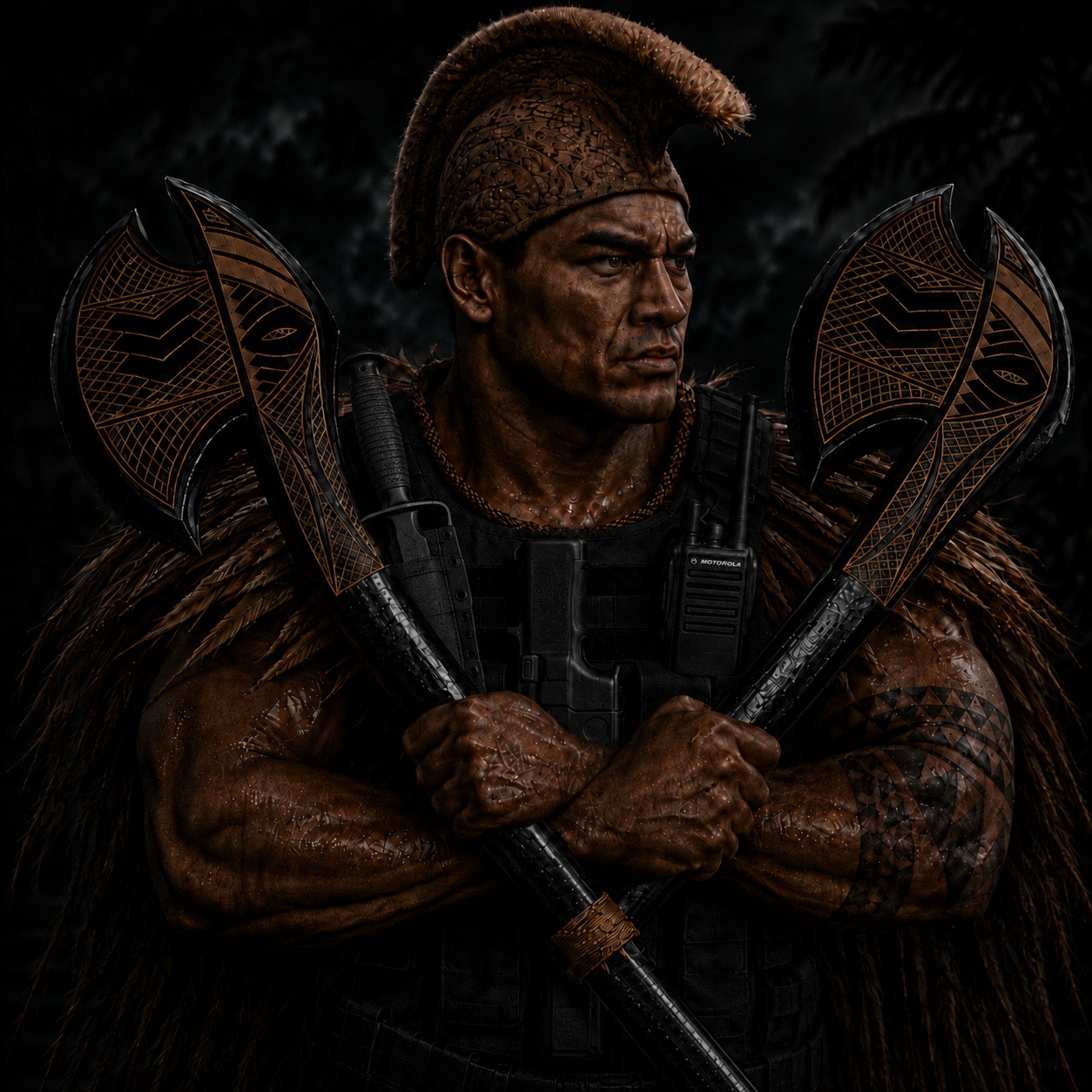
The trouble started when they stopped saying “Aloha” to each other.
Not the tourists—they’d been gone for years, their resorts shuttered and their beaches empty, replaced by Chinese-manufactured surveillance towers that blinked red across the ridgelines like malevolent stars. The trouble started when the kūpuna—the elders who remembered the overthrow, who remembered when their grandparents’ language was beaten out of them in missionary schools—began nodding along to the speeches on the radio.
But before that trouble, before the speeches and the camps and the white robes shuffling toward the sea, there was the collapse. And the collapse did not come with fire and fury, with bombs falling on Honolulu or soldiers marching through the streets of Waikīkī. The collapse came like a slow poison, seeping into the bones of the American empire until the bones turned to dust and the empire crumbled from within, a house of cards collapsing under its own weight.
Kai remembered the first signs, the way his father would come home from the university with news that made no sense to a young man who’d grown up thinking America was eternal. The Treasury auctions had failed, his father explained, investors refusing to buy the government’s debt because the dollar was becoming worthless, pension funds freezing withdrawals while retired workers discovered their life savings had evaporated into nothing. The dollar plunged against a new Asian currency backed by Chinese gold, and American banks imposed capital controls that trapped ordinary citizens’ money while the wealthy spirited their fortunes overseas. Gasoline hit twenty dollars a gallon in California, then thirty, then became simply unavailable, and governors began issuing emergency scrip to pay their police and teachers and hospital workers, state-printed IOUs that were worthless outside their own borders.
“Da kine,” his father would say, shaking his head at the kitchen table. “Da kine all over. You see mainland now? Dis country going down. Not fast—slow. But going down for sure.”
And Kai would nod, not really understanding, because the islands still felt safe, still felt like home, still felt like the same Hawaiʻi he’d always known.
But Kiana saw it differently. She was a nurse at the hospital, and she watched the supply chain collapse in real time, the shipments of medicine and equipment that used to arrive from the mainland becoming less frequent and then stopping altogether. The Chinese began supplying the islands instead—medical supplies, food, fuel—and the government in Honolulu, desperate and grateful, signed agreements that gave Beijing naval access to Pearl Harbor and surveillance rights across the archipelago. The American carriers that had once patrolled the Pacific remained in port, their crews unpaid and their fuel tanks empty, and when the last carrier group was sold for scrap to China, Kiana remembered the way her supervisor, the haole woman from Kansas, had stared at the television with tears in her eyes.
“We’re losing everything,” the woman whispered.
And Kiana had wanted to comfort her, had wanted to say something reassuring, but the words wouldn’t come. Because Kiana was Hawaiian, and part of her—a part she was ashamed of—felt a dark satisfaction watching the empire that had stolen her grandmother’s language and her grandfather’s land finally crumble into dust.
Kalani, on the other hand, felt nothing but rage. His brother had been beaten by haole cops in the 1990s, his grandmother had been forced to speak English in school, and every Hawaiian he knew had a story about being made to feel like a stranger in their own home. When the United States military retreated from the Pacific, when the Chinese flags first flew over the bases that had once belonged to America, Kalani had cheered. He’d marched in the streets with Ke Ea Hou—the New Sovereignty—chanting for independence, for restoration, for the return of the land to the people who had always belonged to it.
“Eh, braddah,” his friend would say, slapping him on the back. “We going get our islands back. We going make it pono again.”
And Kalani believed him. He believed it with his whole heart.
The collapse accelerated as the United States devolved into regional chaos. California rationed electricity while Texas declared its own currency and New York became a city-state dependent on European bailouts. The military, once the most powerful force in human history, withered on the vine of its own logistical nightmares, carrier groups trapped in port because spare parts were unavailable and fuel contracts unpaid, overseas bases abandoned one after another as Congress discovered that supremacy purchased with borrowed money could disappear much faster than it had been constructed. The American flag was lowered from embassies across the Pacific not with ceremony but with humiliating haste, and within eighteen months of the first Treasury failure, the United States possessed no meaningful naval presence in the Pacific, its warships either sold for scrap or left to rust at anchor.
Hawaiʻi watched the continent fracture from three thousand miles away, and the Hawaiian legislature, meeting in emergency session beneath portraits of the deposed monarchy, voted by the narrowest of margins—forty-seven to forty-two—to sever the ties that had bound them to a dying empire. Independence passed, and the Republic of Hawaiʻi was born, its first act to secure diplomatic recognition from Beijing, its second to accept billions in reconstruction loans, its third to grant Chinese naval vessels access to former American facilities in exchange for security guarantees.
Kai was there that day, standing outside the legislature with his father and Tutu, his grandmother who still spoke of the overthrow as if it had happened yesterday. The crowd was electric with hope, thousands of Hawaiians waving the new flag and chanting the old chants that had been suppressed for generations, and when the vote was announced, the roar that went up was unlike anything Kai had ever heard. It was joy, yes, but it was also something deeper: a collective exhale, a release of pressure that had been building for more than a century, a recognition that the islanders were finally, after all this time, masters of their own destiny.
Tutu wept, her withered hands clutching his shoulders as she whispered “E ola kākou”—we live, we survive—and Kai felt something shift inside him, a certainty that his children would grow up in a free country, a nation that honored its ancestors and protected its land and spoke its language without shame.
His father put his arm around him and said, “Da kine, yeah? We going make it right dis time. We going make it pono.”
And Kai believed him.
But the euphoria didn’t last. It never does. Because power, once seized, corrupts. Because freedom, once won, demands enemies. Because the revolution that begins with liberation always, always ends with something darker.
The speeches that said: The land must return to the people.
No one argued with that. How could you? Every Hawaiian family had stories. Kai’s grandmother, Tutu, used to whisper about how her great-grandfather’s kuleana—his sacred responsibility to the ʻāina—had been stolen by the sugar barons, parceled out to white planters who turned the loʻi into cane fields and the taro patches into golf courses. The old wounds were still raw, still weeping after all these years.
But then the speeches changed.
And the people must return the land.
Kai remembered the first time he heard that second sentence. He was sitting on the lanai of his parents’ house in Waimānalo, the trade winds rustling the plumeria trees, his slippahs kicked off by the door because you never wore shoes inside, no matter how many times his haole friends forgot. His father, a quiet man who worked maintenance at the university, turned off the radio and stared at the ocean.
“Da kine get choke meaning,” his father said, using the old Pidgin that meant that thing and there’s a lot of it all at once. “You know what dey saying, yeah?”
Kai didn’t. Not yet. But he would learn.
The First Classification
By the time the Ancestral Status Bureau opened its doors in Honolulu, Kiana had already lost her job at the hospital. She was a nurse, third-generation Japanese-Hawaiian, and she’d spent fifteen years caring for keiki in the pediatric ward. Her patients loved her. Their parents trusted her. But when the new regulations came down, her blood quantum—that strange, clinical number that determined who was Hawaiian enough—fell below the threshold.
“You can apply for reclassification,” the bureau officer told her, not meeting her eyes. The man was Hawaiian himself, his features familiar in a way that made Kiana’s stomach turn. “Just need to provide documentation. Birth certificates. Marriage records. Genealogical charts going back to 1893.”
“1893,” Kiana repeated. “The overthrow.”
The officer shrugged. “Before da kine, yeah.”
She went home that night and found her husband, Mark, sitting at the kitchen table with their daughter, Leilani. Mark was haole—white, fourth-generation, his family had been in Hawaiʻi since the 1920s. His grandfather had worked the pineapple fields. His father had built houses in Kailua. Mark himself was a carpenter, his hands calloused from decades of framing and roofing, and he’d never once acted like he owned anything more than the tools in his truck.
But the bureau didn’t care about intentions. It cared about lineage.
“Eh, howzit?” Mark said when she walked in, his Pidgin still carrying that mainland flatness no matter how many years he’d lived here. “You okay?”
Kiana sat down and told him about the reclassification form. About the genealogical charts. About the threshold.
“That’s not right,” Mark said slowly. “That’s not—they can’t just—”
“Can,” Kiana said. “Dey can. Dey already doing.”
Leilani, who was fifteen and had inherited her mother’s dark eyes and her father’s sandy hair, looked between them. “What about me? What am I?”
Neither parent answered.
The Camps Come to Maui
On Maui, the first “Temporary Relocation Facility” opened in what used to be a sugar plantation. The fences went up overnight—concertina wire glinting in the morning sun, guard towers sprouting like invasive species. The government called it Hoʻomaha, which meant “rest,” but everyone knew what it really was.
Kalani worked as a guard there. He’d joined Ke Ea Hou—The New Sovereignty—because his brother had been beaten by a haole cop in the 1990s, because his grandmother had been forced to speak English in school, because every Hawaiian he knew had a story about being made to feel like a stranger in their own home. He’d believed in the movement. He’d marched in the independence parades. He’d wept when the Chinese flags first flew over ʻIolani Palace.
But he hadn’t believed in this.
The first bus arrived before dawn. Families were permitted one suitcase each. Kalani watched them unload: a white couple with two keiki, the children crying because they were hungry, because they didn’t understand why they were being taken from their house. An elderly Japanese woman who kept saying “Mahalo” to the guards as if politeness would save her. A Filipino family whose ancestors had come to work the plantations in the 1920s, just like Kalani’s own.
“Eh, brah,” one of the other guards said, nudging him. “Stop looking so hamajang. Dey just settlers.”
Kalani nodded. He’d heard that word so many times now—settlers—that it had lost its meaning. Or maybe it had gained too much meaning. He wasn’t sure anymore.
Inside the facility, the families were processed. Their belongings were searched. Their ancestry certificates were checked against the databases. Those who failed—those whose blood quantum was too low, whose lineage didn’t stretch back far enough—were sent to the “repatriation” wing.
Kalani didn’t ask what happened in that wing. He didn’t want to know.
The Execution of Uncle Makoa
Uncle Makoa was a kupuna, an elder respected throughout the North Shore. He’d taught hula to generations of keiki. He’d blessed the new canoes before every regatta. He’d spoken ʻŌlelo Hawaiʻi when it was illegal, when the government punished children for speaking their mother tongue.
When the camps opened, Makoa spoke out.
“Da kine wrong,” he said at a community meeting, his voice trembling with age and outrage. “We was colonized—we know how dat feel. We know what it’s like to be dragged from your home, to be told your culture is kapu, to watch your children forget da language of their ancestors. We cannot do dis to odda people. We cannot become da t’ing we hated.”
The crowd was silent. Some nodded. Others looked away.
The next morning, Uncle Makoa was arrested.
Kalani was on duty when they brought him in. The old man walked slowly, supported by two guards who were young enough to be his grandsons. His wrists were bound with zip ties. His slippahs had been left at the door.
“Uncle,” Kalani whispered.
Makoa looked at him. There was no anger in his eyes, only a profound, bone-deep sadness.
“Eh, keiki,” the old man said gently. “You know what we doing here? You know what dis is?”
Kalani couldn’t answer.
“Dis is how it starts,” Makoa continued. “First dey come for da settlers. Den dey come for da mixed. Den dey come for da hapa who not Hawaiian enough. And den dey come for you, braddah, because you not pure enough, because you not akamai enough, because you not loyal enough. Dey always find someone else to put in da kine. Always.”
The guards dragged him away.
Kalani never saw Uncle Makoa again. He heard, though. Everyone heard. The old man was tried by a military tribunal—the whole process lasted less than an hour—and convicted of “undermining national rebirth.”
The execution was broadcast on the radio. Not the visuals—the government wasn’t that cruel—but the sound. The shuffling feet. The murmured prayer in ʻŌlelo Hawaiʻi. The single crack of the rifle.
Kalani sat in the guard tower that night and stared at the ocean. The moon was full, silvering the waves that had carried his ancestors’ canoes across the Pacific. He thought about Uncle Makoa’s words. He thought about his own grandmother, Tutu, who’d taught him to fish off the rocks at Kaʻena Point. He thought about the blood quantum on his own ancestry certificate—high enough now, but what about tomorrow? What about next year?
He took off his uniform. He left his rifle by the tower door. And he walked down to the beach, where the water was warm and dark and forgiving.
He didn’t come back.
The Last Aloha
Kiana and Mark were taken on a Wednesday.
The buses came at 5 AM, their headlights cutting through the pre-dawn mist. Kiana had been awake for hours, holding Leilani’s hand, whispering reassurances that neither of them believed.
“Where dey taking us?” Leilani asked.
“Try wait,” Kiana said, using the old phrase that meant be patient, slow down. “We go figure out.”
But there was no figuring out. There was only the bus, and the fences, and the guards who called them by numbers instead of names.
The facility on Oʻahu was a converted military base—the same base that had once housed American soldiers, the same base that had been turned over to the Chinese after the collapse. The irony was so sharp it cut.
They were processed. They were separated. Mark was sent to the men’s wing, Kiana to the women’s. Leilani was taken to a separate area for keiki.
Kiana screamed. She clawed at the guards. She called them every name she could think of—lolo, moke, paka lolo—but they just laughed and dragged her away.
In the women’s wing, she found herself surrounded by women she’d known her whole life. There was Mrs. Nakamura, who’d run the bento shop in Kaimukī. There was Auntie Lehua, who’d been her mother’s best friend. There was a young haole woman who’d just given birth, her baby crying in her arms, no formula, no clean diapers, nothing.
“Eh, Aunty,” Kiana said to Lehua, her voice breaking. “What we going do?”
Lehua was old, her skin weathered by decades of sun and salt, but her eyes were clear. “We going kokua each other,” she said, using the old word for help, for care. “Dat’s what we do. Dat’s what we always do. Dey can take our land. Dey can take our houses. But dey cannot take our ʻohana.”
Kiana nodded. She held the crying baby while the young mother slept. She shared her meager rations with the women who had less. She whispered Hawaiian lullabies to the children who were too scared to close their eyes.
She did what Hawaiians had always done: she survived.
The Pilgrims
The executions became routine.
Every morning, the guards would read a list of names. Every morning, families would hold their breath, praying not to hear their own. Every morning, someone would scream when they did.
The bodies were stacked in the back of trucks and driven to the north shore, where the cliffs dropped into the pounding surf. The government called it “repatriation.” Everyone else called it what it was.
The killing didn’t stop. It couldn’t stop. Because the ideology had its own momentum now, its own hunger that could never be satisfied. Every execution demanded another. Every camp required expansion. Every “settler” removed from the islands had to be replaced by someone more pure, more authentic, more Hawaiian.
But there was a problem: there weren’t enough pure Hawaiians left.
Generations of intermarriage had diluted the bloodlines. Even the guards—even Kalani, even his brother, even the leaders of Ke Ea Hou—had mixed ancestry somewhere in their past. The Ancestral Status Bureau kept raising the threshold, kept redefining who counted, kept finding new categories of people to exclude.
First it was the haole. Then the Japanese-Hawaiians. Then the Filipinos. Then the Chinese-Hawaiians. Then anyone who couldn’t trace their lineage back before the overthrow.
And then, finally, they came for each other.
The Broken Leis
On the last day, Kiana was released.
She didn’t know why. No one told her. One morning, a guard came to her cell and said, “You can go.” No explanation. No apology. Just the door swinging open and the sun blinding her after months of darkness.
She walked out of the camp in her bare feet—her slippahs had been taken on the first day—and started walking toward the mountains. Toward mauka. Toward the green ridges that had once been her home.
The road was empty. The houses were empty. The stores were boarded up, their windows smashed, their shelves bare.
She walked for hours. Finally, she reached the outskirts of Honolulu. The city was a ghost town, its streets littered with debris, its buildings scarred by fire and neglect.
And then she saw them.
A group of people were walking down the middle of King Street. They were dressed in white—stark, simple robes that reminded Kiana of something she’d seen in old photographs, the kind of photographs that showed pilgrims in ancient times, walking toward some holy place.
But these weren’t ancient. These were her neighbors. Her friends. The families who had lived next door, who had shared their grindz at block parties, who had called her “Auntie” and meant it.
They were walking slowly, their heads bowed, their hands clasped. Some were crying. Some were praying. Some were singing hymns—old Protestant hymns, the kind that had been forced on their grandparents, the kind that had become entwined with Hawaiian identity in ways no one could untangle.
Behind them walked the guards. No rifles this time, just batons and zip ties. The guards weren’t in any hurry. The pilgrims weren’t going anywhere.
Kiana watched them pass. She recognized faces: the baker from the corner store, the schoolteacher who’d taught her daughter, the fisherman who’d sold poke at the market.
They didn’t look at her. They didn’t look at anything. They just walked, their feet bare on the hot asphalt, their white robes stained with dust and sweat.
“Eh,” Kiana called out. “Eh, where you going?”
No one answered.
She ran to the front of the procession, grabbing the arm of an old man she’d known her whole life. “Uncle! Uncle, where dey taking you?”
The old man looked at her with empty eyes.
“To da beach,” he said. “Dey taking us to da beach. Dey say we going holo holo one last time.”
And then he smiled. It was the saddest smile Kiana had ever seen.
“Shoots, den,” he said. “Shoots, den.”
Kiana let go of his arm. She stepped back. She watched the pilgrims shuffle past her, their white robes fluttering in the trade winds, their voices rising in a hymn that had once meant hope and now meant only goodbye.
She thought about Uncle Makoa. She thought about her husband, Mark, who she’d never see again. She thought about Leilani, her daughter, who’d been taken to the keiki wing and never returned.
She thought about the land. The ʻāina. The green mountains and the blue ocean and the red earth that had sustained her people for a thousand years.
And she thought about what Uncle Makoa had said, that day in the camp, before they took him away.
Dey always find someone else to put in da kine. Always.
The pilgrims reached the end of King Street. They turned toward the water. The guards followed, their batons glinting in the afternoon sun.
Kiana watched them go.
And then she turned away, toward the mountains, toward the green ridges that were still green, still beautiful, still Hawaiʻi even now.
She walked. She didn’t look back.
Because looking back meant seeing the truth: that the Republic of the Islands had eaten its own soul, that the revolution had devoured its children, that the land had been returned to the people and the people had returned nothing but ash.
She walked until the sun set, until the stars came out, until she couldn’t walk anymore.
And then she sat down on the red earth—her kuleana, her birthright, her curse—and she waited.
She didn’t know what she was waiting for.
But she knew that when it came, there would be no aloha left to greet it.
Only silence.
Only the wind.
Only the broken leis, scattered on the shore, waiting for the tide to take them home.
Leave a Reply