
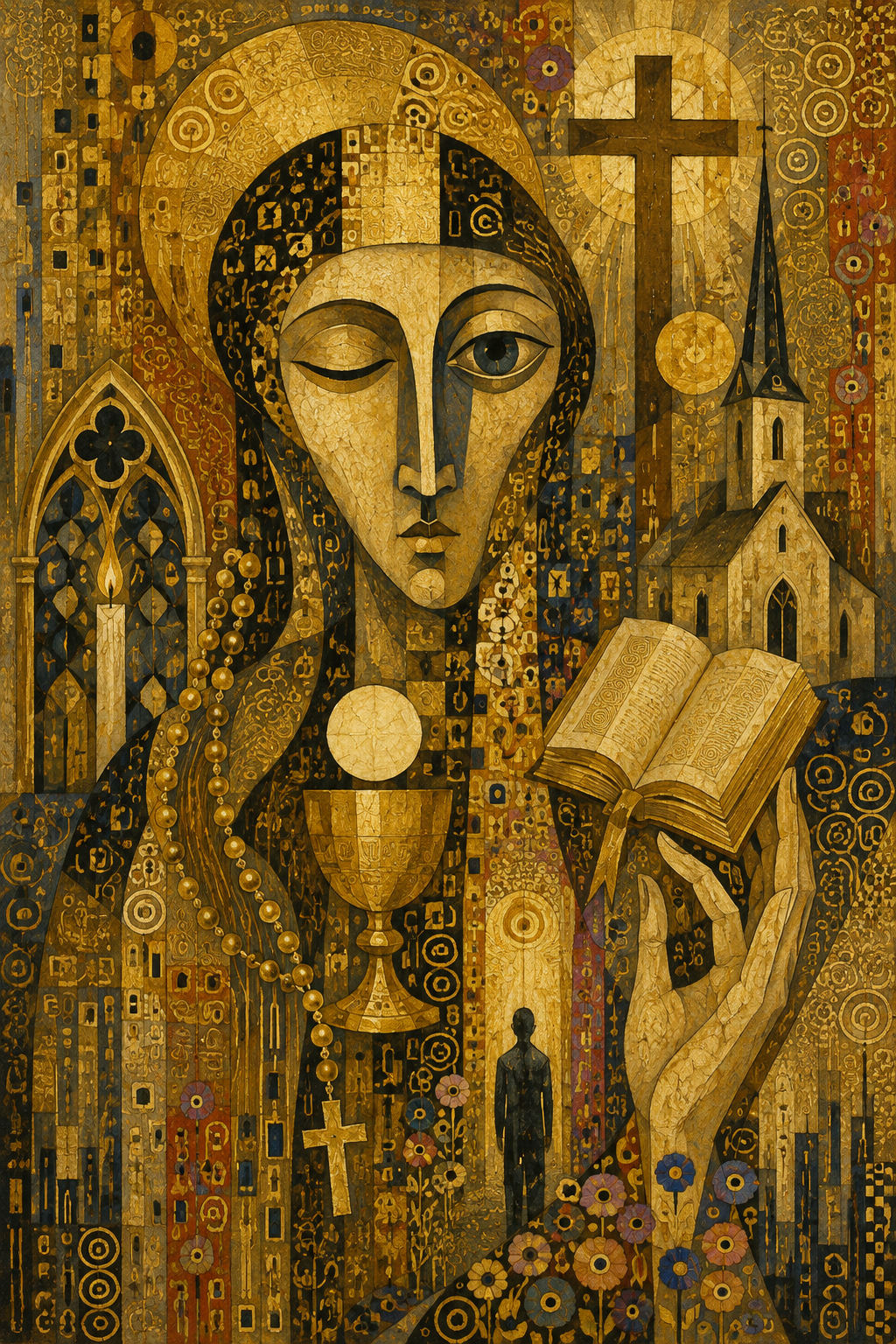
The United States is simultaneously one of the most religious and most theologically illiterate societies in the developed world. Americans profess belief in God at rates far higher than their European counterparts, yet surveys consistently show that large numbers of self-identified Christians cannot articulate basic doctrinal differences between their own tradition and others.
Catholics attend Protestant-style Bible studies. Protestants pray the Rosary. Both use the language of “being saved,” “having a personal relationship with Jesus,” and “accepting Christ into my heart” — phrases that would have been theologically incoherent to Catholics of earlier centuries and that many Protestants would not have recognized either.
Meanwhile, a growing number of Americans describe themselves as “spiritual but not religious,” “none,” or atheist, yet they often retain the moral grammar, work ethic, and psychological habits of the very traditions they have abandoned.
Why is this theological mixing so common? Why do Americans not know the difference between Catholicism and Protestantism? And why does this confusion persist even among those who have become atheists?
The answer lies in the unique history of American religious settlement, the structural pressures of a democratic culture, the erosion of institutional authority, and the peculiar way that Protestantism itself — the dominant religious force in American history — destroyed the conditions for its own doctrinal preservation.
I. The Historical Roots: A Protestant Nation with a Catholic Presence
A. The Protestant Foundation
America was founded, in its dominant cultural forms, as a Protestant nation. The Puritans of New England, the Quakers of Pennsylvania, the Anglicans of Virginia, the Presbyterians of the Carolinas, the Baptists and Methodists of the frontier — all were products of the Protestant Reformation. The theological grammar of American public life — covenant, calling, conscience, election, jeremiad, revival — was Protestant grammar. The very idea of America as a “city upon a hill” was a Puritan Calvinist vision.
This means that even American Catholicism, when it arrived in significant numbers through Irish, Italian, Polish, and Latino immigration, was shaped by the surrounding Protestant culture. Catholic parishes in America adopted congregational structures, lay participation, English-language hymns, and a certain democratic ethos that would have been foreign to medieval or even continental European Catholicism. American Catholicism, in other words, was Protestantized from the beginning.
B. The Catholic Minority Experience
For much of American history, Catholics were a suspect minority. They were seen as agents of a foreign power, loyal to the Pope rather than the Constitution. Anti-Catholic prejudice was widespread, and Catholics responded by trying to prove their American-ness. One way to do this was to adopt the vocabulary and habits of the dominant Protestant culture. American Catholics began to speak of “faith,” “being saved,” and “personal conversion” in ways that blurred the distinctiveness of Catholic sacramental theology.
The result was a cultural flattening. The theological differences between Catholicism and Protestantism remained, but they were increasingly invisible to ordinary believers. Both groups lived in the same neighborhoods, watched the same television, attended the same schools, and absorbed the same cultural assumptions. The sharp doctrinal lines that had once defined the Reformation controversies — justification by faith alone, the nature of the Eucharist, the role of the saints, the authority of the Pope — faded from everyday consciousness.
II. The Structural Pressures of Democracy and Pluralism
A. The Marketplace of Religions
The United States, unlike most European nations, never had an established church. The First Amendment prohibited state support for any particular denomination. The result was what historians call the religious marketplace: churches competed for members in a free market of belief.
This marketplace created enormous pressure to soften doctrinal edges. A church that insisted too strongly on its distinctive teachings risked alienating potential converts. The successful churches were those that offered a generic, accessible, emotionally satisfying message that could appeal to anyone regardless of theological background. Mega-churches, revival movements, and televangelism all tended toward a lowest-common-denominator Christianity that minimized the differences between traditions.
B. The Rise of Nondenominational Christianity
The twentieth century saw the explosive growth of nondenominational and evangelical churches that explicitly rejected denominational labels. These churches drew members from Catholic, mainline Protestant, and unchurched backgrounds and taught a simplified, revivalistic Christianity centered on personal conversion, Bible reading, and moral living.
In this environment, doctrinal specificity was a liability. The preacher who insisted on transubstantiation or predestination would lose his audience. The preacher who spoke of “a personal relationship with Jesus” and “living a life of purpose” would thrive. The result was a Christianity stripped of most of the theological content that had historically divided Catholics from Protestants.
C. The American Preference for Experience Over Doctrine
American religion has always been deeply experiential. From the Great Awakenings to the Pentecostal revival of the twentieth century to the contemporary worship music of today, Americans have valued the felt experience of God over the intellectual content of theology. The altar call, the revival meeting, the emotional testimony — these are the hallmarks of American religious life.
This preference for experience over doctrine naturally leads to theological mixing. If what matters is how you feel about God, then the distinctions between Catholic and Protestant theology are largely irrelevant. The Catholic who has a “born again” experience at a retreat and the Protestant who weeps during a praise song are having the same kind of experience, regardless of their differing views on the Eucharist or the Pope.
III. The Erosion of Institutional Authority
A. The Protestant Suspicion of Authority
Protestantism was born in rebellion against institutional authority. Luther defied the Pope. Calvin rejected the bishops. The Anabaptists rejected the state church. The radical Reformation rejected everything. The principle of private judgment — the right of every believer to interpret Scripture for themselves — was built into the Protestant DNA.
This principle, once unleashed, could not be contained. If every believer could interpret Scripture, then every believer could conclude that the church was wrong. If every believer could judge doctrine, then every believer could judge whether doctrine mattered at all. The Protestant suspicion of authority eventually produced the American suspicion of authority in general: the distrust of experts, the rejection of tradition, the insistence that each individual must decide for themselves.
This suspicion destroyed the very possibility of doctrinal preservation. A tradition can only maintain its distinctiveness if it has institutions — schools, seminaries, bishops, catechisms — that teach and enforce its doctrines. Protestantism, in its radical individualism, progressively weakened these institutions. The result was a Christianity that floated free of doctrinal anchor.
B. The Catholic Collapse of Authority
American Catholicism, meanwhile, was deeply affected by the Second Vatican Council and the cultural upheavals of the 1960s. The Council was intended to renew the Church, but it also created confusion. Many Catholics experienced the changes — the vernacular Mass, the relaxed fasting rules, the ecumenical outreach — as a loosening of the old certainties. The authority of the Church, once absolute, now seemed negotiable.
The sexual abuse crisis then delivered a devastating blow to Catholic institutional authority. Millions of Catholics concluded that if the bishops could not be trusted on matters of basic morality, they could not be trusted on matters of doctrine either. The result was a massive exodus from the Church and a further erosion of distinctive Catholic identity among those who remained.
C. The Rise of Religious Individualism
The combined effect of Protestant suspicion and Catholic collapse was the triumph of religious individualism. Americans increasingly saw religion not as a matter of institutional membership or doctrinal commitment but as a matter of personal choice, private belief, and individual spirituality.
The phrase “I’m spiritual but not religious“ captures this perfectly. The individual claims a direct connection to the divine without any need for church, creed, or sacrament. This is Protestantism taken to its logical extreme: the individual alone before God, with no mediators, no tradition, no institutional authority. But it is also a kind of secularized Catholicism: the individual still wants a sense of the sacred, still craves ritual and mystery, but no longer believes that the Church is the necessary channel.
IV. The Specific Mechanisms of Theological Mixing
A. Shared Vocabulary, Different Meanings
One of the most important reasons Americans do not know the difference between Catholicism and Protestantism is that the two traditions use the same words with different meanings.
- Faith: For Protestants, faith is primarily trust in Christ’s finished work on the cross. For Catholics, faith is the beginning of a process of justification that involves cooperation with grace. Both use the word “faith,” but they mean different things.
- Grace: Both traditions speak of grace, but Protestant grace is often understood as forensic — God declares the sinner righteous. Catholic grace is often understood as transformative — God makes the sinner righteous. The distinction is subtle but real.
- Eucharist: Both traditions celebrate the Lord’s Supper, but Catholics believe in transubstantiation — the bread and wine become the body and blood of Christ. Protestants have various views — symbolic, spiritual presence, consubstantiation — but most reject transubstantiation. Yet both use the language of “receiving Christ” and “communion.”
- Salvation: Both traditions speak of salvation, but Catholics understand it as a process involving baptism, sacraments, and cooperation with grace, while Protestants understand it as a one-time event of justification by faith alone. Yet both use the language of “being saved.”
Because the vocabulary is shared, ordinary believers assume the meanings are shared too. They are not, but no one has taught them the difference.
B. The Influence of Popular Culture
American popular culture — movies, television, music, self-help books — has created a generic spirituality that blends elements of both traditions without understanding either.
- The cross, the saint medal, the prayer candle, the yoga mat, the Zen garden, the Native American sweat lodge — all are mixed together in the American spiritual marketplace.
- Oprah Winfrey, Joel Osteen, and a thousand motivational speakers offer a message that is part Protestant prosperity gospel, part Catholic mysticism, part New Age pantheism, and part secular self-help.
- Christmas and Easter are celebrated by nearly all Americans, regardless of theological belief, as occasions for family, food, and gift-giving. The theological content — incarnation, atonement, resurrection — is largely forgotten.
This cultural blending has made it almost impossible for ordinary Americans to distinguish between Catholic and Protestant theology. The distinctive content of each tradition has been dissolved into a warm, vague, emotionally satisfying spiritual mush.
C. The Decline of Catechesis and Religious Education
Both Catholic and Protestant traditions have largely failed to transmit their distinctive doctrines to the next generation.
- Catholic catechesis in the post-Vatican II era has often been weak, emphasizing experience and community over doctrine. Many Catholics raised since the 1960s cannot explain the difference between transubstantiation and consubstantiation, do not know the seven sacraments, and cannot articulate why they should go to confession.
- Protestant Sunday schools have often focused on moral lessons and Bible stories rather than systematic theology. Many Protestants cannot explain justification by faith alone, do not understand the doctrine of predestination, and cannot articulate the difference between their own denomination and others.
The result is two generations of Americans who identify as Catholic or Protestant but cannot explain what either means.
V. The Atheist Inheritors of Theological Confusion
A. Atheism as the Logical End of Protestant Individualism
The path from Protestantism to atheism is well documented. The same principle of private judgment that allowed Luther to reject the Pope allowed Voltaire to reject the Church and Nietzsche to reject God. The Protestant emphasis on individual conscience eventually produced the Enlightenment emphasis on individual reason, which eventually produced the possibility of individuals concluding that no religion is true.
But American atheism often retains the moral grammar of the Protestant tradition it rejects. The atheist who grew up in a Protestant or culturally Protestant culture still carries:
- The work ethic: diligence, productivity, self-discipline, the horror of idleness.
- The moral seriousness: a sense that life is a matter of choices with eternal consequences, even if eternity no longer means heaven or hell.
- The individual responsibility: the belief that each person must stand alone and answer for themselves.
- The suspicion of authority: the instinct to distrust institutions and traditions.
- The judgmental impulse: the tendency to judge oneself and others by high moral standards.
- The anxiety about worthiness: the nagging feeling that one is never quite good enough.
This is Protestantism without God: the iron cage without the divine inhabitant. The atheist has rejected the theology but cannot escape the psychological and moral habits that the theology created.
B. Atheism and the Loss of Catholic Consolation
At the same time, American atheism often mourns the loss of Catholic consolation without knowing that it is mourning.
The atheist may feel:
- A longing for ritual and beauty: the incense, the candles, the music, the sense of sacred space.
- A desire for mediation and intercession: someone to help, someone to carry the burden, someone to stand between the self and the abyss.
- A hunger for confession and absolution: a place to admit failure and receive mercy.
- A hope for second chances: a purgatory, a gradual path of restoration, a way back from failure.
But because the atheist does not know the theological distinction between Catholic and Protestant approaches, they cannot name what they are longing for. They simply feel a vague, unarticulated sense of loss. They call it “nostalgia” or “aesthetic appreciation” or “spiritual but not religious.” They do not realize that what they miss is the very system of consolation that Protestantism stripped away.
C. The Atheist Who Is Still Protestant or Catholic
Many American atheists are, in fact, unconscious Catholics or Protestants. They have rejected the label but retained the substance.
- The atheist who works 80 hours a week, feels guilty for resting, and believes that success is a sign of worth is still a Protestant.
- The atheist who lights candles, practices meditation, and seeks mystical experience is still a Catholic.
- The atheist who judges themselves harshly, feels perpetually inadequate, and cannot accept forgiveness is still a Protestant.
- The atheist who longs for community, ritual, and a sense of the sacred is still a Catholic.
Because they do not know the difference between the two traditions, they cannot recognize which one is still shaping their lives. They simply experience the effects — the anxiety, the longing, the guilt, the hunger for meaning — without understanding the source.
VI. The Philosophical Significance of Theological Confusion
A. The Loss of a Coherent Moral Language
The mixing of Catholic and Protestant theologies has produced a culture without a coherent moral language. Americans use words like “sin,” “grace,” “forgiveness,” and “redemption” without knowing what they mean. The result is moral confusion.
- Is forgiveness something that can be earned through penance, or is it a free gift received by faith?
- Is sin a stain that requires purification, or a legal guilt that requires pardon?
- Is salvation a process or an event?
- Is the self fundamentally fallen or fundamentally good?
Americans cannot answer these questions because they have inherited fragments of both Catholic and Protestant answers without the framework that made each answer coherent. The result is a culture that oscillates between Catholic guilt and Protestant anxiety, between the longing for ritual and the suspicion of ritual, between the desire for authority and the rejection of authority.
B. The Atheist as the Logical Product of Confusion
The atheist who emerges from this confusion is not a clean break with religion. They are a symptom of the confusion itself. They have rejected a Christianity they never understood, inherited fragments of both Catholic and Protestant morality they cannot name, and now live in a condition of unarticulated longing and unexamined anxiety.
This is why so many American atheists are angry, not merely indifferent. They are not free from religion; they are haunted by it. They carry the Protestant work ethic without Protestant grace, the Catholic longing for consolation without Catholic ritual, the Protestant suspicion of authority without Protestant faith, the Catholic desire for community without Catholic sacraments.
They are, in short, the products of a culture that has mixed two incompatible theological systems into a paste that no one can digest. The mixing has produced confusion, the confusion has produced rejection, and the rejection has produced a generation of atheists who are still, deep down, unconscious Catholics and Protestants, still carrying the moral grammar of traditions they no longer believe in, still shaped by theologies they can no longer name.
VII. A Culture Adrift Between Two Theologies
The American inability to distinguish between Catholicism and Protestantism is not a minor theological problem. It is a symptom of a deeper cultural crisis.
The two traditions offer fundamentally different answers to the fundamental questions of human existence:
- How do we stand before God? Catholicism: through mediators, sacraments, and the loving embrace of a maternal Church. Protestantism: alone, by faith, before an inscrutable God.
- What happens when we fail? Catholicism: confess, do penance, be absolved, begin again. Protestantism: look inward for signs of election, and hope.
- Is there a second chance? Catholicism: yes, purgatory offers purification and hope. Protestantism: no, death fixes eternal destiny forever.
- Can the dead help the living? Catholicism: yes, the saints intercede and the living pray for the dead. Protestantism: no, there is no intercession and no prayer for the dead.
American culture has mixed these two systems into a vague, generic Christianity that offers neither Catholic consolation nor Protestant rigor. The result is a culture of anxious, isolated, exhausted individuals who feel guilty but do not know how to confess, who long for ritual but do not know how to receive it, who crave community but do not trust institutions.
The atheists who emerge from this culture are not free from it. They are its most visible symptom. They have rejected a religion they never understood, inherited a morality they cannot name, and now live in a condition of perpetual confusion, carrying the weight of two traditions they cannot distinguish and cannot escape.
America is not a Catholic nation or a Protestant nation. It is a nation caught between the two, unable to choose, unable to distinguish, and unable to free itself from the consequences of the confusion. The iron cage is real, and it is made of mixed theologies that no one can fully believe and no one can fully escape.