
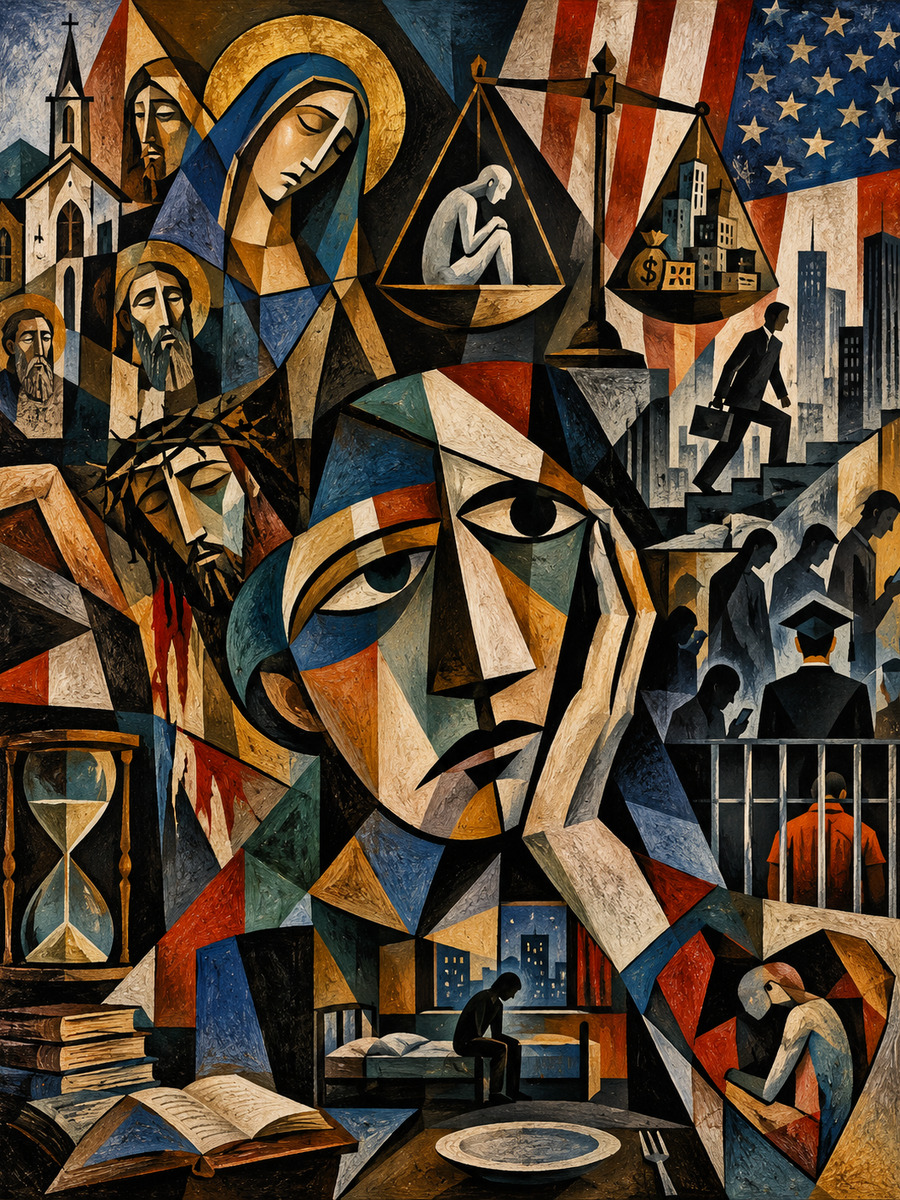
The theological revolution that stripped away Catholic consolation did not remain confined to the church. It migrated into the very structure of American culture, shaping how Americans work, rest, judge one another, understand suffering, and experience their own inner lives.
The “tyranny” of Protestantism — the isolation of the individual before an inscrutable standard, the loss of mediators, the rejection of second chances, the anxiety of proving one’s worth — has become the invisible grammar of everyday American existence. What was once a theological position is now simply— “the way things are.”
To understand this, we must trace how the core features of Protestant theology became secularized into the habits, institutions, and emotional patterns of modern American life.
I. The Loss of Mediators: The Isolated Individual
A. Theological Origin
Protestantism removed the saints, the Virgin Mary, and the priesthood as mediators between the believer and God. Each soul stood alone before the Almighty, with no intercessors, no heavenly advocates, no community of the glorified to carry one’s prayers. The relationship was direct, unmediated, and therefore radically individual.
B. Secular Manifestation in American Life
American culture is built on the myth of the self-sufficient individual. The ideal American is the self-made person who needs no one, asks for nothing, and stands alone before the forces of the market, the law, and history.
This manifests in everyday ways:
- The cult of independence: Americans are taught from childhood that asking for help is weakness. “Pull yourself up by your bootstraps.” “Don’t be a burden.” “Figure it out yourself.” The person who needs mediators — whether in the form of government assistance, family support, therapy, or community care — is subtly judged as morally deficient.
- The loneliness epidemic: The United States is experiencing a profound crisis of social isolation. The Surgeon General has declared loneliness a public health emergency. Yet the culture offers no structural solution because its foundational assumption is that each person must stand alone. Friendship, community, and mutual dependence are treated as optional luxuries rather than necessary supports.
- The suspicion of institutions: Protestantism taught that no institution — church, priest, bishop — could stand between the individual and God. This suspicion has been secularized into a generalized distrust of all institutions: government, media, universities, even science. The American individual believes they must judge everything for themselves, with no trusted authority to rely on. The result is not liberation but exhaustion and paranoia.
The isolated Protestant believer, alone before an inscrutable God, has become the isolated American citizen, alone before the inscrutable forces of the market, the state, and fate. There are no saints to intercede, no priests to mediate, no community to carry the burden. There is only the self.
II. The Loss of Purgatory: The Culture of No Second Chances
A. Theological Origin
Protestantism rejected purgatory. At death, the soul went directly to heaven or hell. There was no intermediate state, no gradual purification, no possibility of growth or healing after failure. The moment of death fixed one’s eternal destiny forever.
B. Secular Manifestation in American Life
American culture has secularized this doctrine into a brutal culture of no second chances.
- The permanence of criminal records: In the United States, a single mistake — a drug arrest, a minor felony, even a misdemeanor — can permanently disqualify a person from employment, housing, voting, and full citizenship. There is no secular purgatory where one can gradually work off one’s debt and be restored. The stain is permanent. The door is closed.
- The harshness of moral judgment: When a public figure is accused of wrongdoing, the American response is often total and irreversible. There is no path of penance, restitution, and restoration. The person is exiled from public life forever. Social media mobs function like Protestant inquisitions: one mistake, one bad tweet, one moment of ignorance, and the verdict is eternal damnation with no appeal.
- The terror of failure: American education, careers, and social life are structured as a series of high-stakes tests with no room for gradual growth. The SAT, the college admission decision, the first job, the first promotion — each is treated as a moment of final judgment. A student who fails an exam is told they have ruined their future. A worker who loses a job is told they are unemployable. There is no institutional space for the slow, gradual process of becoming better.
The Catholic doctrine of purgatory was, at its deepest level, a doctrine of hope: failure is not final, and love can reach across the boundary of death. American secular culture has replaced this with a doctrine of despair: failure is final, and there is no second chance.
III. The Loss of Ritual Penance: The Culture of Endless Guilt
A. Theological Origin
Protestantism rejected the sacrament of penance. There was no confession, no absolution, no assigned act of satisfaction, no objective pronouncement of forgiveness. The believer had to look inward for assurance of grace, and the inward heart was unreliable. The result was what historians call salvation anxiety: the perpetual, gnawing uncertainty about whether one was truly saved.
B. Secular Manifestation in American Life
American culture has secularized this anxiety into a culture of endless guilt without absolution.
- The wellness and self-improvement treadmill: Americans are perpetually told they are not good enough. They are not thin enough, not productive enough, not mindful enough, not successful enough. The self-help industry, the fitness industry, the productivity industry — all are secularized forms of the Protestant demand for visible righteousness. But unlike Catholic penance, there is no moment of absolution. No matter how much one improves, it is never enough. The goalposts always move. The anxiety never ends.
- The therapeutic culture without forgiveness: Modern American therapy often helps people understand their wounds, but it rarely offers a moment of definitive release. The patient is encouraged to process, to cope, to manage — but not to receive absolution. The Catholic could walk out of the confessional clean. The American therapy patient walks out of the session still carrying the weight, still anxious, still uncertain.
- The culture of apology without restoration: When public figures apologize, the apology is rarely accepted. The person apologizes, but the mob demands more. There is no institutional mechanism for saying, “You have done your penance; now you are restored.” The apology is never enough. The guilt is endless.
The Catholic doctrine of penance was a doctrine of closure: sin, confession, absolution, restoration. American secular culture has replaced this with a doctrine of perpetual anxiety: no matter what you do, it is never quite enough, and you can never be sure you are okay.
IV. The Inscrutable God: The Culture of Arbitrary Judgment
A. Theological Origin
Protestantism, especially Calvinism, emphasized the absolute sovereignty and inscrutability of God. God’s will could not be understood or appealed. He chose whom he would save and whom he would damn, and his choices were beyond human comprehension. The believer could not negotiate, could not appeal, could not understand. They could only submit.
B. Secular Manifestation in American Life
American secular life is governed by inscrutable, unaccountable forces that function like the Calvinist God.
- The market as inscrutable God: The market decides who succeeds and who fails, and its judgments are final. Why did one company thrive and another collapse? Why did one person’s career soar and another’s stagnate? The market does not explain itself. It rewards and punishes with no visible logic. The worker, like the Calvinist believer, can only work harder and hope.
- The algorithm as inscrutable God: Modern life is increasingly governed by algorithms — on social media, in hiring, in credit scoring, in criminal sentencing — whose decisions are opaque and unchallengeable. Why was your post suppressed? Why were you denied a loan? Why did the algorithm flag you? The algorithm does not explain itself. The individual is alone before a silent, sovereign, inscrutable power.
- The bureaucracy as inscrutable God: Anyone who has tried to navigate the American healthcare system, the immigration system, the tax system, or the DMV has encountered the inscrutability of bureaucracy. The rules are complex, the decision-makers are anonymous, and the outcomes are often arbitrary. There is no intercessor, no advocate, no one to explain. The individual is alone before a system that does not care.
The Calvinist believer lived in terror of an inscrutable God whose will could not be known. The modern American lives in a similar condition before the inscrutable powers of the market, the algorithm, and the bureaucracy. The result is the same: anxiety, fatalism, and a desperate search for signs.
V. The Work Ethic Without Grace: The Culture of Exhaustion
A. Theological Origin
Protestantism taught that every vocation was a divine calling. Work was not merely a necessity; it was a form of worship. Diligence, discipline, and productivity were signs of election. The believer was to work methodically, avoid idleness, and treat time as a sacred trust.
But this work ethic was originally grounded in grace. The believer did not work to earn salvation; they worked as a response to salvation, as a sign of gratitude and election. Over time, however, the grace receded, and the work remained.
B. Secular Manifestation in American Life
American culture has inherited the Protestant work ethic without the Protestant grace. The result is a culture of exhaustion, burnout, and chronic overwork.
- The glorification of busyness: “How are you?” “Busy!” Busyness is a status symbol. The person who works 80 hours a week is admired. The person who rests is suspected of laziness. Idleness is sin, even though there is no God to whom the work is offered.
- The collapse of rest: Americans are famously bad at rest. Vacation days go unused. Weekends are filled with productivity. Even leisure is optimized — the workout, the side hustle, the self-improvement podcast. There is no Sabbath, because there is no God who commands rest and no grace that makes rest possible. Rest feels like failure.
- The productivity cult: The modern productivity industry — time management apps, morning routines, optimization hacks — is a secularized form of the Protestant demand for methodical, disciplined living. But there is no moment of completion, no absolution, no rest. The work is endless because there is no grace to receive. The iron cage has become a treadmill.
The Catholic tradition had built-in rhythms of rest, festival, and celebration. The liturgical year alternated between work and feast, fast and carnival. Protestantism, in its rejection of Catholic ritual, largely destroyed this rhythm. American secular culture has inherited the destruction: a culture of endless work with no sacred rest, endless striving with no moment of arrival.
VI. The Absence of Mediators: The Culture of Radical Responsibility
A. Theological Origin
Protestantism placed the full weight of salvation on the individual’s faith. There was no church to mediate, no saint to intercede, no sacrament to convey grace. The individual was radically responsible for their own standing before God.
B. Secular Manifestation in American Life
American culture has secularized this into a doctrine of radical individual responsibility that is both empowering and crushing.
- The meritocracy myth: Americans believe that success is earned and failure is deserved. The rich are rich because they worked hard. The poor are poor because they are lazy. There is no room for structural explanation, no acknowledgment of inherited disadvantage, no intercessor to help the fallen. Each individual is radically responsible for their own fate.
- The shame of needing help: In American culture, needing help is shameful. The person who cannot afford healthcare, who needs food stamps, who relies on family support — they are judged as moral failures. There is no cultural framework for saying, “We are all weak, we all need help, and that is okay.” The Protestant believer stood alone before God; the American citizen stands alone before the market.
- The burden of self-optimization: Americans are told they must be their own doctors, their own financial advisors, their own therapists, their own career coaches. The institutions that once mediated these functions — family, church, community, union — have eroded. The individual is left to navigate a complex world alone, with no saints to intercede and no priest to guide.
The result is a culture of radical loneliness and radical responsibility. The individual is told they can be anything, but also that they have no one to help them. The burden is crushing, and the culture offers no relief.
VII. The Culture of Surveillance and Judgment
A. Theological Origin
Protestantism, especially in its Calvinist form, encouraged believers to scrutinize their own lives for signs of election. It also encouraged the community to scrutinize one another. The priesthood of all believers meant that everyone was a moral inspector. The result was a culture of mutual surveillance and judgment.
B. Secular Manifestation in American Life
American culture has secularized this into a culture of surveillance, judgment, and public shaming.
- Social media as moral court: Social media platforms function like secularized Protestant congregations. Users perform their righteousness through posts, photos, and opinions. They judge one another’s moral worth. A single misstep — an insensitive joke, an old tweet, a controversial opinion — triggers a public shaming that can destroy careers and reputations. The mob functions like a Protestant consistory, enforcing moral purity with no mercy.
- The performance of virtue: Americans feel constant pressure to perform their virtue publicly. The corporate diversity statement, the Instagram activism, the carefully curated moral identity — all are secularized forms of the Protestant demand for visible righteousness. The question is not “Am I good?” but “Do others see that I am good?”
- The anxiety of being watched: Just as the Calvinist believer lived under the constant gaze of an omniscient God, the modern American lives under the constant gaze of social media, surveillance cameras, and corporate data collection. There is no escape from judgment. Every action is recorded, evaluated, and potentially punished.
The Catholic system offered confession and absolution: a private place to admit failure and receive mercy. The Protestant system replaced this with public scrutiny and mutual judgment. American secular culture has inherited the latter: a culture of constant surveillance with no private space for confession and no public space for mercy.
VIII. Conclusion: The Iron Cage of Protestant Tyranny
The Protestant Reformation sought to free the believer from the tyranny of the medieval church. But in removing the mediators, the rituals, and the consolations, it created a new kind of tyranny: the tyranny of the isolated individual before an inscrutable standard.
American culture has inherited this tyranny and secularized it. The result is a society in which:
- Individuals are alone, with no mediators and no community to carry their burdens.
- There are no second chances, no purgatory, no gradual path to restoration.
- Guilt is endless, with no confession, no absolution, no moment of release.
- The forces that govern life — the market, the algorithm, the bureaucracy — are inscrutable and unaccountable.
- Work is endless, with no grace and no rest.
- Responsibility is radical, with no help and no mercy.
- Judgment is constant, with surveillance and shame replacing confession and forgiveness.
This is the iron cage that Weber described: a world built by Protestant discipline but emptied of Protestant grace. The methods remain — the work ethic, the self-scrutiny, the moral judgment, the individual responsibility — but the God who once justified them is gone. What remains is a culture of exhaustion, anxiety, loneliness, and judgment with no escape.
The Catholic tradition, for all its flaws, offered a vision of a maternal community: a church that understood human weakness, provided mediators for the helpless, offered second chances through purgatory, and granted absolution through penance. The Protestant tradition, in its zeal for purity, stripped this away. American secular culture has inherited the stripping but not the purity. It has kept the tyranny and lost the love.
The result is a nation of isolated, anxious, exhausted individuals, each standing alone before an inscrutable standard, each desperately trying to prove their worth, each knowing, deep down, that they can never be sure they are enough. This is the Protestant tyranny, secularized and made total. And it is the air Americans breathe every day.