
Based on the Loss of Consolation
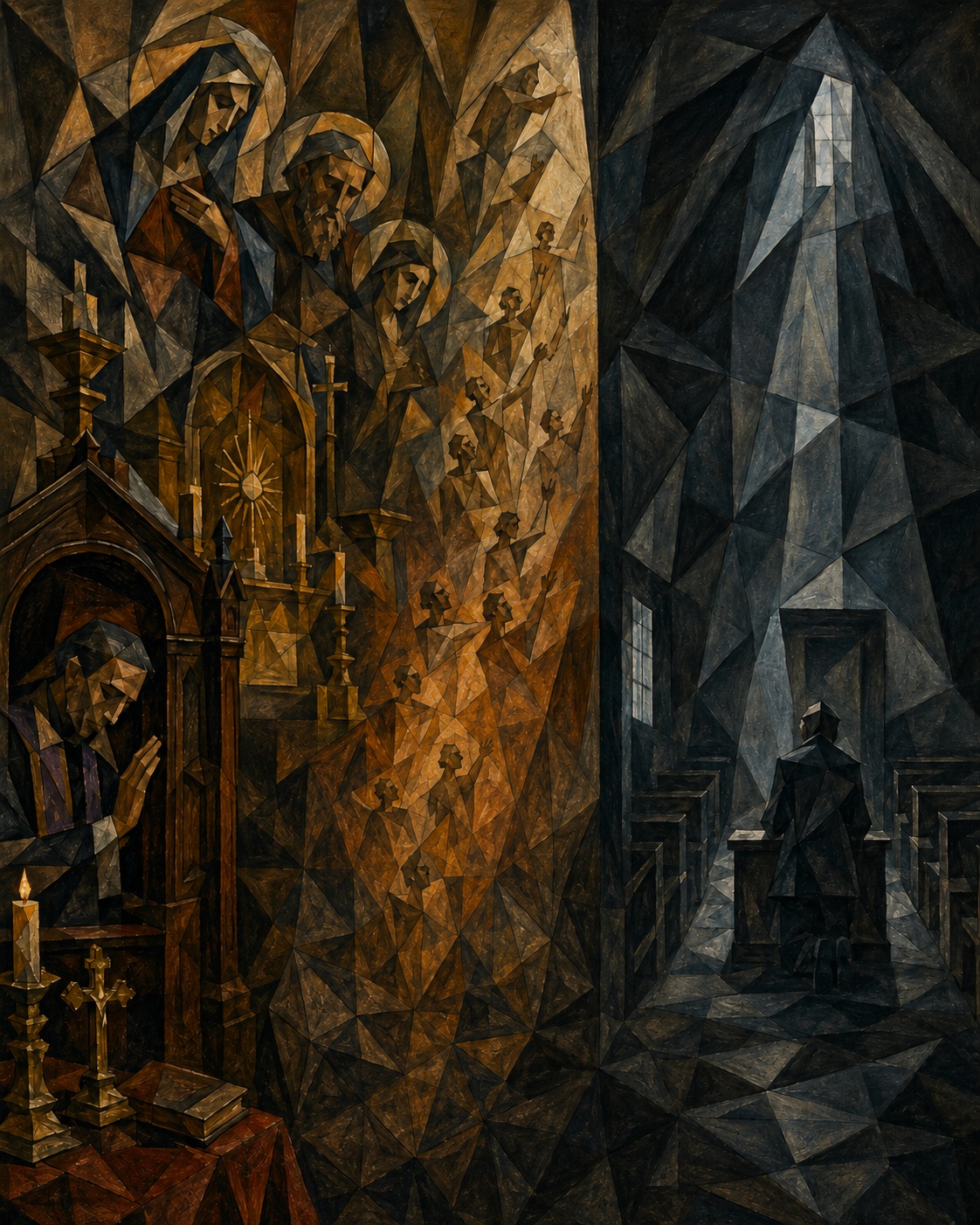
The passage highlights a profound difference in how the two traditions understood the relationship between God and the suffering believer. Medieval Catholicism, for all its institutional flaws, had developed an elaborate system of consolation — a network of mediations that softened the terrifying distance between fallen humanity and an all-powerful God. Protestantism, in its zeal to purify the faith, dismantled that network and left the believer alone before an inscrutable God.
The Catholic Consolations: A Religion of Mediation and Mercy
Medieval Catholicism was, at its heart, a religion of intercession, process, and restoration. It did not ask the believer to stand directly before the absolute God without help. Instead, it provided a rich architecture of intermediaries and remedial practices.
A. The Intercession of Saints
The saints were not remote figures from Scripture. They were living presences, heavenly patrons who could be invoked, prayed to, and trusted. Each saint had a particular sphere of influence — one for travelers, one for the sick, one for lost causes, one for the dying. The believer was never alone. There was always a saint who understood, who had suffered, who could carry prayers to God with a sympathetic voice.
This was a loving system because it acknowledged human weakness. It did not demand that the ordinary person possess the spiritual strength of a theologian or a mystic. It allowed the believer to approach the divine through familiar, accessible, compassionate figures. The saints were like older siblings in the household of God — flawed, human, but now glorified and merciful.
B. The Purifying Power of Purgatory
Purgatory was perhaps the most consoling doctrine in the Catholic imagination. It taught that death was not a stark choice between heaven and hell. Most souls, though not yet pure enough for heaven, were not damned. They entered a state of purification, where sin was burned away and the soul was gradually made ready for the vision of God.
This meant that failure was not final. A life of mixed virtue and vice did not end in eternal ruin. Purgatory extended the possibility of healing beyond the grave. It also connected the living and the dead: prayers, masses, and alms offered by the living could assist the souls in purgatory. Death did not sever the bonds of love. The community of the faithful extended across time and eternity.
C. The Efficacy of Ritual Penance
The sacrament of penance offered a concrete, repeatable path from sin to restoration. The believer confessed, expressed contrition, received absolution through the priest, and performed an assigned act of satisfaction. The sin was then truly forgiven. The believer could walk out of the confessional with a clean conscience, not because of subjective feeling, but because the Church, acting in Christ’s name, had pronounced absolution.
This was a loving system because it recognized that humans sin repeatedly. It did not demand perfect sanctity. It provided a mechanism for failure, repentance, and renewal. The door of mercy was always open. The believer did not have to live in perpetual anxiety about whether they were truly saved. They could confess, be absolved, and begin again.
D. The Overall Texture: A Maternal Church
Taken together, these consolations created the image of a maternal Church. Like a mother, the Church understood human weakness. It provided help for the helpless, comfort for the suffering, and a path back for the fallen. It did not leave the believer alone. It surrounded the soul with saints, sacraments, rituals, and the prayers of the community. The medieval Catholic did not face God in isolation; they faced God within a vast, living, loving web of mediation.
2. The Protestant Tyranny: A Religion of Isolation and Inscrutability
The Protestant Reformers, especially in their Calvinist form, saw these consolations as corruptions. Saints were idolatry. Purgatory was unbiblical. Penance was a human invention that obscured free grace. In their zeal to restore the purity of the Gospel, they removed the mediators and left the believer alone.
A. The Loss of Saints: No One to Intercede
Protestantism rejected the invocation of saints as a form of idolatry. Christ alone was the mediator. The saints were exemplary but not accessible. The believer could not pray to Mary, could not ask St. Christopher for safe travel, could not trust that a heavenly patron was watching over them.
This was theologically rigorous. But it was also spiritually isolating. The believer now stood before God with no older siblings, no sympathetic intercessors, no one to carry their prayers. The heavenly court was emptied. Only the solitary soul and the sovereign God remained.
B. The Loss of Purgatory: No Second Chance
Protestantism rejected purgatory as unbiblical. At death, the soul went directly to heaven or hell. There was no intermediate state, no purification, no possibility of growth or healing after death.
This was terrifying. It meant that the moment of death fixed one’s eternal destiny forever. A life of mixed virtue and vice, which Catholic theology had treated with patience and hope, now became a gamble. There was no second chance, no gradual preparation, no assistance from the living. The believer had to be ready at all times, because death would bring either eternal bliss or eternal torment with no possibility of change.
C. The Loss of Ritual Penance: No Assurance of Forgiveness
Protestantism rejected the sacrament of penance as a human invention. Forgiveness was by faith alone, through grace alone. But this created a new problem: how could the believer know they were forgiven?
In the Catholic system, the priest pronounced absolution. The penitent heard the words: “I absolve you from your sins.” The process was objective, external, and repeatable. In the Protestant system, there was no priest, no absolution, no assigned penance. The believer had to look inward for assurance. But the inward heart is unreliable. How could one know that one’s faith was genuine? How could one know that one was truly among the elect?
This produced what historians have called salvation anxiety. The believer was left to scrutinize their own soul, searching for signs of election, never certain, never at rest. The Catholic could confess and be absolved. The Protestant had to live with the terrifying possibility that their faith was not real, their repentance not deep enough, their election not certain.
D. The Inscrutable God: Alone Before the Absolute
The deepest problem was theological. Protestantism, especially Calvinism, emphasized the absolute sovereignty and transcendence of God. God’s will is inscrutable. His decrees are eternal and unchangeable. He chooses whom he will save and whom he will damn, and his choices are beyond human comprehension.
This is a majestic doctrine. But it is also a tyrannical one, because it leaves the believer with no recourse. The Catholic could appeal to the saints, could hope for purgatory, could perform penance. The Protestant could do none of these. They could only trust — and wonder if their trust was genuine.
The believer was thus left alone before an inscrutable God: no intercessors, no second chances, no ritual assurance, no objective forgiveness. Only the naked soul and the silent, sovereign, unapproachable deity.
3. Summary of the Contrast
| Dimension | Roman Catholicism | Protestantism |
|---|---|---|
| View of the believer | Weak, fallible, in need of help | Alone, responsible, must stand directly before God |
| Mediators | Saints, Mary, priests, sacraments | None; Christ alone, but Christ is distant and invisible |
| Failure and sin | Forgiveness through confession and penance | Forgiveness by faith alone, but assurance is uncertain |
| After death | Purgatory offers purification and hope | Heaven or hell immediately; no second chance |
| Community | The living and the dead are connected in prayer | The believer stands alone; no prayer for the dead |
| God’s disposition | Merciful, accessible through mediators | Sovereign, inscrutable, terrifyingly transcendent |
| Emotional texture | Maternal, consoling, forgiving | Paternal, demanding, anxiety-producing |
| Experience of suffering | Shared with saints, eased by ritual | Borne alone, with no intercession |
4. Conclusion: Love vs. Tyranny
From the perspective of the suffering believer, the Catholic system was loving because it acknowledged human limitation. It did not demand that the ordinary person be a spiritual athlete. It provided help at every step: saints to intercede, purgatory to purify, penance to restore. The believer was never alone, never without recourse, never beyond the reach of mercy.
Protestantism, in its zeal to restore the purity of the Gospel, stripped away these consolations. It left the believer with no intercessors, no second chances, no ritual assurance, and no escape from the inscrutable will of God. The result was a kind of spiritual tyranny: the individual soul, naked and trembling, before an absolute God who offered no comfort except the bare command to believe.
This is not to say that Protestantism was without its own forms of love or that Catholicism was without its own forms of tyranny. But on the specific question of consolation for suffering, the Catholic tradition offered a rich, humane, and merciful architecture of care, while Protestantism, by its own rigorous logic, removed that architecture and left the believer alone in the dark.