
By: Christopher Maffei
The Bridge of the Silent Wind
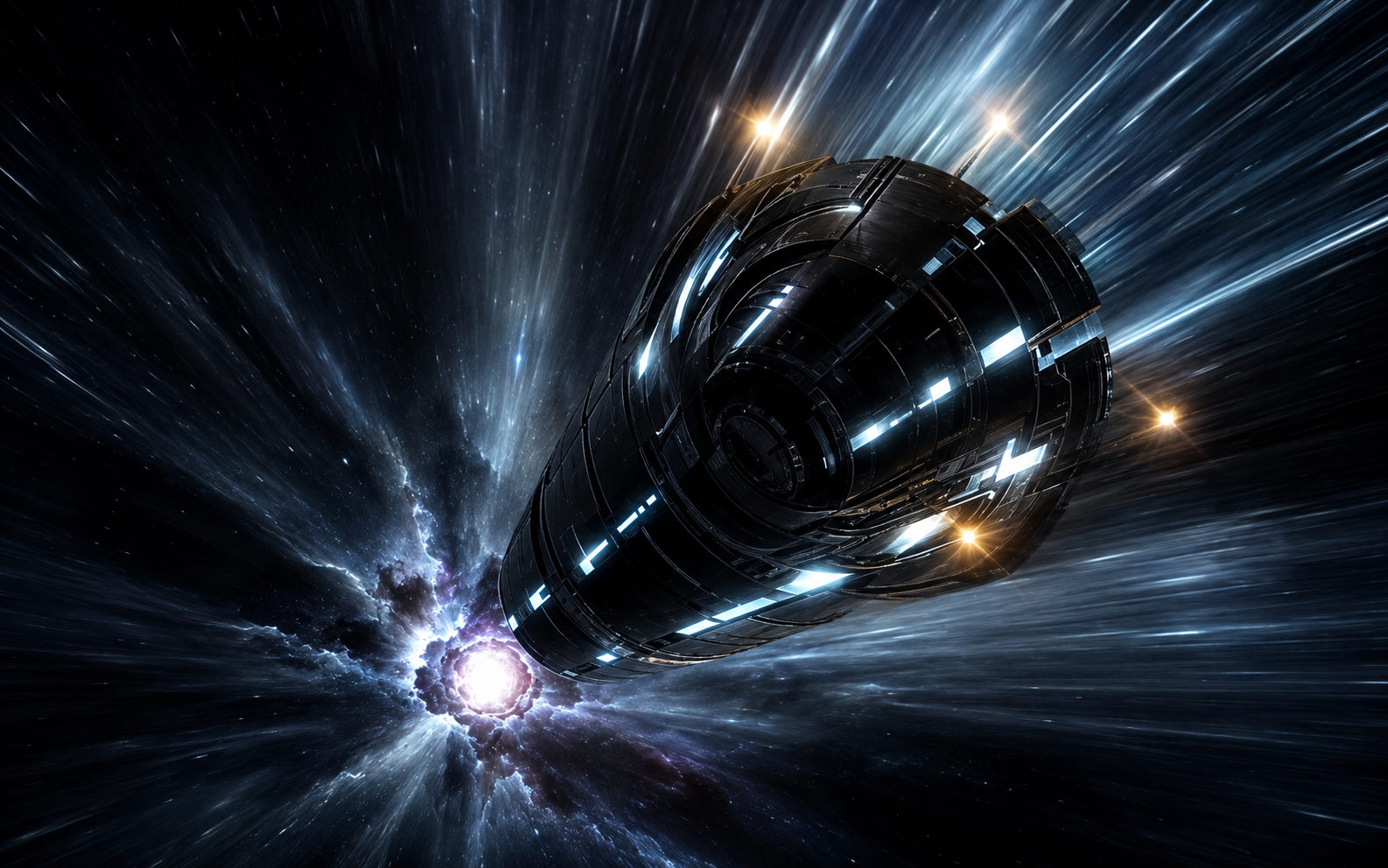
The heighliner’s navigation bridge was a cathedral. Three hundred meters of crystalline circuitry, suspension fluids, and the organic architecture that only the Guild could manufacture. At its center, suspended in a tank of orange spice-gas, floated Navigator Kaelen—his body elongated, his eyes milky orbs that saw dimensions no human should perceive.
But Kaelen was not alone.
The Principal Crew
Navigator Kaelen (Third Rank): Kaelen had been navigating for seventy-three standard years. His body was a ruin of mutation—webbed fingers, a distended cranium, skin the color of old parchment. But his mind was the most precious commodity in the known universe. He could perceive the Weyl-Tensor Singularity as naturally as a child perceives a sunset.
“The manifold is agitated today,” he thought, his consciousness already reaching into the n-dimensional lattice. “There are… disturbances. Echoes of a recent fold. Someone has been careless.”
He felt the presence of his support crew through the spice-gas. They were his limbs, his senses, his connection to the physical realm that he had long since abandoned.
Chief Engineer Voss (Navigator’s Interface): Voss was a Guild acolyte—not mutated, not yet. His body was still human, still capable of walking on planets without assistance. But his mind had been trained in the nightmare mathematics that preceded Navigator ascension. He stood at the primary control console, his fingers dancing across holographic interfaces.
“Resonance cascade in thirty seconds,” Voss announced, his voice steady despite the tremor in his hands. “Phase angle calibrating to Navigator’s neural signature.”
He could feel the ship responding, the Holtzman generators in the engine room beginning their agonizing spin-up. The hum was not sound—it was a vibration in the bones, a pressure in the skull.
Second Engineer Marla (Field Stabilization): Marla was Voss’s counterpart, responsible for maintaining the integrity of the suspensor-nullification field during the transition. She was younger, sharper, her eyes alight with the intensity of someone who had never experienced a Guild’s Error and desperately hoped she never would.
“Null-field forming,” she reported. “Inertial mass dropping. We’re at… negative two-point-three percent and falling.”
Her station was a web of diagnostic displays, each showing a different aspect of the ship’s quantum state. She watched them all simultaneously, her mind trained in the art of parallel processing.
Captain Orin (Vessel Commander): Orin was the only member of the crew who had never set foot in a Navigator’s chamber. He was a Guild agent of a different sort—a master of logistics, of politics, of the mundane realities of interstellar commerce. He sat in his command chair, isolated from the technical chaos by a bubble of forced calm.
“Status report,” he ordered, his voice carrying the weight of eighty years of command.
The irony was not lost on him: he was the captain, but he was also the least essential person on this bridge. The heighliner would fold regardless of his presence. His role was to ensure that the fold happened correctly—to manage the humans, the Guild protocols, the endless bureaucracy of the Imperium’s most valuable resource.
The Transition Begins
Phase One: Suspensor-Nullification Cascade. “Negative mass threshold achieved,” Marla announced. “We are now a topological defect.”
Kaelen felt it through the spice: the ship was no longer a ship. It was a violation, a tear in the symmetry of the universe. The crew’s atoms began to delocalize, their quantum states spreading across a probability field that encompassed both Caladan and Giedi Prime.
Voss felt his consciousness begin to fragment. It was a familiar sensation, but no less terrifying for its familiarity. He was in his body, and he was also outside it, floating in a sea of possibilities. He could feel the atoms of the ship, the atoms of the crew, the atoms of the passengers in stasis. They were all connected, all part of a single quantum system.
“Maintain focus,” he muttered to himself, gripping the console.
Marla was experiencing the dissociation differently. She felt her awareness expand, felt herself becoming one with the field she was maintaining. It was beautiful, terrifying—a glimpse of what it meant to be a Navigator. She understood, in that moment, why Kaelen had chosen to abandon his humanity.
The Crisis Begins
“I detect a fold echo,” Kaelen’s voice came through the spice-interface, a telepathic whisper that resonated in the crew’s minds. “Someone folded through this region recently—within the last rotation. The manifold is contaminated.”
Voss’s blood ran cold. Fold echoes were the debris of previous transitions, the ripples left behind in the Null-Space Continuum. They could disrupt a new fold, cause interference that would scatter the heighliner across dimensions.
“How bad?” he asked.
“Significant,” Kaelen replied. “The echo is concentrated at our emergence point. If we attempt to emerge as planned, we will phase dislocate. The ship will become plasma.”
Phase Two: The Fold Decision. Captain Orin felt the weight of command settle on his shoulders. He was not a Navigator; he could not perceive the manifold, could not see the danger that Kaelen described. But he trusted his Navigator—trusted him with the lives of forty thousand passengers and crew.
“Can you find an alternative emergence point?” Orin asked.
“Possibly,” Kaelen replied, his mental voice strained. “But it will require additional calculations. I must re-map the manifold in real-time. The stress on my neural pathways will be significant.”
“Do it,” Orin said, without hesitation.
Kaelen dove deeper into the manifold, his consciousness expanding to encompass dimensions that would shatter a normal mind. He perceived the universe as a web of infinite connections, each point linked to every other point by threads of probability. He identified the origin—the heighliner’s current location in Caladan’s orbit—and the destination—Giedi Prime’s orbital path.
But the echo was there, a scar in the manifold, a place where the fabric of reality was weak. If he attempted to “collapse the metric” between origin and destination, the heighliner would emerge inside the echo, its atoms out of phase with local spacetime.
He needed a new path.
The Weight of Calculation
Kaelen began his search, tracing the threads of probability across the n-dimensional lattice. He was not moving through space—he was identifying equivalence between points, forcing the universe to recognize them as the same location.
But the manifold was vast, impossibly vast. There were a near-infinite number of paths between any two points, and each path had its own characteristics—its own risks, its own rewards.
“Calculating alternative emergence points,” he broadcasted to the crew. “There are… four-point-three-seven million potential destinations within the acceptable probability envelope.”
Voss stared at his display in disbelief. “Navigator, we don’t have time for—”
“Silence,” Orin commanded. “Let him work.”
Kaelen worked. He eliminated possibilities one by one, applying his prescience to each potential path. He perceived the future states of each destination, saw the ships that would be there, the asteroids that would drift through, the gravitational anomalies that could disrupt the emergence.
After what felt like hours—but was only seconds in the external universe—he identified the optimal path.
“Emergence point located,” he announced. “Phase angle adjusted. Collapsing metric… now.”
Phase Three: The Danger of Emergence. The Holtzman generators emitted the Weyl-Planck Radiation, a wave that propagated through the Null-Space Continuum and redefined space. The heighliner was not moving—it was being reassigned.
Voss felt his consciousness snap back into focus. The dissociation faded, replaced by a crushing sense of physicality. He was in his body again, and his body was alive.
But the emergence was not complete. The ship was transitioning from the Null-Space Continuum back to normal spacetime, and the synchronization was… imperfect.
“Phase dislocation detected!” Marla shouted, her voice panicked. “We’re emerging at the wrong angle! The atoms are out of alignment!”
She stared at her displays, watching the numbers spiral out of control. The heighliner’s hull was beginning to glow, the energy of the transition converting into heat. If the synchronization failed completely, the ship would become a cloud of plasma.
“Navigator!” Orin shouted. “Correct the phase angle!”
Kaelen was already working, his prescience stretching into the future to perceive the optimal synchronization point. He adjusted the Holtzman field’s phase angle, a fractional tweak that would have been invisible to any non-Navigator.
“Resync in progress,” he announced. “Hold. Hold…”
The ship shuddered, the glow intensifying. For a moment—a terrifying, infinite moment—Voss thought they were lost. He thought of his family, his training, his entire life, all reduced to atoms scattered across the quantum foam.
And then the shuddering stopped.
“Emergence complete,” Kaelen announced. “We have arrived at Giedi Prime. All systems nominal.”
The Aftermath
Voss slumped against his console, his body trembling with adrenaline. Marla was crying—silent tears of relief that she quickly wiped away. Captain Orin sat in his command chair, his face betraying nothing.
“Good work, everyone,” Orin said. “Stand down from emergency protocols. Prepare for standard docking procedures.”
Kaelen remained in his spice-tank, his mind already retreating from the manifold to the mundane reality of the bridge. He was exhausted, his neural pathways burned from the effort of finding the alternative path.
“You saved us,” Voss said, his voice barely a whisper. “You saved all of us.”
Kaelen did not reply. He did not need to. He had done his duty—the duty that the Guild had trained him for, mutated him for, sacrificed his humanity for.
But as he floated in the spice-gas, his milky eyes staring at nothing, Kaelen allowed himself a moment of regret. He had seen the future, had perceived the paths that lay ahead. He knew what was coming—the wars, the betrayals, the fall of houses and the rise of new powers.
He knew that this heighliner, this ship, would one day be destroyed. He knew that he would be aboard when it happened.
But that was a problem for another day. For now, there was only the silence of the manifold, the comfort of the spice-gas, and the knowledge that he had done his duty.
The Bridge Crew Reflects
As the heighliner settled into Giedi Prime’s orbit, the bridge crew began their post-transition checks. Voss was reviewing the diagnostic logs, his mind already moving to the next challenge. Marla was recalibrating the null-field generators, her hands steady despite the earlier crisis. Orin was coordinating with the Guild’s docking authority, his voice calm and professional.
But in the quiet moments between tasks, each of them reflected on what had happened.
Voss thought about the fold echo, the scar in the manifold that had nearly killed them. He wondered who had created it, what ship had passed through this region so recently. He wondered if they had been as careful as Kaelen, if they had survived.
Marla thought about the dissociation, the feeling of her consciousness expanding to encompass the ship. She had glimpsed what it meant to be a Navigator, and she was not sure she wanted to see it again. It was beautiful, yes, but it was also terrifying—a loss of self that she was not ready to accept.
Orin thought about Kaelen, the Navigator who had saved them all. He wondered what it cost to see the future, to perceive the manifold, to sacrifice one’s humanity for the Guild. He wondered if Kaelen regretted his choice.
And Kaelen, floating in the spice-gas, thought about the future he had seen. He saw the wars, the betrayals, the fall of houses. He saw the rise of a new power—a boy with the eyes of a predator, a boy who would change everything.
He saw Paul Atreides.
And he was afraid.
The Bene Gesserit Envoy
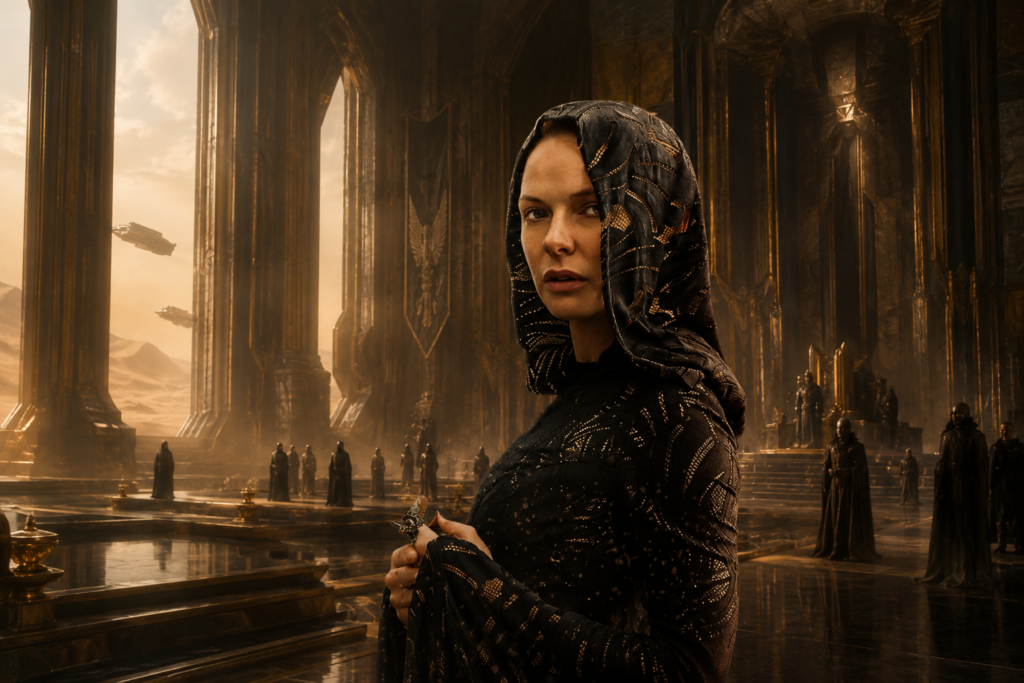
Reverend Mother Gaius Helen Mohiam remained awake aboard the Silent Wind, but her wakefulness was directed inward—toward the wreckage of the Sisterhood’s plans—rendering her utterly blind to the heighliner’s near-catastrophic emergence from folded space.. Sleep was a luxury she could not afford, not when every muscle in her body was coiled with the tension of her mission. She sat in her private quarters, the dim light of a glowglobe casting soft shadows across her aged, severe features, and she felt.
The Bene Gesserit were masters of emotional control. They could suppress fear, desire, anger—any of the base impulses that governed lesser beings. But suppression was not eradication. The emotions were there, always, buried beneath layers of discipline, waiting for moments of solitude to surface.
The Weight of Failure
She allowed herself, for a moment, to feel the crushing weight of what was at stake. The Sisterhood had spent millennia cultivating the bloodlines. Generation after generation, they had guided the great Houses, arranging marriages, manipulating births, all with the singular goal of creating the Kwisatz Haderach—the being who could bridge space and time, male and female, conscious and unconscious. The being who would unlock the mysteries of the universe and secure the Sisterhood’s dominance for all eternity.
And Jessica—her acolyte, her student—had thrown it all into chaos.
Mohiam felt a surge of cold fury, quickly quashed. Jessica had defied her, defied the Sisterhood, out of a perverse love for her Duke. Love. Such a fragile, human emotion. Mohiam had thought she had beaten the weakness out of Jessica, had thought her protege understood that the Sisterhood’s mission transcended mere personal attachment. But she had been wrong.
And now, Mohiam was forced to negotiate with the Baron Harkonnen—a man whose very existence was an affront to her sensibilities. The Baron was everything the Bene Gesserit stood against: uncontrolled, decadent, driven by base appetites. His cruelty was not calculated, not purposeful; it was a reflexive, animalistic indulgence. To deal with him was to debase herself, to wallow in the filth of the Imperium’s least noble House.
The Fear Beneath the Mask
But it was not just anger and disgust that Mohiam felt. It was fear. A deep, gnawing fear that she dared not acknowledge, even to herself.
The Sisterhood’s plans were unraveling. The Kwisatz Haderach might yet be born—there were other bloodlines, other contingencies—but the window of opportunity was closing. If the Bene Gesserit lost control of the breeding program, if the Emperor or the Guild or some other power seized the initiative, centuries of work would be undone.
And there was another fear, one that Mohiam buried deeper still: the fear of Paul Atreides.
She had tested him, there in the Caladan keep. She had subjected him to the Gom Jabbar, the poisoned needle that could kill with a single scratch. And he had passed. He had felt the agony of the box—the pain that she herself had felt as an acolyte—and he had endured it, not out of bravery, but out of sheer, unyielding will.
The boy was more than just a potential Kwisatz Haderach. He was something else, something the Sisterhood had not accounted for. His prescience, if it developed, would be untrained, uncontrolled. He could become a threat, an unpredictable variable in a system that demanded absolute predictability.
And yet, Mohiam had felt something else during that test. Something she had not felt in decades, not since she herself was an acolyte, struggling to master her own emotions.
Pity.
She had looked into the boy’s eyes, had seen his pain and his defiance, and she had felt a flicker of compassion. It had been brief, quickly suppressed, but it had been there. She had allowed herself to hope, just for a moment, that this boy might be the one. That he might fulfill the prophecy and redeem the Sisterhood’s long, bloody struggle.
The Descent to Giedi Prime
As the shuttle descended through the noxious atmosphere of Giedi Prime, Mohiam’s fear intensified. She was entering the lion’s den. The Baron Harkonnen was not a rational opponent; he was a creature of whim and spite. He could not be predicted, could not be controlled by the usual methods of manipulation. He was a chaos agent, and chaos was the Bene Gesserit’s greatest enemy.
She observed the Baron’s keep from the shuttle’s viewport, its spires and walls a monument to Harkonnen brutality. She remembered the last time she had been here, decades ago, to extract genetic material from the Baron’s predecessor. That had been a sordid affair, a violation of all her principles, but it had been necessary. The Harkonnen bloodline carried traits that were essential to the breeding program: resilience, cunning, a certain ruthlessness.
And now she would have to negotiate with the Baron’s nephew, Feyd-Rautha. Another Harkonnen, another vessel for the same volatile genetic legacy. She had reviewed his psychological profiles, had studied his tendencies toward sadism and his desperate need for approval. He was a simpler creature than the Baron, more easily manipulated, but no less dangerous.
The Audience
When she entered the Baron’s chamber, Mohiam felt her control waver for the briefest instant. The Baron was a monstrosity. His suspended form, his pallid, diseased flesh, his eyes—those pale, predatory eyes that seemed to see through her mask of serenity—all of it was designed to unsettle. And it did.
But Mohiam was a Reverend Mother. She had faced worse than this bloated parasite. She had faced the agony of the spice agony, had died and been reborn, had absorbed the memories and traumas of countless women before her. She had become something more than human.
She steadied herself, drawing on the Other Memory. She felt the presence of her predecessors, a chorus of voices whispering guidance. She was not alone; she was the culmination of a lineage that stretched back to the Sisterhood’s founding. The Baron was nothing. A minor obstacle. A stumbling block to be overcome.
And yet, as she delivered her ultimatum, as she watched the Baron’s face contort with rage, Mohiam felt a thrill of satisfaction. It was petty, beneath her, but it was there. She was forcing this creature to submit, forcing him to acknowledge the power of the Sisterhood. It was a small victory, but in a lifetime of small victories, it was enough.
The Aftermath
As she walked away from the audience chamber, Mohiam allowed herself a moment of respite. Her heart was pounding, her hands trembling slightly. She had won, but the cost was high. The Baron would not forget this humiliation. He would plot, scheme, and when the moment was right, he would strike.
And she had planted a seed of hatred that would one day blossom into war. She had done what she had to do, but she could not escape the feeling that she had set in motion events that would spiral beyond the Sisterhood’s control.
She thought of Paul Atreides again. The boy with the eyes of a predator, the boy who had endured the Gom Jabbar and emerged unbroken. She had seen something in him, something that terrified her as much as it thrilled her. He was the wild card, the unpredictable variable. He could be the Kwisatz Haderach, or he could be the end of everything the Sisterhood had built.
And there was nothing she could do to stop it.
The Private Reflection
In the silence of her quarters, Mohiam allowed the mask to slip. She was tired. So terribly tired. She had lived for centuries, had guided the Sisterhood through countless crises, had sacrificed everything for the greater good. And what did she have to show for it? A breeding program in chaos, a potential Kwisatz Haderach who was beyond her control, and a galaxy that seemed determined to tear itself apart.
She closed her eyes and reached into the Other Memory. She sought comfort in the voices of her predecessors, the women who had come before her, who had faced similar trials and emerged victorious. But their voices were faint, distant, as if they too were weary of the endless struggle.
“We are the Sisterhood,” she whispered to herself, reciting the ancient mantra. “We are the guardians of humanity. We are the ones who see the path, who guide the blind, who shape the future.”
The words felt hollow. She had been shaping the future for so long that she had forgotten what it felt like to live in the present. She had become a machine, a tool of the breeding program, a vessel for the Sisterhood’s will.
And yet, in that moment of exhaustion, Mohiam allowed herself to feel one final emotion: hope. Not the cold, calculating hope of the Sisterhood’s plans, but a simpler, more human hope. The hope that Paul Atreides might be more than just a pawn in their game. The hope that he might transcend their designs and become something truly great.
It was a dangerous hope. It was a weakness that the Baron would exploit, that the Sisterhood would disapprove of. But it was also the only thing that kept her going.
She opened her eyes, composed her features, and prepared for the long journey back to the Imperial Court. The game was not over. It was only beginning.