
A Philosophical and Cultural Analysis
The Unknowing Jeremiad
Josh Brolin’s interview with Graham Bensinger presents itself as a casual Hollywood conversation—two men discussing career, family, and the peculiarities of fame. Yet beneath the surface of this ostensibly secular exchange lies a remarkably coherent theological architecture, one that Brolin himself seems only partially aware of. His narrative, with its obsessive focus on sin, redemption, confession, and the relentless scrutiny of the self, mirrors the deep structures of American Protestantism in its Puritan strain with an accuracy that borders on the uncanny.
What makes this particularly striking is that Brolin is not a professed Puritan, nor even particularly religious in any conventional sense. He speaks of God only peripherally, never attends church in the narrative, and explicitly frames his journey in psychological rather than theological terms. And yet, the form of his self-understanding—the categories through which he interprets his life—is unmistakably Puritan in its architecture. This is the “unknowing parallel”: a man who believes himself to be telling a secular story of recovery and self-actualization is, in fact, recapitulating the central dramas of American Protestant spirituality.
The Elect and the Damned: The Predestinarian Unconscious
The Puritan’s central anxiety was the question of election: “Am I saved?” This was not a question that could be answered through good works alone, for salvation was predestined. The only evidence of election was the experience of grace itself—a subjective, interior transformation that manifested in observable ways. This created a peculiar psychological state: one could never be entirely certain of one’s salvation, yet one was constantly searching for signs.
Brolin’s entire narrative is structured around this same anxiety, transposed into a secular key. Throughout the interview, he oscillates between two poles: the conviction that he is somehow marked for significance (“people like you don’t die,” his ex-wife tells him after he’s stabbed), and the equally persistent fear that he is a “fraud” who will be “found out.” This is election anxiety rendered in vocational terms. He is constantly asking: “Am I really an actor? Am I really a writer? Do I have what it takes?”
Consider this exchange:
“I was literally wishing that it didn’t exist… I’m going to be found out now, I’m a total fraud. What is this whole idea like being a writer and why is that so important to me?”
This is not mere career anxiety. It is the Puritan’s terror of reprobation, translated into the language of artistic legitimacy. The “elect” are those who truly possess talent; the “damned” are the frauds. But the assurance of election is perpetually elusive, requiring constant evidence and susceptible to constant doubt.
The Conversion Narrative as Professional Origin Story
The Puritan conversion narrative followed a predictable arc: conviction of sin, despair, and then the experience of grace—a moment of transformation that proved one’s election. Brolin’s professional origin story follows exactly this pattern:
- Conviction of sin: His early life as a “Cito Rat” (a term that itself suggests a form of damnation), engaging in “rebellion with no ceiling,” drug use, crime, and juvenile hall. He describes himself as “broken,” as someone who “manifested against” every expectation of success.
- Despair: The “22-year lull” after The Goonies, the “broke” periods, the sense of being the “guy who’s not going to hit.”
- Grace: The phone call about the American Gangster backend money (which he initially misreads as 60k before realizing it’s 600k), the audition for No Country for Old Men, the sobriety that opens a new life. These are his moments of “conversion”—secular salvations that prove he is, after all, among the elect.
The structure is identical. The content has merely been secularized.
The Jeremiad: Confession as Cultural Form
The Puritan jeremiad was a form of public confession and self-examination, typically delivered from the pulpit, in which the speaker would lament the community’s sins, call for repentance, and offer hope of redemption. It was a ritual of collective and individual scrutiny that served to maintain the community’s covenant with God.
Brolin’s interview functions as a jeremiad for a secular age. He confesses to: public masturbation, drug use, alcoholism, fabricated resumes, juvenile delinquency, feuds with Denzel Washington, and a thousand other failures. But this confession is not mere exhibitionism. It serves the same function as the Puritan jeremiad: it establishes the speaker’s authenticity through his acknowledgment of sin, demonstrates his election through his willingness to engage in painful self-scrutiny, and offers hope of redemption through his eventual transformation.
The genre of the celebrity confessional interview is itself a secularized jeremiad. The audience, like the Puritan congregation, participates in the ritual of examination, judging the sincerity of the confession and the reality of the transformation. Brolin’s explicit awareness of this dynamic emerges when he discusses the book’s explicit content:
“They talked about taking that out… rewriting it in a way that wasn’t as crude.”
He resists this pressure, insisting on the raw confession. But why? Because the power of the jeremiad depends on its apparent lack of calculation. The confession must seem to emerge spontaneously, against the speaker’s own interests, in order to carry conviction. Brolin’s refusal to soften his material is precisely the Puritan logic: the truth of the confession is indexed to its unpleasantness.
The Epistemology of Sincerity
There is a deep epistemological commitment here: the belief that truth is located in the interior and must be “brought out” through painful confession. The Puritan emphasis on the “heart” as the seat of true religion finds its secular echo in Brolin’s constant invocation of “honesty,” “rawness,” and “realness.”
“What if I’m just raw with this whole thing? What if I just am honest?”
This is not a casual rhetorical question. It reflects a fundamental conviction about how truth is accessed. For Brolin, truth is not to be found in objective facts but in the subjective willingness to expose the self. His father’s refusal to engage with the recorded questions represents a failure of this epistemology: by refusing the confession, the father refuses the truth.
The Covenant and the Broken Chain
Puritan theology was built on the idea of covenant—a binding agreement between God and His people that extended across generations. The “Half-Way Covenant” was a later attempt to maintain this intergenerational connection even when the original signatories had died. The preservation of the covenant across time was a central preoccupation.
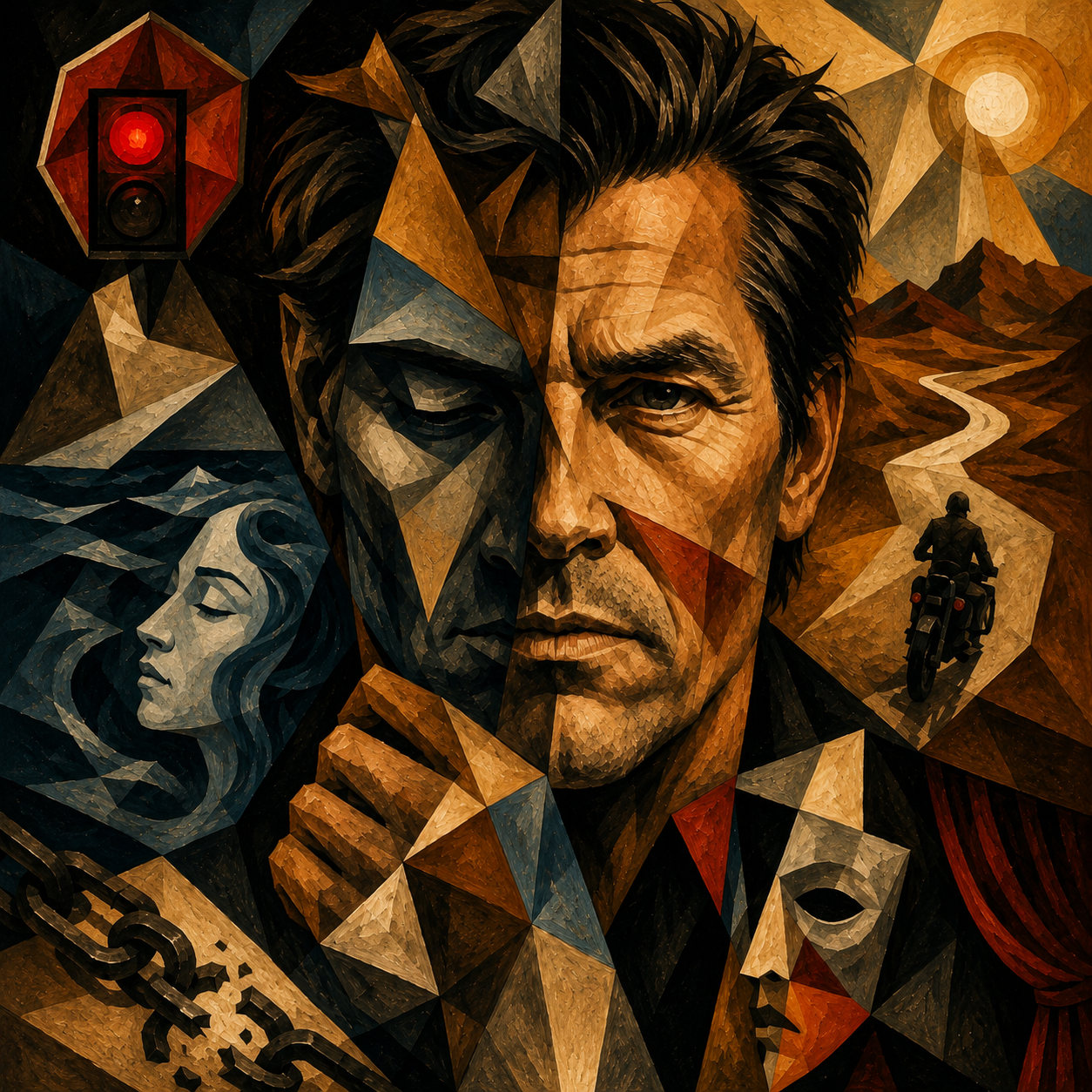
Brolin’s narrative is structured by this same covenantal anxiety. His relationship with his father, James Brolin, is the central drama of his life, and he explicitly frames it in terms of “breaking the chain.” The father represents an old covenant—one characterized by emotional distance, a “stop sign” that never changes, a “perpetually red” light. Brolin’s project is to create a new covenant, one characterized by presence, openness, and emotional availability.
“My daughter for Christmas I open a thing and it’s ‘Getting to know my dad better’… that’s Breaking the Chain, that’s a broken chain.”
The language is unmistakable: this is the covenant renewed. The daughter’s gift is the secular equivalent of a new covenant, a ritual that repairs the broken relationship between generations. The “107 questions” that Brolin sent to his father, and his father’s refusal to answer them, represents the failure of the old covenant. The daughter’s book represents its renewal.
The Mother as Unmediated Nature
If the father represents the law, the covenant, the structure that requires interpretation and transmission, the mother represents something more primal—the raw, unmediated, pre-covenantal reality. Brolin describes his mother as:
“A narcissist period… she’d say anything, do anything, didn’t matter to her, zero filter.”
This is the Puritan’s nightmare of unmediated nature—the self that exists before or outside the covenant. Brolin’s ambivalence toward his mother mirrors the Puritan’s ambivalence toward the natural self: it is simultaneously fascinating and terrifying, the source of authentic life and the seat of sin.
“She was there unapologetically herself… nobody compares to my mom.”
And yet this “unapologetic” self is also the self that nearly destroyed him, that created the “Cito Rat” mentality, that led to addiction and criminality. The mother represents the pre-covenantal chaos that the covenant is meant to contain.
The Visible Saints: Performance and Authenticity
Puritan communities were built on the distinction between the “visible saints”—those who could demonstrate evidence of grace—and the reprobate. But this created a profound anxiety about hypocrisy. How could one distinguish genuine grace from mere performance? The fear that one might be a “whitewashed tomb,” outwardly righteous but inwardly corrupt, haunted the Puritan imagination.
Brolin’s professional life is an extended meditation on this same anxiety. Acting, for him, is constantly shadowed by the suspicion of inauthenticity. The fear of being “found out” as a fraud is not merely a professional anxiety; it is a theological anxiety about the relationship between performance and reality.
“If I’m conscious that everybody knows then it only compounds.”
This is the actor’s version of the Puritan’s spiritual anxiety: the awareness of being observed, the fear that one’s performance will be exposed as mere performance, the terror that the authentic self will be revealed as inadequate.
The Hollywood Red Carpet as Theatrum Mundi
Brolin explicitly describes celebrity as a form of false performance:
“The perception of celebrity is walking down a perpetual red carpet waving… that’s what you spend your life doing. But for real, no, of course not.”
This is the Puritan’s critique of worldly theater rendered in Hollywood terms. The red carpet is the false stage, the performance of success that masks the “messy” reality beneath. Brolin’s commitment to “destroying this concept of celebritism” is a Puritan iconoclasm, an attempt to strip away the false appearances and reveal the truth beneath.
The Work Ethic and the Problem of Mammon
The Protestant work ethic, famously analyzed by Max Weber, held that material success could be a sign of election—not because wealth itself was virtuous, but because it demonstrated discipline, industry, and God’s favor. This created an ambivalent relationship to money: it was simultaneously a sign of grace and a temptation to worldliness.
Brolin’s relationship to money follows this exact logic. He describes being “always the one that was paid the least,” and there is a clear pride in this: it demonstrates that he is not motivated by Mammon. The American Gangster backend money, when it arrives, feels like “winning the lottery”—grace descending from above, confirming his value in the eyes of the world.
But there is also a deep suspicion of money, of “being on the hook,” of “some manipulative something going on” when money is offered freely. This is the Protestant suspicion of unearned grace: the fear that money, like salvation, might be a trap if it is not properly earned.
“I want to earn my buck, know that I’ve earned my buck.”
This is the work ethic in its pure form: the conviction that value must be merited, that grace must be earned, that the unearned gift is somehow suspect.
The Rejection of “Yes People” as Anti-Idolatry
Brolin’s insistence on having people in his life who “tell me the truth” rather than “yes people” is another iteration of this same logic. The “yes people” are the false prophets, the ones who flatter rather than correct. They represent the temptation to believe one’s own press, to become comfortable in one’s sin.
“People who listen but don’t really listen, that irks me. What’s the point in the conversation if you’re not going to listen?”
This is the Puritan’s horror of idolatry translated into social terms. The “yes people” are the golden calves—images that reflect back the self’s desire rather than reality. The truth-teller is the prophet, the one who speaks the difficult word that the self needs to hear.
Sobriety as Secular Sanctification
The sobriety narrative is the most explicitly theological element of Brolin’s interview, though he rarely frames it in religious terms. The structure is unmistakeable:
- The Fall: The “Tuesday” that was “another day” of drinking, the sidewalk awakening, the “wet brain,” the humiliation.
- The Crisis: The fork in the road, the realization that he could “be this for the rest of your life” or “try to find a different version.”
- The Transformation: The commitment to sobriety, the willingness to “lose anything” to make it work, the new life that emerges.
- The Witness: The desire to make sobriety “more fun than my greatest romance of what drinking used to be”—to testify, in effect, to the superior pleasures of grace over sin.
“My job is to make sobriety more fun than my greatest romance of what drinking used to be.”
This is the Puritan’s testimony of grace: the conversion that produces a new self, and the commitment to demonstrate that the new life is superior to the old.
The Desert as Place of Testing
The Puritan imagination was deeply shaped by the biblical wilderness—the desert as a place of testing, purification, and encounter with God. Brolin’s description of writing in the desert, of being in Jordan, of the “dunes” and the “Wadi Rum,” taps into this same symbolic geography. The desert is where the self is stripped of distractions, where it must confront its own emptiness and where transformation becomes possible.
“I was sitting at this hotel in Jordan… this is the time that I have to write. I probably wrote 60,000 words in that two weeks.”
The desert is the place of the covenant, the place where the law is given and the self is remade.
The Problem of the Father and the Unforgivable Sin
The relationship with the father is the most unresolved element of Brolin’s narrative, and it maps onto the Puritan’s most difficult theological problem: the unforgivable sin.
The Puritan understood the unforgivable sin as the sin against the Holy Spirit—the rejection of grace so complete that repentance becomes impossible. It was a state of spiritual hardness that could not be broken.
Brolin describes his father as a “stop sign” that never turns green—a figure who is “super friendly” but also “there’s a stop sign… before you get on the freeway, the red light, you’re ready to go… and the light never turns.” This is the unforgivable sin translated into personal terms: the father who cannot give what the son needs, the love that is perpetually withheld.
The tragedy is that Brolin cannot simply judge his father. He also loves him, recognizes his limitations, and struggles to understand him. The result is a complex emotional state that mirrors the Puritan’s relationship to the God who damns:
“It’s hard for me without sounding victimized, which I don’t feel… I threw myself into a labyrinth to want to know more about what that is… where do you adjust yourself, which is ultimately the only thing you can do, because I can’t worry about him changing.”
This is the Puritan’s posture toward the reprobate: one cannot change them, one can only accept the reality of their state and adjust one’s own relationship to it.
The Recorder and the Unanswered Questions
The 107 questions sent to the father, the tape recorder with its battery, the silence that follows—this is the ritual of failed connection, the confession that the listener will not accept. The daughter’s book, “Getting to know my dad better,” is the redemption of this failure, the covenant renewed in the next generation.
The Adventure as Transcendence
Brolin’s description of the sea is extraordinary in its explicitness:
“The sea on Earth to me reminds me of my mother in this world—it’s emotional, it’s super calm, I can always count that it’s going to be there, there’s going to be something going on.”
The sea is the mother, the source of life, the ever-present but uncontrollable reality. But it is also the place of the sublime—the experience that exceeds the self and connects it to something larger. The Puritan’s relationship to God was mediated through nature, through the “book of creation,” and the sea was a particularly potent symbol of God’s power and mystery.
Brolin’s need to be “saturated” in the sea, to be “in the ocean every day,” is a form of sacramental practice—a ritual that connects the self to the transcendent.
The Motorcycle and the Desert
The motorcycle ride in the Mojave Desert, the heat, the bees, the fear of the bike breaking down, the vision of the mother—this is the journey into the wilderness, the place of encounter. The adventure itself becomes the meaning:
“The adventure is everything, man. The adventure is it’s all in the adventure, that’s the nectar.”
This is grace rediscovered in the secular world: not the grace of salvation but the grace of experience, of presence, of being fully alive in the midst of risk.
The Unknowing Calvinist
Josh Brolin is not a Calvinist. He is not a Puritan. He is, by his own account, a “Cito Rat” who became an actor, a man who spent decades in addiction and rebellion, a celebrity who has no interest in traditional religion. And yet, his self-understanding, his narrative structure, his relationship to sin and redemption, his ambivalence about money and success, his struggle with his father, his need for confession and authenticity—all of these are shaped by a cultural inheritance that is unmistakably Puritan in its origins.
This is the “unknowing parallel”: the way that cultural forms persist beyond the explicit belief systems that created them. Brolin tells his story as if it were uniquely his, and it is. But the form of that story—the categories through which he interprets his experience—belongs to a tradition he does not consciously acknowledge.
The Puritan strain in American Protestantism has bequeathed to American culture a particular way of being human: one that is intensely introspective, obsessed with authenticity, suspicious of performance, structured by narratives of fall and redemption, ambivalent about material success, and haunted by questions of election and reprobation. Brolin’s interview is a near-perfect exemplification of this cultural inheritance, and his unawareness of its sources makes it all the more powerful.
He is, in the deepest sense, a secular Puritan—a man who does not know he is a Calvinist, but who lives as if he were one. The jeremiad continues, in the form of the confessional interview. The covenant persists, in the form of the family’s intergenerational struggle. The search for election continues, in the form of the quest for authentic artistic legitimacy. And the red light of the unforgivable sin still shines, perpetually, as the father’s silence.
The adventure—the “nectar”—is the only redemption. And perhaps, for the secular Puritan, it is enough.
Leave a Reply