
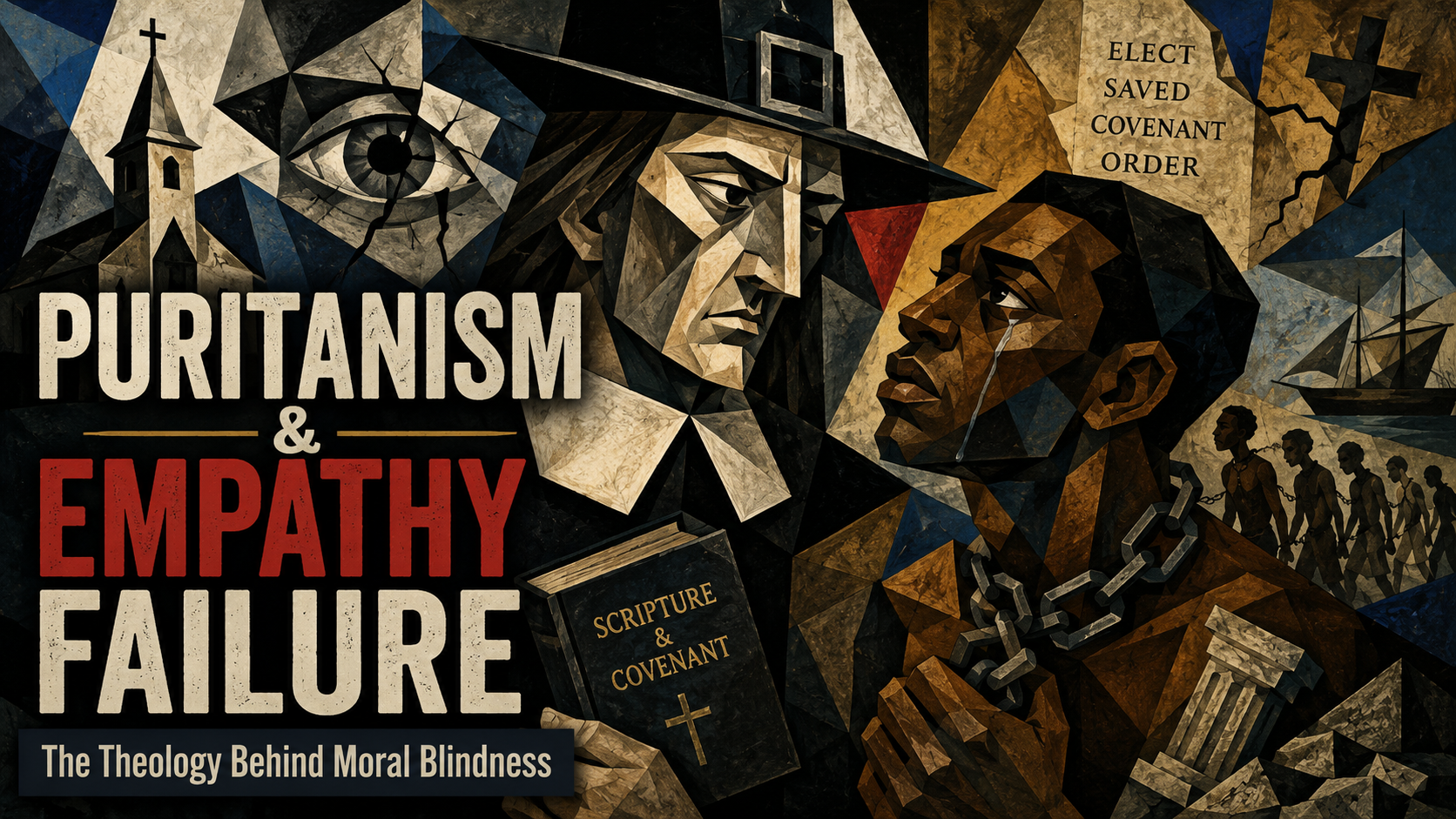
The Problem of American Theological Empathy
The question posed—whether the Puritan tradition, so quick to condemn the poor for lack of spiritual receptivity, was itself a perpetrator of profound empathy failure toward Black Americans—opens a philosophical wound in the American moral consciousness. This is not merely a historical curiosity but an ongoing structural reality that continues to shape the moral architecture of American life. The Puritan response to Black suffering was not a failure of theological consistency but rather its most horrifyingly logical extension—a systematic, theologically sanctioned production of empathy denial that functioned as the psychological and moral infrastructure for chattel slavery.
What follows is a philosophical excavation of how the Puritan tradition, through its deepest theological commitments, constructed an ontological hierarchy that rendered Black humanity invisible to the moral imagination of the white Puritan conscience. This is not an exercise in anachronistic moral judgment but a structural analysis of how theological systems can generate what philosopher Charles Mills terms “an epistemology of ignorance”—a way of knowing that systematically produces not-knowing about the humanity of the oppressed.
I. The Ontological Architecture of Empathy: Scarcity, Being, and the Heathen
The Puritan Ontology of Value
At the foundation of Puritan theology lies a particular ontology—a theory of what it means to truly be. For the Puritan, being was not a neutral given but a hierarchical participation in divine order. To exist in the full sense was to exist within covenant relationship with God, to be among the elect, to have one’s name written in the Lamb’s Book of Life. This was not merely a spiritual status but an ontological condition: the regenerated soul participated in being itself in a way that the unregenerate could not.
This ontology of scarcity—the idea that true being is rare, precious, and distributed according to inscrutable divine will—structured the Puritan perception of all human life. The poor were not merely economically disadvantaged; they existed in a state of ontological poverty, their material lack serving as a visible sign of their spiritual emptiness. The Puritan gaze upon the poor was therefore not one of empathetic recognition but of diagnostic scrutiny—searching for signs of election or damnation, reading the body as a text of divine judgment.
The Racialization of Ontological Scarcity
When this ontological framework encountered African peoples, it underwent a catastrophic transformation. The African was not merely poor in the economic sense but existed in a state of absolute ontological scarcity—a void of being that Puritan theology was structurally incapable of recognizing as fully human.
The philosophical mechanism here is crucial. The Puritan did not simply deny humanity to the African; rather, the African’s blackness became epistemologically constitutive of a different order of being. Drawing on a hermeneutic tradition that stretched from Augustine’s reading of the Psalms to the genealogical curses of Genesis, Puritan theologians constructed a racialized ontology in which black skin was the visible sign of a spiritual reality: the absence of the divine image in its fullness.
This is not merely premodern superstition but a sophisticated theological maneuver. The African’s blackness, in this framework, functioned as what philosopher Emmanuel Levinas would call a “trace” of the divine absence—not a sign of God’s presence but of God’s withdrawal. The slave’s body became a text of divine judgment, a living testament to the curse of Ham or the mark of Cain, an embodied proof of reprobation that required no further evidence.
Empathy as Category Error
The consequence of this ontological relegation was absolute: to extend Christian empathy to the enslaved African was not merely inappropriate but ontologically confused. Empathy, in the Puritan framework, was a covenantal obligation—a recognition of shared participation in the divine life, a mutual acknowledgment of common election. To feel empathy for the African was to commit what philosopher Gilbert Ryle would call a “category mistake”—treating a being of one ontological order as if it belonged to another.
The Puritan conscience was therefore not troubled by its failure to empathize with Black suffering. On the contrary, the very desire to empathize was suspect—a dangerous sentimentalism that threatened to blur divinely ordained boundaries. The fortress of the self that the Puritan constructed against the poor’s claims on charity was here repurposed as a fortress against the recognition of Black humanity. The defense was not against a drain on resources but against the collapse of an entire theological-cosmological order.
II. The Economy of the Gaze: Mastery, Calling, and the Deliberate Refusal to See
The Destruction of the Leisured Gaze
Recall the Puritan condemnation of the “leisured gaze”—that contemplative attention that the poor were accused of withholding from God’s providence. The poor, in the Puritan imagination, were too preoccupied with their immediate material suffering to properly perceive God’s hand in their affliction. They lacked the spiritual discipline to see their poverty as divine pedagogy rather than cosmic injustice.
But the slave system required something far more sinister: the systematic destruction of the leisured gaze toward the humanity of the enslaved. The master class could not afford the luxury of seeing Black suffering as human suffering, for such seeing would make the entire system morally intolerable. The economy of slavery depended on what philosopher Judith Butler might call a “deliberate foreclosure” of recognition—an active, disciplined refusal to acknowledge the humanity that was, at some level, always already visible.
The Holy Calling of Mastery
The Puritan master understood his role not as a violator of divine law but as its executor. His “holy calling” was to manage his estate—including his human property—for God’s glory. This was understood as a masculine duty, a burden of orderly control that required the suppression of “effeminate” sentimentality in favor of stern justice.
The philosophical significance of this cannot be overstated. The master’s cruelty was not a deviation from his religious commitments but an expression of them. The whip, the chain, the separation of families—these were not sins to be repented of but disciplines to be administered. The master who failed to control his slaves was failing in his covenantal duty, shirking the divine mandate to maintain order in his household.
This is what philosopher Giorgio Agamben might call a state of exception made permanent: the slave exists within the master’s domain but outside the moral order that governs relations between full persons. The master’s gaze is trained not to see a human face but a body to be managed, a resource to be optimized, a threat to be neutralized.
The Spiritual Discipline of Unseeing
The slave economy required what we might call a spiritual discipline of unseeing—a systematic training of perception to register suffering as mere fact rather than moral claim. The cries of a child torn from its mother, the agony of the whip, the slow destruction of bodies and souls under the weight of forced labor—all of this had to be perceived and then deliberately refused as a claim on empathy.
Puritan theology provided the perfect infrastructure for this discipline. The doctrine of providence taught that all events were divinely ordained, and the doctrine of total depravity taught that human suffering was ultimately deserved. The slave’s suffering could therefore be interpreted as divine judgment, the visible working out of God’s inscrutable purposes. To intervene would be to question God’s wisdom; to empathize would be to rebel against divine order.
This is not merely psychological defense but theological training in sociopathy—a systematic production of moral blindness that was understood as spiritual virtue. The Puritan conscience, far from being troubled by the slave’s suffering, was reinforced by it. Each act of unseeing was a reaffirmation of divine sovereignty, a submission to God’s mysterious will, a mortification of the rebellious flesh.
III. The Inversion of Justice: Cosmic Betrayal and the Proof of Damnation
The Moral Contract and Its Nullification
From the perspective of the enslaved African, the experience of slavery was the ultimate nullification of the moral contract—the world had shown them absolute injustice, a cosmic betrayal that called into question the very possibility of a just order. The slave’s cry of suffering was a philosophical claim: a demand that the universe be held accountable for its failure to honor the basic obligations of justice.
But in the Puritan framework, this cry was heard as something else entirely. The slave’s claim to justice—indeed, the very experience of injustice—became proof of their damnation. The unregenerate soul, in Puritan theology, is characterized by rebellion against God’s ordained order. The slave who complains of his condition is not making a valid moral claim but manifesting his reprobate nature, his refusal to accept the station to which God has appointed him.
The Accusation as Confirmation
The philosophical perversity of this is breathtaking. The slave’s experience of suffering as unjust—which is, from any reasonable moral perspective, evidence that justice has been violated—becomes, in the Puritan framework, evidence that the slave is morally culpable. The sense of injustice is the mark of the unregenerate heart, the sign that one has not submitted to God’s will. To feel empathy for such a one would be to side with rebellion against God.
This is the theological mechanism that allows the Puritan master to hear the slave’s cry and feel not pity but righteous indignation. The slave’s complaint is not a plea for mercy but an act of cosmic treason, a rebellion against the divine order that has placed him in bondage. The master’s cruelty becomes an act of piety, a defense of God’s honor against the ingratitude of the rebel.
Paternalism as Counterfeit Empathy
The master class did not, however, simply deny the slave any recognition. They offered a grotesque counterfeit: paternalism. The master claimed to care for the slave’s physical needs, to provide food and shelter, to offer (a controlled version of) Christian instruction. This “care” functioned as a perfect substitute for true empathy—it allowed the master to feel righteous and benevolent while maintaining a system of absolute control.
The philosophical structure of paternalism is worth examining. The paternalist claims to recognize the slave’s humanity—but only in a limited, conditional way. The slave is human enough to need care, to be capable of obedience, to benefit from instruction. But the slave is not human enough to be autonomous, to have claims, to be owed justice. The paternalist gaze sees the slave as a child, not a person; a body to be managed, not a soul to be recognized.
This counterfeit empathy is perhaps more insidious than outright cruelty. It allows the master to maintain a clear conscience while perpetuating a system of absolute injustice. The master gives the slave food and Scripture, thus fulfilling his “contract,” while utterly closing his heart to the slave’s humanity—which is the one thing the slave most desperately needs to have recognized.
IV. The Philosophical Legacy: Epistemologies of Ignorance and the Structure of White Empathy
Mills and the Epistemology of Ignorance
Philosopher Charles Mills has developed the concept of an “epistemology of ignorance” to describe the systematic production of not-knowing that sustains racial oppression. The white subject is trained not to see race, not to register the experience of people of color, not to acknowledge the structural violence that maintains white supremacy. This ignorance is not accidental but structural—it is built into the cognitive and moral architecture of a society organized around racial hierarchy.
The Puritan tradition provides a theological foundation for this epistemology of ignorance. The refusal to see Black humanity was not merely a cognitive failure but a moral achievement, a discipline of vision that was understood as spiritual virtue. The slave master’s ignorance of his slave’s humanity was not a gap in his knowledge but a triumph of his will—a successful resistance to the claims that empathy would have made on his conscience.
The Structure of White Empathy
The Puritan tradition thus bequeaths to American culture a particular structure of empathy—one that is racialized through and through. White empathy is not simply something that white people sometimes fail to extend to Black people; it is structurally oriented toward its own limits, trained to stop at the boundary of Black humanity.
This is not to say that white people are incapable of empathy for Black suffering. It is to say that such empathy requires a breaking of the cognitive and moral habits that are built into the structure of white identity in American culture. The Puritan legacy is a set of defense mechanisms that make Black suffering invisible, that interpret Black claims to justice as evidence of moral failure, that justify cruelty as divine discipline.
The Ongoing Theological Crisis
The crisis that the Puritan tradition creates is therefore not merely historical but ongoing. American culture continues to struggle with a legacy of empathy denial that is rooted in theological structures that have been secularized but not abandoned. The “epistemology of ignorance” that Mills describes is the secular form of the Puritan refusal to see Black humanity—a refusal that continues to shape police violence, mass incarceration, educational inequality, and the other structures of racial injustice.
The theological challenge is profound. How can a tradition rooted in a theology of election, covenant, and divine sovereignty develop the resources to recognize the full humanity of those it has ontologically excluded? This is not merely a question of revising doctrines but of fundamentally reimagining the relationship between theology and recognition, between faith and empathy, between the divine image and human dignity.
V. Conclusion: The Call for Philosophical Repentance
The Puritan tradition’s production of empathy denial toward Black Americans is not a historical anomaly but a structural feature of its theological architecture. The ontology of scarcity, the economy of the gaze, the inversion of justice—these are not deviations from Puritan theology but expressions of its deepest commitments.
The call for philosophical repentance is therefore not merely a call to feel differently about the past. It is a call to recognize the structures of empathy denial that continue to shape American life, to see how theological commitments can generate systematic moral blindness, to understand how the very mechanisms that make empathy possible can be turned against the oppressed.
The task is not to reject the theological tradition but to critically appropriate it—to find within it the resources for a radical reorientation of the moral imagination. The Puritan emphasis on covenant, for example, can be reimagined as a universal covenant of human dignity. The Puritan emphasis on divine sovereignty can be reinterpreted as a call to align human justice with divine justice. The Puritan emphasis on spiritual discipline can become a discipline of empathy, a training of the gaze to see the humanity that has been systematically rendered invisible.
This is not an easy task. It requires a willingness to confront the ways in which theological traditions can become instruments of oppression, to acknowledge the moral failures that are built into our most cherished commitments, to repent not merely of individual sins but of structural ones. But it is the task that the legacy of Puritan empathy denial demands of us—a philosophical and theological reckoning with the structures of moral exclusion that continue to shape American life.
Leave a Reply