
Fact and Fiction
Bandar Abbas, Iran — 14 September 2026, 0347 Local
The radar operator in the coastal defense bunker had been watching the same empty patch of sea for eleven days.
That was the first thing the Americans never understood. The Strait of Hormuz was not a highway. Not anymore. The great escorted convoys the Pentagon liked to talk about existed mostly in briefing slides and newspaper copy. On the water, the traffic had thinned to almost nothing. A handful of hulls, a few contract ships and some ghost transits that moved on paper and sometimes not at all.
So when a single commercial contact appeared on his screen, squawking the usual merchant codes, the operator did not hesitate.
He keyed the battery commander.
The Qadir was already on its rail, fueled and mated, its active radar seeker warmed to operating temperature. It had been waiting for exactly this.
Over the Gulf of Oman — 0349 Local
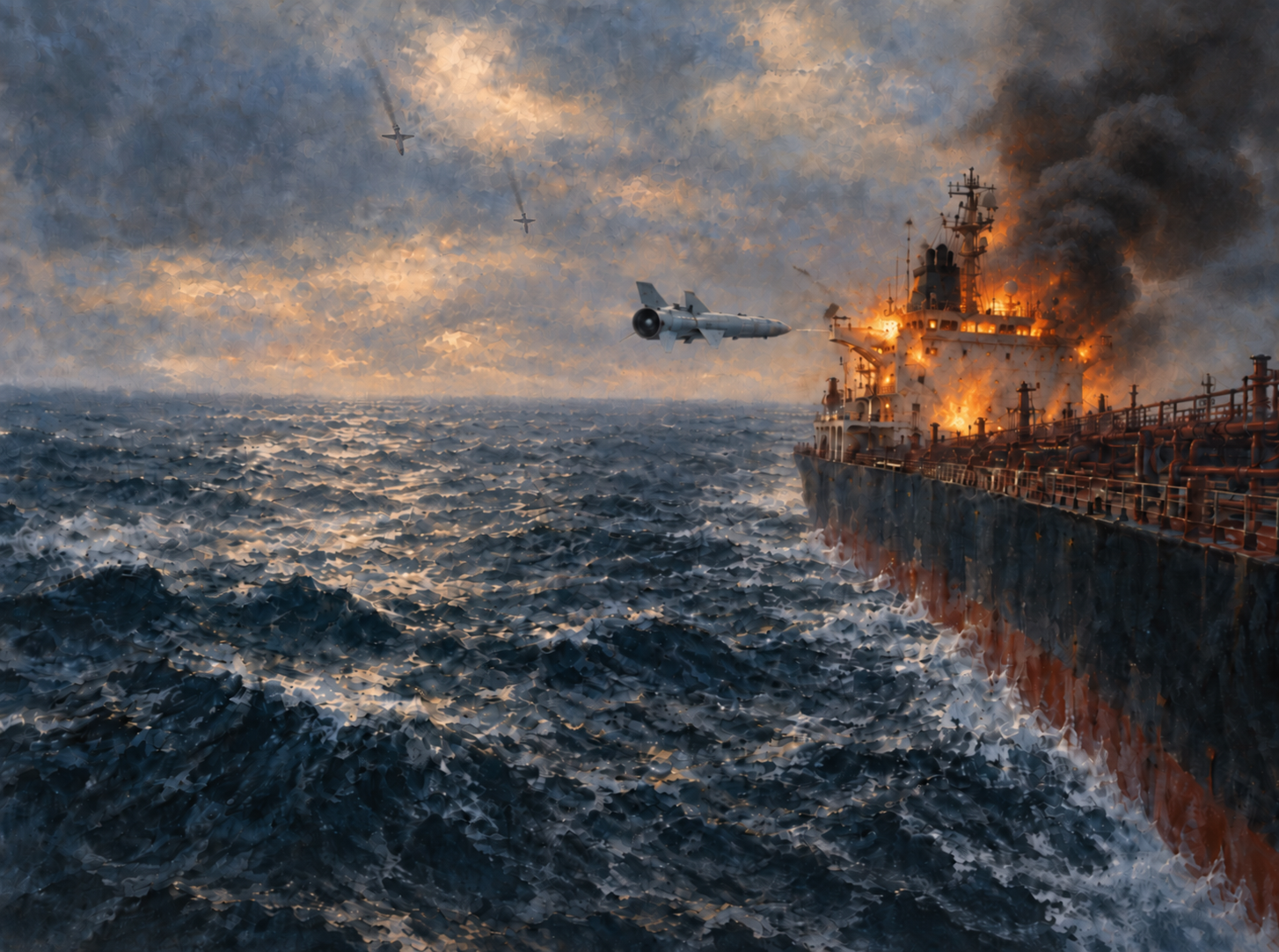
The P-8 Poseidon was orbiting at forty thousand feet when its electro-optical suite caught the launch plume.
The tactical coordinator aboard the aircraft watched the infrared bloom, then the streak of the missile dropping to sea-skimming altitude. He ran the profile through his head— subsonic, roughly 0.9 Mach and about twenty to thirty meters over the water, dropping to three to five in the terminal phase. A 165-kilogram semi-armor-piercing warhead. Just about enough to cripple a 3,000-ton vessel.
A Qadir. Iranian modernization of the Noor, a Chinese C-802 DNA.
He keyed the secure net.
“Red Spear. Red Spear. Red Spear.”
The Pentagon, E-Ring — 0351 Local
The watch officer in the National Military Command Center took the call from CENTCOM and wrote the words on a log sheet that would later be classified, cross-referenced, and buried.
US-contracted vessel. Possible impact. Marines aboard. Injuries unknown.
He picked up the phone to the Joint Staff. Then he picked up another phone. Then another. The machinery of the American military began to turn—not toward action, but toward containment.
MV Ocean Trader, Bridge — 0351 Local
The master of the Ocean Trader had been hired for his experience in the Gulf, his familiarity with the shipping lanes, and his willingness to accept a contract that paid triple the going rate.
He had not been hired to fight a ship.
The Marines aboard—Bravo Company, 1st Battalion, 8th Marines—were passengers. That was the word in the operations order. Passengers. A visible deterrence presence. Their rules of engagement were classified, and nobody had bothered to explain them to the crew.
The Qadir came in at three meters above the water.
The explosion was not cinematic. It was a hard, flat crack that seemed to come from everywhere at once, followed by the shriek of tearing metal and the roar of escaping steam.
Bravo Company Berthing, Deck 3 — 0352 Local
Staff Sergeant Marcus Webb was thrown from his rack.
Smoke. He smelled smoke.
“Up! Up! Everybody up!”
The compartment was chaos—Marines shouting, coughing, stumbling in the darkness. Emergency lighting flickered and died. Someone was screaming in the corridor.
Webb found his flashlight. Eight men in his squad, and all were accounted for. All moving, no blood and no obvious fractures. Smoke inhalation, maybe. Concussions, probably.
The ship was still moving. Still afloat.
He didn’t know then that the missile had struck above the waterline. That the fire was contained to a single compartment. That the Ocean Trader would make port in Bahrain under its own power, and that the eight injured Marines would be treated and released and returned to duty within days.
He didn’t know that the Pentagon would say nothing for thirteen days.
The White House Situation Room — 26 September 2026, 0715
The CIA briefer stood at the far end of the table.
“The Iranians are claiming a successful strike on a Western-operated vessel,” she said. “Our own intelligence confirms a Qadir launch. The vessel was under U.S. contract, and there were Marines aboard. Eight injured. None serious.”
The National Security Advisor looked up. “And the press?”
“NBC is preparing a story. Three officials. They’ll say it was a ‘maritime vessel.’ They won’t name the ship. They won’t name the missile, and they’ll frame it as a minor incident.”
“And the escort numbers?”
The briefer hesitated.
“The official line is that we’ve been running a robust escort corridor since May. The truth is we’ve barely transited anything… basically a handful of ships, and some of them empty. Some of them not even real. The media hasn’t asked anything, and they’ve been given the narrative, and the dumbshits have run it.”
The room was quiet.
“Good,” the National Security Advisor said. “Keep it that way.”
NBC News, Washington Bureau — 27 September 2026, 1400
The call from the Pentagon came in at 1400.
The reporter listened, took notes, said nothing.
The story would be a sad attempt at manufacturing consent, and it would cite three American officials. It would describe the vessel as a “maritime vessel.” It would say the injuries were minor. It would not mention the ship’s name, the missile type, the number of transits, or the fact that the Defense Casualty Analysis System had quietly added thirty-seven new entries—twenty-nine sailors and eight Marines—without explanation.
It would not ask why the Pentagon had said nothing for thirteen days, because the answer was already agreed upon.
The Strait of Hormuz — Present Day
The Qadir is not a sophisticated weapon.
It is subsonic, sea-skimming, derived from the Chinese C-802 by way of the Iranian Noor. Its 165-kilogram warhead can disable vessels up to 3,000 tons. It is exactly the kind of threat any competent assessment should have anticipated in the Strait of Hormuz.
But the assessments had grown complacent.
The official narrative said the United States Navy was running a steady escort mission through the strait. The truth was a skeleton operation. Essentially, a handful of contract ships and performance staged for the cameras and the cables and the newspapers that never bothered to check the numbers.
The media was not honest. Not in the way that matters. It did not lie outright. It simply accepted the framing. It reported the silence as a “no comment.” It reported the unnamed ship as a “maritime vessel.” It reported the injuries as minor. It did not ask why the Pentagon would not name a ship that had been hit by an Iranian missile. It did not ask why the casualty database had been updated without explanation.
It did not ask because the questions were inconvenient, and the answers were already written. The ship’s name remains classified by omission. The missile was predictable.
The strait was never safe.