

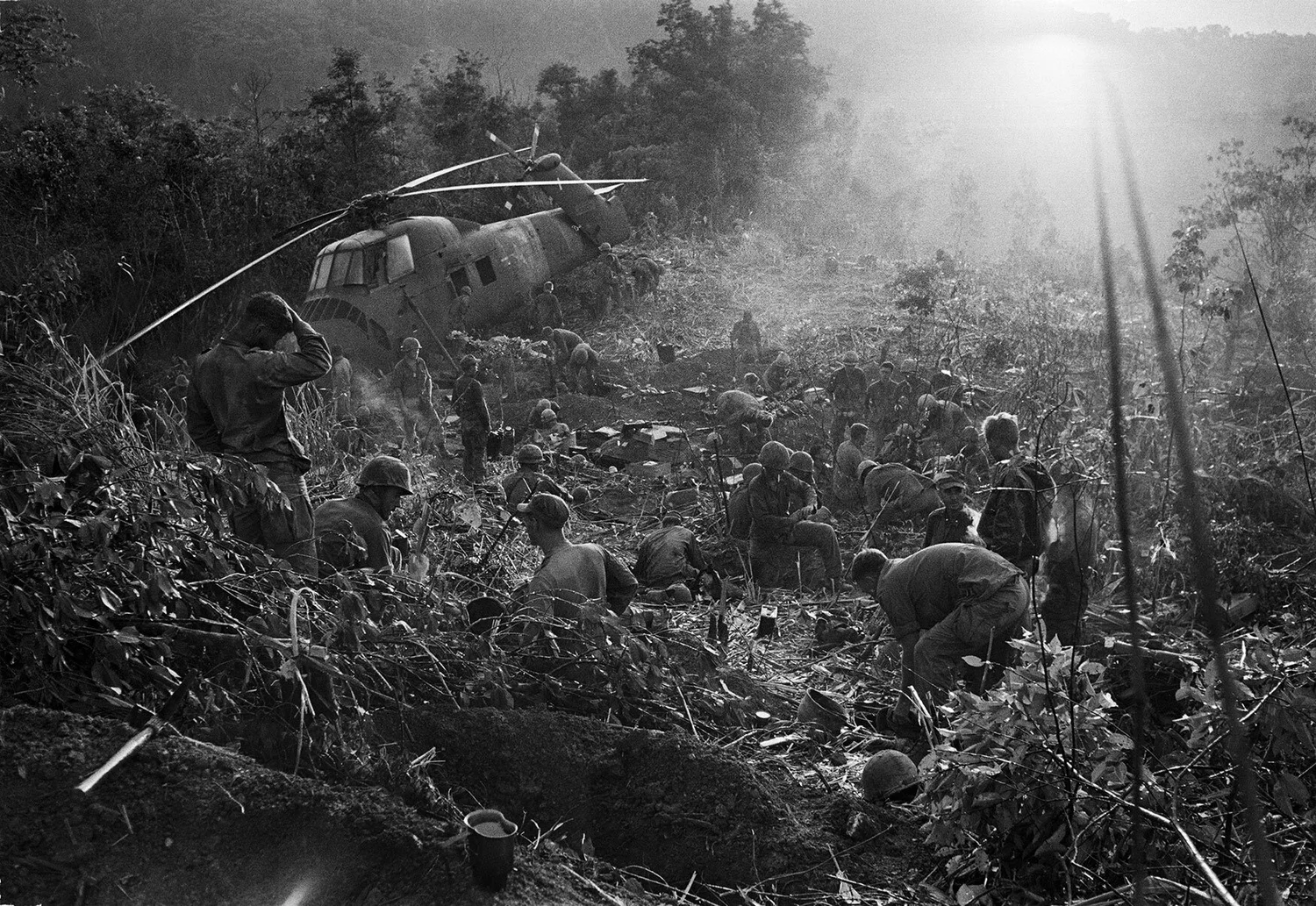
DATELINE: SOME GODFORSAKEN FESTERING SORE ON THE MAP CALLED DĨ AN BASE CAMP, OCTOBER 1971…
The air in the hooch wasn’t air. It was a condition—a foul, breathing paste of mildew, dried buffalo shit, stale beer, and the ever-present cloying reek of DEET and sweat… the smell of a war that had gone rancid, left too long in the brutal sun. Outside, a diesel generator hacked and wheezed in the darkness like a dying buffalo—or maybe a Senator telling the truth, which amounted to the same thing.
Inside, the only rhythm was the low, drugged breathing of sleeping men—not soldiers, not anymore. These were support troops, rear-echelon clerks and mechanics, and lifers who pushed paper instead of patrolling paddies.
They were safe.
That was the official lie, anyway, printed on the mimeographed orders and stapled to the bulletin board next to the “We Are Winning” propaganda.
Safe from Charlie’s mortars. Safe from the NVA’s ambushes. Safe in the belly of the beast… safe.
Safe.
A useless word—a fucking joke—in a year when the very concept of a front line had dissolved into a universal, buzzing paranoia.
In the middle of a cricket-filled night, a shadow cut the moonlit mesh of the doorway. A Man without black pajamas and a conical hat.
This was an American in the shadows, wearing the same faded, jungle utilities as the men snoring off the day’s heat and the night’s beer. In his right hand was a warm, olive-drab M-26 fragmentation grenade. The pin was already straightened—a small, intimate act of premeditation, like a man rolling a cigarette before a long walk… or a last meal.
He didn’t look at the sleeping forms. His eyes were fixed on a partitioned corner of the hooch, the semi-private kingdom of the First Sergeant. The movement was pure, unhurried muscle-memory… a purely… functional psychosis. A pull, a soft, definitive ping as the spoon flew off into the darkness, and then the low, gentle roll of what sounded like an 8-ball across the plywood floor.
It wasn’t a throw. It was a delivery. A bowler going for a spare in some hellish, unseen alley. It whispered under the cot, a final, unanswered argument.
He didn’t run. Running is for amateurs- for men with guilt. He walked. He strolled into the wet, black night like a man leaving a bar after last call, his business concluded… and well done.
Four seconds.
Then the world blew apart.
The noise wasn’t sound; it was a physical violation, a sledgehammer to the temple of the entire base! The M-26 is a democratic weapon—it disseminates over a thousand serrated steel arguments in a 15-meter radius. The hooch vomited splinters and blood and canvas. The cot became abstract art. The First Sergeant ceased to be a problem of discipline and became a problem of logistics, his reign ended by the very ordinance his army issued to prolong it… poetry, of a sort. Black, twisted poetry.
Chaos, of course. A beautiful, brutal opera of confusion. Sirens howled like electronic wolves. Men stumbled blind into boots, fumbling for flak jackets, their brains still cobwebbed with sleep and cheap Thai weed, screaming about a mortar attack—always the mortars, never the truth! Flares popped, bathing the scene in a ghastly, jerking strobe—the light of a bad acid trip at an abattoir.
But the perimeter was quiet. No mortars. No sappers. Just a hole where a hooch had been, stinking of cordite and something richer, older: betrayal.
And in the flickering, cancerous light, the man who rolled the ball lit a cigarette. The match flare illuminated no monster, just another face in the ragged formation. Another gear in the great, grinding machine. He inhaled deeply. The smoke mixed with the same air he had just weaponized…
…not that it mattered, now.
This was no accident. This was not a malfunction. This was a MEMO from the lower depths, written in high explosives and body parts.
A final edit to the chain of command.
By 1971, the war in Vietnam had spawned a magnificent, cancerous twin. The United States military was no longer just fighting Communists in black pajamas. It was engaged in a savage, low-boil civil war, an auto-cannibalization on a scale that would make a Roman emperor blush… and then take notes. The incident at Dĩ An wasn’t an anomaly; it was a data point. A statistic with guts.
They called it Fragging.
It was the true voice of the Grunt, translated into the only language the Lifers understood: explosive punctuation. In ’69, the Army, through clenched teeth and sweating palms, admitted to 96 “confirmed incidents” of officers and NCOs getting their tickets punched by their own.
By ’70, it was 209. And in the godforsaken year of ’71, it would peak at 333. Three hundred and thirty-three! And those were just the fireworks shows… the ones where they found enough pieces to file a report. The ones that couldn’t be explained away as “a sudden VC infiltration” or “an unfortunate training accident”… which was the same thing, really.
The term itself—fragging—sounded like something from a comic book. But there was nothing funny about it. It turned the chain of command into a bargaining session. It turned bases into paranoid city-states where captains slept with .45s under their pillows and sergeants major took the long way around their own latrines after dark… if they were smart. The machine, in all its green, unimaginative glory, was eating its own gears and spitting out shrapnel.
THE ROOT OF THE MADNESS: A WAR WITH NO WIN, ONLY A CLOCK… TICKING LOUDER THAN MORTARS
To understand this—to grok it in the Biblical sense—you have to pull back from the smoking wreckage at Dĩ An and look at the whole rotten map in 1971. The war had changed. The big, stupid, chest-thumping offensives of ’65 and ’67 were ancient history. The gut-punch of Tet in ’68 was a fading nightmare. Now it was all “Vietnamization,” a five-dollar word that meant, “We’re getting the hell out and leaving this corpse for the ARVN to bury… good luck with that.”
Nixon was bringing the boys home. The numbers don’t lie: over half a million American troops in ’69, dwindling down to a skeleton crew of 156,000 by the end of ’71. This created a beautiful, deadly paradox.
Everyone knew the jig was up.
The politicians in D.C., the generals in their Saigon villas, and the nineteen-year-old draftee from Cleveland humping a radio in the A Shau Valley… they all knew.
The mission was no longer “win.” The mission was “don’t be the last poor bastard to die for a mistake.” But the dying didn’t stop. The patrols didn’t stop. The machine demanded its blood, even as it was being disassembled for scrap… madness.
The soldier of ’71 was a different animal. The gung-ho volunteer of ’65 was as extinct as the honest politician. This was a conscripted army, a circus of long-haired, dope-smoking cynics who wore peace symbols on their helmets and listened to Hendrix and The Doors on cassette decks—the soundtrack to the end of the world! They read the anti-war screeds in Stars and Stripes right next to the Pentagon’s body-count press releases. Their bible was the DEROS calendar—365 days, a crucifix to mark off each one with trembling, desperate hands. Survival was the only strategy. Victory was a bad joke told by colonels with clean fatigues.
They were alone, these boys. The replacement system was a masterpiece of dehumanizing efficiency. A soldier didn’t train with a unit, deploy with a unit, or come home with a unit. He was a lone cog, shipped over and hammered into a machine that was already screaming and throwing sparks… no history, no future. He had no loyalty to the storied history of the 1st Cav or the 101st. His loyalty was a feral, desperate thing, given only to the six or seven other guys in his hooch or his squad who were trying to beat the same clock… the only clock that mattered.
The officers, the Lifers, were on a different timeline entirely. A career man needed command time. He needed a combat command on his OER. He needed aggressiveness. He needed to show he was fighting a war, even if the war was over and nobody had told the bullets… especially the bullets! His objective was promotion. The draftee’s objective was to live until his freedom bird left. These two realities were on a collision course, and by ’71… CRACK-BOOM-BANG. The wreckage was piling up.
THE INCUBATOR: BOREDOM, RAGE, AND HEROIN IN THE REAR… A TRINITY OF DOOM
We think of Vietnam as a war of jungle patrols and firebases. But by 1971, the vast majority of GIs were support, living in sprawling, festering base-cities like Long Binh and Da Nang. These were not primitive outposts. They were American-style prisons with swimming pools, enlisted clubs, movie theatres, and bowling alleys… the whole sick carnival. The boredom was a physical weight, a crushing, soul-killing ennui you could taste in the warm beer. Thousands of armed, terrified, pissed-off young men with nothing to do but wait… and hate.
Into this vacuum poured two kinds of gasoline: racial fury and pure, cheap heroin… the great American equalizers.
The racial turmoil of America had arrived “in-country” with a vengeance. Black soldiers, drafted from the burning cities, were done with the Jim Crow bullshit. They saw a white officer corps sending Black grunts to die at disproportionate rates. They saw Confederate flags flying over hooches. They said no more. The Dap, the Black Power salute, “Soul Brother” handshakes—it was a nation within a nation. “Soul Alley” wasn’t just a nickname; it was sovereign territory in every major base. White officers, many from the segregated South, didn’t have a clue. They saw insubordination. They cracked down. They demanded haircuts … madness! They handed out Article 15s like traffic tickets. They tried to enforce the stateside rulebook in a place where all the rules had been burned for fuel.
Then came the scag. In 1970, a pipeline of 95% pure, smokable white heroin opened from the Golden Triangle. It was cheaper than beer. Two dollars a vial! For a kid scared shitless or bored out of his skull, it was the ultimate escape hatch… the back door out of reality. The Pentagon’s own terrified estimates put usage between 10-15% of all troops. In some units, it was closer to a third. The Army was no longer just fighting the Viet Cong; it was occupying a nation of junkies, and half of them were wearing its own uniform… a terrifying symmetry.
And the weapon to defend this new, dark lifestyle was everywhere. The M-26 grenade. Weighs about a pound. Fits in a cargo pocket. Has no serial number. When it goes off, it destroys the evidence… perfect. It was the perfect murder weapon for a war where the enemy was now the man who gave the order to search your footlocker for drugs.
THE MECHANICS OF A MUTINY… A HOW-TO GUIDE
Fragging wasn’t just killing. It was a language. A collective bargaining agreement written in a 4-second fuse and fragmentation coils.
Often, the first grenade was a warning. A tear-gas canister rolled into the officer’s hooch at night. A live grenade with the spoon taped down, left on his cot so he’d find it and understand: We can get to you. Anytime. The next one won’t be taped…
The mutiny was bureaucratic in its terrible clarity:
- The Freeze-Out: The officer enters the mess hall. Conversation dies. He is a ghost… already dead, just walking.
- Passive Sabotage: His jeep has constant “mechanical failures.” His radio “mysteriously” breaks before patrol… every. damn. time.
- The Warning: The smoke grenade. The rock on the roof at 0300. The pinned grenade on the pillow… a love note from the abyss.
- The Correction: The frag. The final, un-negotiable edit. The Dĩ An Solution.
This created a black market of violence. The bounty system. By late ’71, pots of $500, $1000—a fortune to a PFC—were being pooled to pay for the removal of a particularly despised officer. It turned murder into a community investment… a stock purchase in survival. If you kicked in twenty bucks, you were complicit. Your silence was bought and paid for.
The system’s response was a joke. The Criminal Investigation Division was like sending a traffic cop to investigate a riot in a madhouse!! The crime scene was a crater. The witnesses were all accomplices or too terrified to speak. The evidence was dust. Cases were closed as “enemy action” or “accident” just to make them go away. The signal to the ranks was clear: You can get away with it.
THE PARALYSIS OF COMMAND… OR, HOW TO NEGOTIATE WITH A GRENADE
The true terror of ’71 wasn’t the explosions. It was the silence that followed.
The paralysis.
Officers stopped leading. They started negotiating. “Okay, men… look, we have to patrol to this grid coordinate. How about we go halfway, sit tight, call in some phantom artillery for the log, and come home? Hmm?” This was “Search and Evade,” and it was the standard operating procedure for a disintegrating army. The grunts would call in false coordinates, fake contact, burn through ammunition, shooting at nothing… all to simulate a war that was already over.
If an officer refused to play this game—if he was a true believer, a Lifer, a hard-ass—he became a threat to the unit’s survival. And in the logic of 1971, a threat was something you eliminated. Not for victory. For sanity. For the right to see your twentieth birthday… a simple calculus, really.
The statistics from the Judge Advocate General tell a chilling story: over 80% of victims were officers or NCOs. Lieutenants and First Sergeants—the men in their faces every day. The attacks spiked after payday and after a unit stood down from patrol. A cocktail of cash, booze, resentment, and the sheer, mind-bending boredom of the rear… the Dĩ An cocktail. Drink up.
THE LEGACY: A MACHINE THAT BROKE ITSELF… AND THEN BUILT A CAGE
The fragging epidemic of 1971 was more than a crime wave. It was a systemic nervous breakdown. It proved that you cannot conscript an army to fight a war its own government has already quit. The social contract was in tatters… burned in a scorching hooch.
The draftee saw himself not as a soldier, but as a hostage of a failed policy. And hostages, when pushed far enough, stop pleading and start planning their jailbreak… with extreme prejudice.
The U.S. didn’t lose in Vietnam because of fragging. But fragging was the most violent, undeniable symptom of an army that had already lost its will, its purpose, and its soul. It was the sound of the great green machine seizing up, its pistons firing randomly, blowing its own cylinders to hell.
The fallout was immediate and permanent.
The draft ended.
The all-volunteer army was born not from some lofty ideal, but from sheer, pants-pissing terror in the Pentagon. They could never again risk manning their military with unwilling citizens… the lesson of Dĩ An was too stark, too written in blood and craters. The modern, professional, unit-cohesion-obsessed U.S. military is a direct child of the fragging nightmare. They built a new machine, vowing never to let the gears grow teeth again.
But for the men who were there, in the hooches and the heroin haze of 1971, the lesson was simpler and darker. It was a lesson in the limits of authority. A lesson written not in manuals, but in craters on plywood floors… in Dĩ An, and a hundred other forgotten sores on the map.
The war ended. The bases were abandoned. The jungle crept back in. But if you listen to the silence left behind, beneath the whir of history, you can still hear it: the soft, rolling trundle of a grenade on a floorboard, the final argument in a war where the enemy finally, definitively, wore the same uniform… and had your address.