

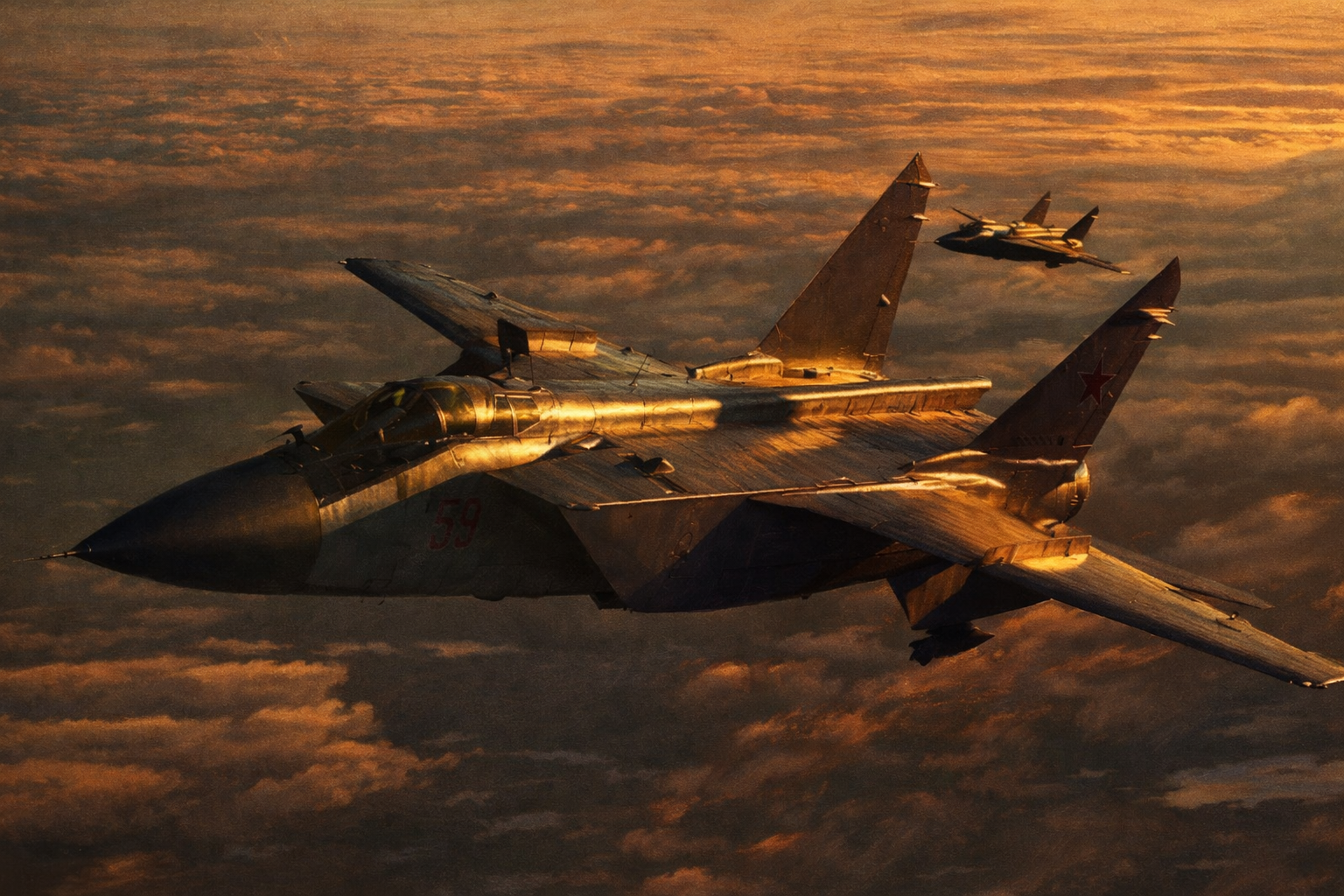
The Annihilation of the NATO Surface Fleet
18:00 ZULU – THE INCURSION
The order came from Norfolk, Virginia, via satellite relay. Admiral Henk Brinkman of the Royal Netherlands Navy, commanding NATO’s Standing Maritime Group 1, read the flash traffic on his secure tablet.
Execute Operation Northern Safeguard. Effective immediately//
The plan was simple in concept, if audacious in execution. For weeks, satellite imagery had shown a massive build-up of Russian naval infantry and Iskander short-range ballistic missiles in Kaliningrad.
Simultaneously, the Baltic Fleet in Kronstadt, outside Saint Petersburg, was preparing for its summer exercises. NATO intelligence, however, had detected an anomaly: the electronic signatures of the Admiral Gorshkov-class frigates were silent.
They weren’t sailing.
Instead, intelligence suggested Russia was planning to resupply the Kaliningrad exclave by sea, running the gauntlet of NATO surveillance right through the Baltic.
NATO wouldn’t allow it.
The order was to establish a blockade.
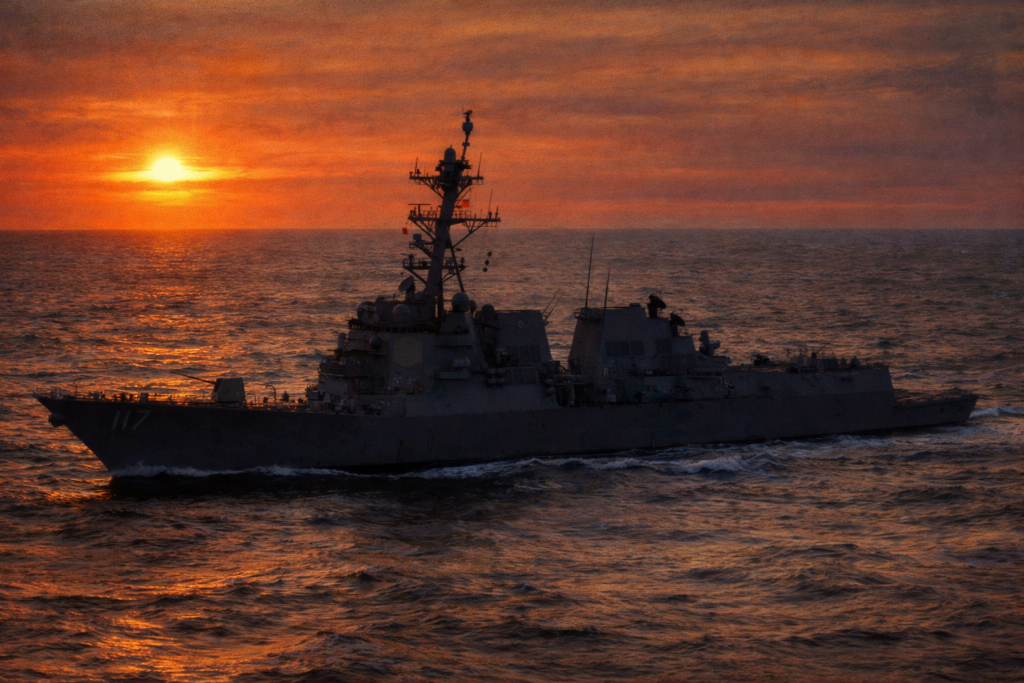
As the sun dipped below the horizon in the Baltic, the force was sailing East. At the spearpoint was the USS Donald Cook, an Arleigh Burke-class destroyer, and its AEGIS Combat System SPY-1D already painting the sky.
Flanking her were the Dutch frigate De Zeven Provinciën and the German Sachsen-class frigate FGS Hessen.
Ten thousand tons of NATO naval power, bristling with Standard Missiles, designed to create a no-go zone for any Russian surface combatant attempting to break out from Saint Petersburg or reinforce Kaliningrad. They took position 80 nautical miles off the Estonian coast, their radars a wall of energy facing East.
They were looking for ships.
They were not looking for what was about to hit them.
19:15 ZULU – THE KINZHAL LAIR
Three hundred miles to the southeast, at an airbase in the depths of Belarus, the silence of the night was shattered by the ear-splitting howl of afterburners. Six MiG-31K interceptors tore into the darkness.
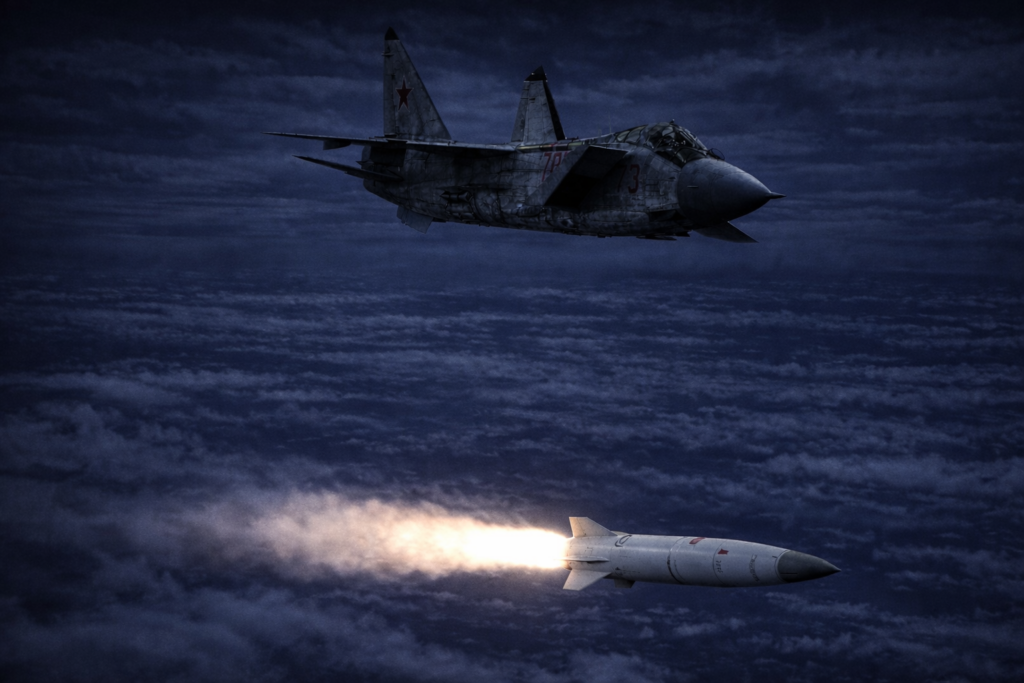
The MiG-31K is a dedicated carrier for one of the most feared weapons in the Russian arsenal: the Kh-47M2 Kinzhal. As the Foxhounds climbed to their launch altitude of 50,000 feet, the pilots initiated the weapon’s final alignment. The Kinzhal follows a quasi-ballistic trajectory, but its true terror lies in its terminal phase.
Down on the Baltic coast, in Kaliningrad, another component of the strike was warming up. The 3M22 Zircon is a different beast entirely. A scramjet-powered maneuvering anti-ship cruise missile, it sits within the VLS cells of the frigate class Admiral Gorshkov
The Gorshko had not been idle in port; it had been quietly tucked into a berth at Baltiysk, its systems live, its target data being fed via a covert datalink from a surveillance aircraft high above the clouds.
The NATO fleet, confident in its electronic warfare superiority, was scanning for active radar. They detected nothing. The Russian strategy was one of absolute silence until the moment of launch.
20:42 ZULU – THE UNVEILING
The order came from the National Defense Control Center in Moscow.
“Протокол-Буран” Protocol Buran.
On the Admiral Gorshko, tucked into its berth at Baltiysk, the hatches over its 3S14 UKSK VLS cells blew off in rapid succession. Within seconds, four 3M22 Zircon missiles erupted from their tubes in a cascade of steam and orange flame. They climbed sharply on solid rocket boosters, punching through the inversion layer at Mach 4 before the scramjets kicked in with a throaty roar that shook the windows in Kaliningrad, twenty kilometers away.
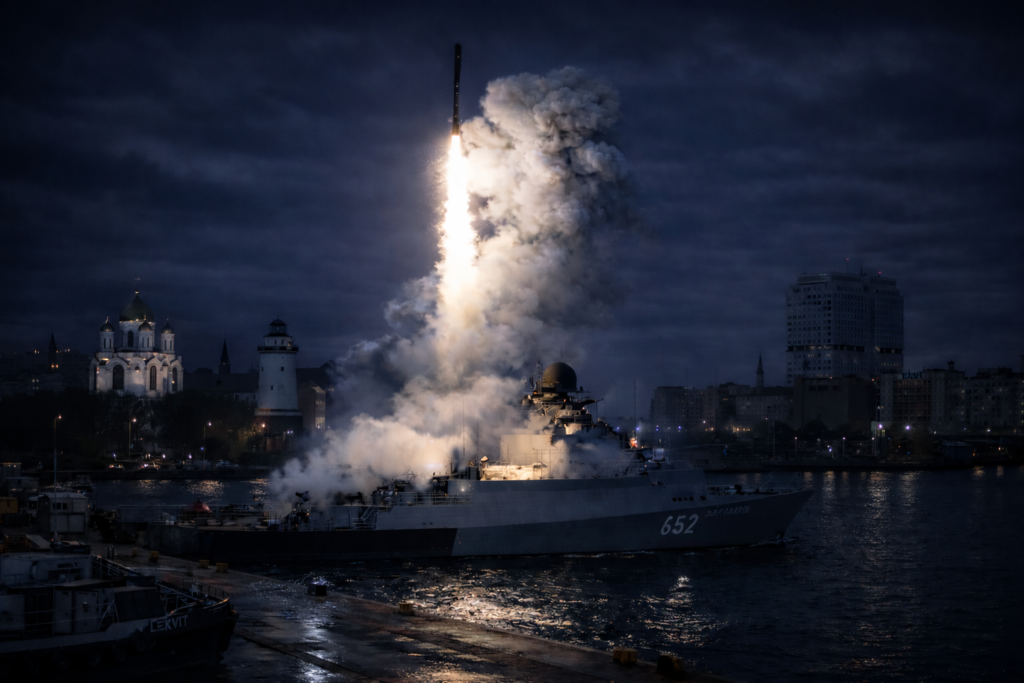
The missiles vanished from the view of NATO surface radar, becoming ghostly blips that moved at over Mach 7—5,400 miles per hour—at altitudes exceeding 100,000 feet, pulling high-G zigzags not to avoid detection, but to defeat any possibility of a kinematic intercept.
At the same moment, over Belarus, six MiG-31Ks performed a shallow dive from 60,000 feet and released their payloads. Six Kh-47M2 Kinzhal missiles dropped for a split second before their rocket motors ignited with actinic brilliance. They shot skyward on a massive parabolic arc, exiting the atmosphere entirely. The Kinzhal follows a depressed trajectory that makes it nearly impossible to track by horizon-limited radar.
To the AEGIS SPY-1D array on the Donald Cook, the first indication of an attack was not a missile climbing toward them from the east, but the sudden appearance of ten supersonic objects materializing from directly overhead as the Kinzhals re-entered the atmosphere.
20:43 ZULU – THE DEATH OF AEGIS
On board the USS Donald Cook, the AEGIS Combat System went from quiet confidence to screaming chaos in less than a second.
“THREAT WARNING! MULTIPLE INCOMING! BEARING 090! RANGE… RANGE NEGATIVE!”
“THEY’RE ON TOP OF US!”
The Combat Information Center was a hive of panic.
The radar display showed tracks that weren’t playing by any rules of naval engagement. The first four—the Zircons—were coming in at sea-skimming altitude but at hypersonic velocity, their plasma sheaths rendering them faint, flickering returns.
The AEGIS radar could see them, but the fire control solution was a nightmare of negative time-on-target calculations. The Standard Missile-3s were designed for ballistic defense in space; the SM-2s and evolved Sea Sparrows were for subsonic and supersonic threats, not targets moving faster than a rifle bullet at treetop height while executing random evasive maneuvers.
The Donald Cook launched chaff and activated its SLQ-32 electronic warfare suite. It was useless. The Zircon homes in on electronic emissions; the chaff was a cloud of aluminum confetti wafting gently in the wind compared to the missile’s closing velocity.
The first Zircon struck the Donald Cook just aft of the bridge. The 400-kilogram warhead, travelling at Mach 7, didn’t just explode; it transferred its kinetic energy in a cataclysmic fashion. The missile penetrated the destroyer’s Kevlar armor like a hot needle through butter, passing through the portside, through the CIC, and out the starboard side before detonating. The ship was cut in half by the sheer force of the object passing through it, the bow and stern rising momentarily before the keel snapped with a sound like the world ending.
The second Zircon hit the HNLMS De Zeven Provinciën amidships, igniting her magazines. The Dutch frigate vanished in a globe of orange fire that lit the clouds from below, a thousand fragments of Dutch steel raining into the Baltic for miles around.
As the AEGIS network disintegrated into a cacophony of dying datalinks, the Kinzhal warheads rained down from above. They arrived at a 90-degree angle, travelling at speeds in excess of Mach 10—over 7,600 miles per hour. One struck the FGS Hessen directly on her helicopter deck, the force of the impact pulverizing the stern and sending a shockwave through the hull that snapped the keel like a dry twig.
The ship rolled and began to sink in under three minutes, her screws still turning as she plunged into the abyss.
But war is never perfect.
One of the six Kinzhals, released from its MiG-31K over Belarus, experienced a split-second glitch in its guidance data stream. The missile, travelling at the edge of the atmosphere, relied on a continuous flow of targeting updates from the Russian network to refine its terminal approach. For 0.3 seconds—an eternity at hypersonic speeds—that flow stuttered.
A relay satellite, overloaded by the sudden surge of data from the Baltic strike, dropped the packet. The Kinzhal’s onboard computer, expecting a final course correction, instead defaulted to its last valid: a set of coordinates that placed the USS Donald Cook approximately 200 meters south of its actual position.
The missile never wavered in its trajectory. It came screaming down from the blackness of space, its plasma sheath painting a burning scar across the night sky, but its aim was true to the flawed data. Instead of striking the Donald Cook’s bridge, it plunged into the Baltic Sea less than fifty meters off the destroyer’s starboard beam.
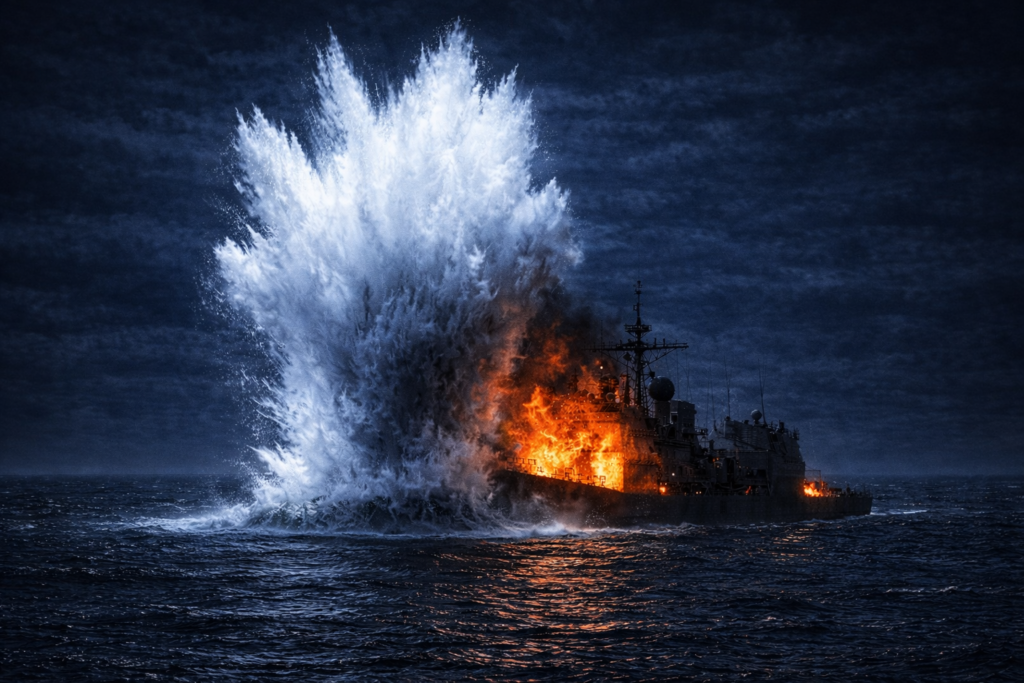
The impact was cataclysmic.
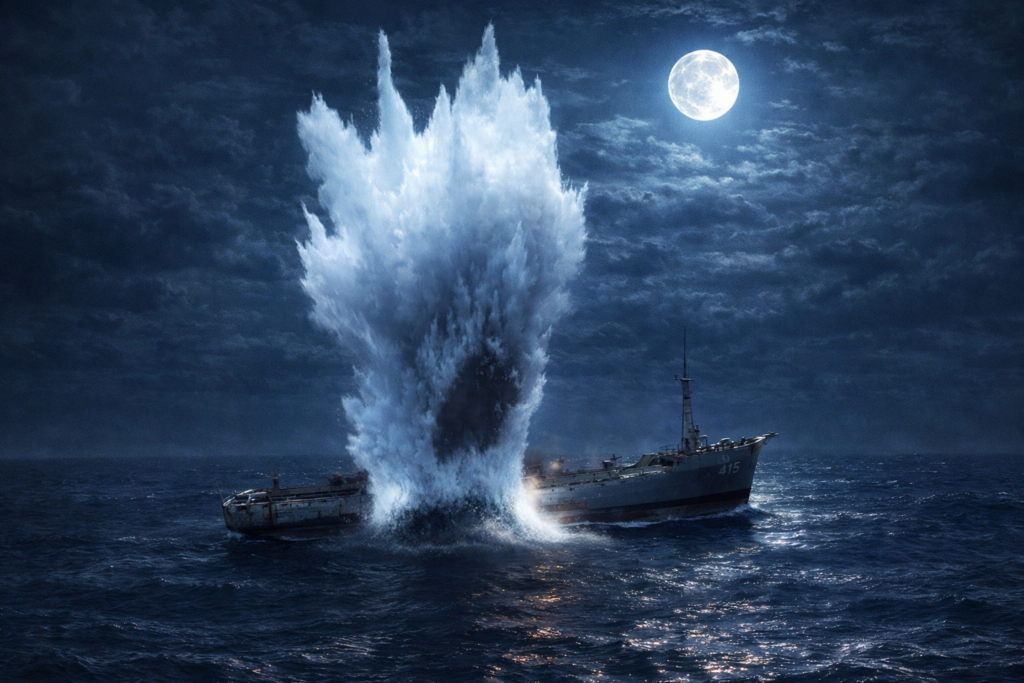
The Kinzhal, carrying a 500-kilogram warhead and travelling at over 7,600 miles per hour, hit the water with the force of a small earthquake. The sea did not simply splash; it detonated.
A column of water erupted skyward with terrifying violence, a white geyser of vaporized seawater and compressed air that rose higher than the Donald Cook’s mast, higher than her radar arrays—over 1,500 feet into the night sky.
For a terrifying moment, the destroyer was bracketed by a wall of water that blotted out the stars. The shockwave through the water hammered the hull, sending men on the deck tumbling—rattling every bulkhead on the ship. The geyser hung in the air for a long, frozen second before collapsing back into the sea in a thundering cascade that drenched the entire ship and left a swirling, steaming maelstrom where a killing blow should have landed.
On the bridge of the Donald Cook, men who had braced for death looked up to see water raining down instead of what was left of their boat. The CIC, still reeling from the Zircon impacts that had already mortally wounded the ship, registered the near-miss with a flicker of data before the systems went dark.
A faulty data stream, a single lost packet of information, had been the difference between a confirmed kill and a towering monument of seawater. But for the sailors of the Donald Cook, it was only a brief reprieve. The Zircons had already done their work, and the ship was dying around them. The geyser, a ghost of what might have been, was merely the last thing they saw before the boat disappeared into darkness.
20:44 ZULU – THE AIR GUARDIANS FALL
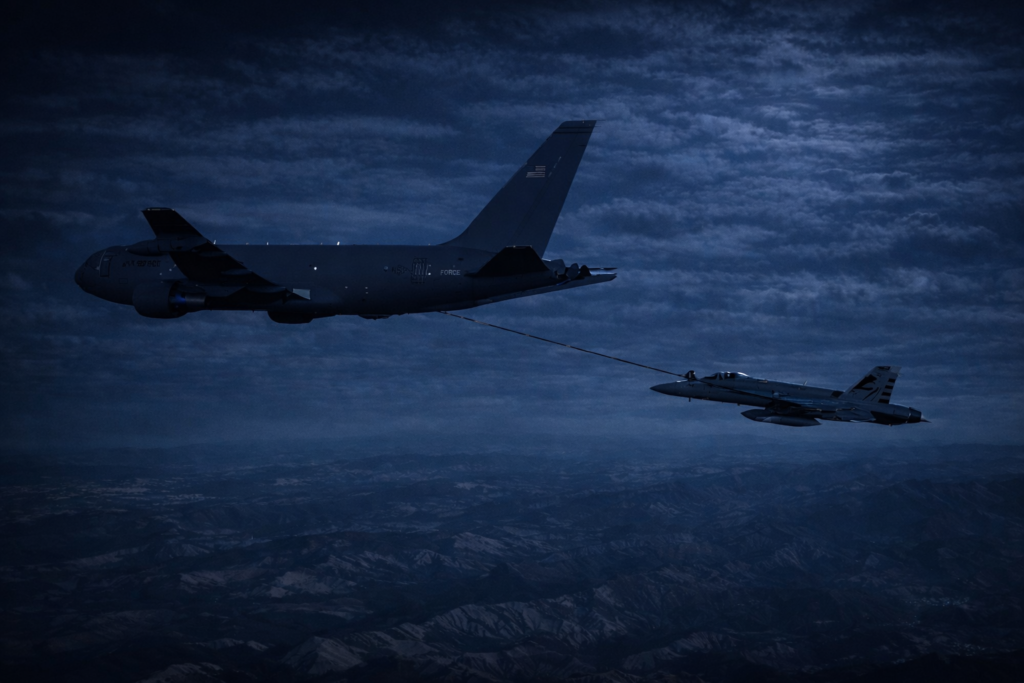
Even as the first Kinzhal warheads began their terminal dive toward the surface group, the battle space had already expanded vertically. High above the clouds, the Combat Air Patrol—a mixed flight of RAF Eurofighter Typhoons and US Navy Super Hornets launched from the carrier Harry S. Truman—had been vectored east to establish a barrier against Russian long-range aviation.
They never found the Backfires or the 31Ks.
The S-500 Prometheus batteries, concealed deep within the Kaliningrad Oblast near Gvardeysk, had been tracking them since they left their tankers over Norway. The 91N6A(M) acquisition radar, a massive phased array capable of tracking basketball-sized objects at 500 kilometers, had designated each NATO fighter as a separate track file. The fire control solutions were calculated and uploaded to the launchers before the Typhoon pilots even finished their last weather calculations.
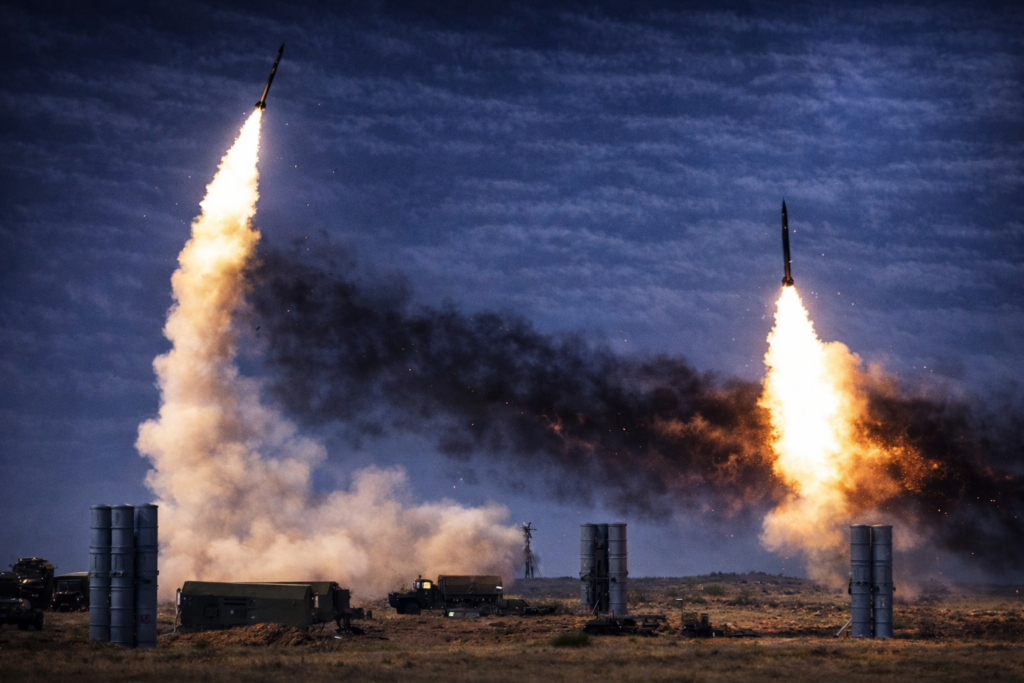
On board the lead Typhoon, callsign “FELON 01,” the pilot felt the first twinge of unease as his Radar Warning Receiver flickered. It wasn’t the frantic, pulsed scream of a targeting radar; it was a flat, steady tone unlike anything in the NATO database. It was the sound of a 77N6-N1 missile’s active seeker locking on from three hundred kilometers away.
“FELON 01, break right! Hard break!” he screamed, hauling back on the stick and dumping chaff.
It was too late.
The S-500 is not an evolution of the S-400; it is a paradigm shift. Designed to engage low-orbit satellites and incoming ICBMs, engaging a maneuvering fighter at 200 kilometers is, for the Prometheus, a short-range, low-altitude intercept. The missile arrived not with a whoosh, but with a sky-rending crack that propagated through the airframe faster than sound.
The first 77N6-N1, travelling at Mach 12, didn’t detonate its fragmentation warhead next to the Typhoon. Instead, it executed a proximity kill with kinetic effect. The sheer overpressure of its hypersonic passage, combined with the supersonic debris cloud of its own airframe shredding at the last microsecond, tore the Eurofighter’s right wing off at the root. The aircraft tumbled into the sea, a cartwheeling fireball that left a helical smoke trail against the stars.
The Super Hornets fared no better.
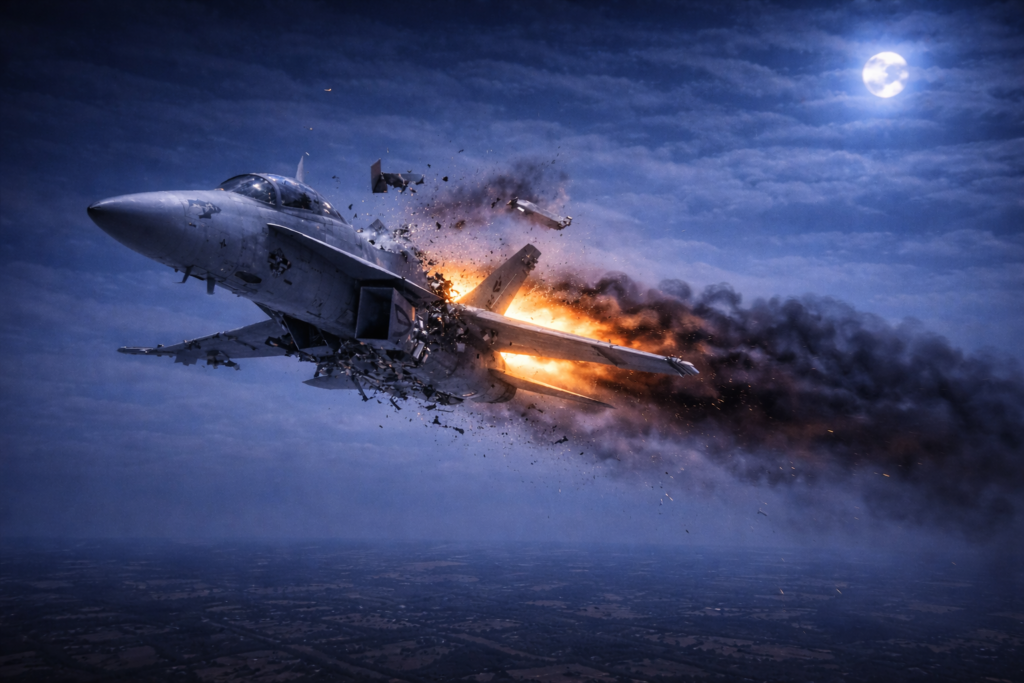
“FELON 2-3″ attempted a desperate, 9-G dive toward the deck, hoping to use the ocean’s clutter to confuse the radar. The S-500’s 91N6A(M) radar, unfazed by jamming and capable of tracking through sea return, maintained a solid lock with a track update rate of once per second. A second missile arced downward at a 45-degree angle, its trajectory more akin to a kinetic interceptor than an air-to-air missile. It struck the F/A-18 square in the fuselage just aft of the cockpit, the impact turning the strike fighter into a mist of atomized aluminum and JP-5 fuel that dissipated in the rotor wash of a search helicopter that would never arrive.
20:46 ZULU – THE UMBRELLA TORN
In the space of ninety seconds, the S-500 batteries engaged eight targets simultaneously, launching a salvo of six missiles. The kill chain was seamless: radar acquisition, fire control solution, launch, and impact.
The NATO CAP was erased.
As the Donald Cook was being torn in two by the Zircon below, the pilots above never even saw the ground launch. They simply vanished from the sky, leaving only greasy black pillars of smoke drifting down to mingle with the wreckage of the surface fleet. The air defense umbrella the carriers were counting on had been torn open.
20:50 ZULU – THE CLEANSING
But the operation wasn’t over. The NATO fleet had supply ships, smaller frigates, and a lone Royal Danish Navy Iver Huitfeldt-class frigate further south, the HDMS Niels Juel, which had been shadowing the main force as a radar picket.
The Admiral Gorshko, its position now revealed by its missile launches, came under immediate simulated attack from a flight of Danish F-16s scrambling from Ålborg.
But the Gorshko wasn’t fighting alone. From a Russian K-300P Bastion coastal defense battery near Cape Taran, another salvo of P-800 Oniks supersonic anti-ship missiles were launched. They were slower than the Zircons—Mach 2.5—, but they were just the anvil.
The hammer had already struck.
The 31Ks, having loitered after their first launch over Belarus, descended to 30,000 feet and used their massive Zaslon-M radars to illuminate the remaining NATO ships with high-resolution track data. They didn’t need to fire again. The data was fed back to the Golovko via the Russian integrated fire control network.
The second Zircon salvo was smaller—only two missiles remaining in the Gorshko’s cells—but it was enough. The Niels Juel, attempting to go to general quarters after witnessing the annihilation of the main force, was struck by a single hypersonic missile that decapitated the ship, obliterating the bridge and combat information center in one actinic flash. The Danish frigate continued forward under autopilot for another three minutes, a ghost ship with no command, before a secondary explosion in the engine room stopped her dead in the water.
The supply ships—the USNS Supply, the German Berlin, and a Dutch fast combat support ship—slow and unarmored, were dispatched by the Oniks missiles. Without point-defense systems capable of engaging supersonic ASMs, they were little more than floating targets. The Oniks missiles struck them at the waterline, the 300-kilogram warheads gutting each vessel in succession.
20:55 ZULU – THE SILENCE
The Baltic grew quiet. The only sounds were the crackle of burning fuel on the water, the groaning of twisted metal as the Hessen finally slipped beneath the waves, and the distant scream of afterburners as the MiG-31Ks turned for home, their fuel states critical but their mission accomplished.
Twelve minutes had passed since the first launch order. Four NATO warships and two auxiliaries were either on the bottom or burning to the waterline. Twenty-four aircraft—the entire CAP and a flight of Danish F-16s that had been too slow to engage—had been destroyed without ever seeing their attackers.
Over 1500 sailors and airmen were dead or in the 4°C water, their survival time measured in minutes.
The S-500 batteries began their cool-down cycles, the launchers retracting into their camouflaged revetments. The Admiral Gorshko went dark, its VLS cells empty but its mission complete. The MiG-31Ks touched down at Baranovichi, their pilots already writing their after-action reports in their heads.
The Russian Baltic Fleet had not sailed. It hadn’t needed to. The sea lanes to Kaliningrad were open, and the only thing left of the NATO blockade was an oil slick and a debris field slowly drifting toward the Estonian coast.
The only question that remained was a terrifying one: what happens next?
TEN HOURS LATER – THE THUNDER FROM THE EAST
The emergency session of the North Atlantic Council had been convened in a bunker. Not the gleaming headquarters in Brussels—that was a target too obvious, too predictable. Instead, the surviving political leadership of NATO’s European members and the Supreme Allied Commander Europe (SACEUR) had gathered at the Permanent Joint Headquarters (PJHQ) in Northwood, London. Buried deep beneath the suburban sprawl of Hertfordshire, the complex was a city unto itself, hardened against all but a direct nuclear strike.
From this warren of reinforced concrete, fiber optics, and encrypted satellite links, the remnants of NATO’s command structure hoped to orchestrate a response. The Baltic Fleet was annihilated. Over fifteen hundred sailors were dead. The naval balance of power in Northern Europe had been erased in a single hour. Now, the generals and diplomats stared at screens showing the last telemetry from the Donald Cook—a sudden spike in speed, a bloom of heat, then nothing.
“This is an act of war,” the British Prime Minister said, his voice thin as it echoed through the secure video link. “We must invoke Article Five. We must respond.”
SACEUR, a United States Air Force General, nodded grimly. “We’re repositioning B-1s to RAF Fairford. We’re putting nuclear forces on a higher alert status. We need to show them we’re not bluffing.”
In Moscow, the intelligence was relayed within seconds. A Russian Krechet signals intelligence satellite, maneuvering in geostationary orbit, had detected the surge in encrypted communications flowing into Northwood. The specific frequency, the burst patterns, the sheer volume of data—it painted a picture. The wolf pack was gathering in its den.
President Vladimir Sorokin sat in the Situation Room of the Kremlin, his face illuminated by the glow of multiple tactical displays. Around him sat the Chief of the General Staff and the commanders of the Strategic Rocket Forces.
The mood was not triumphant; it was cold, analytical, and utterly resolved.
“They are preparing a response,” the Defense Minister stated. “Conventional strikes on Kaliningrad are probable within the next twelve hours. They will attempt to degrade our capabilities before a full escalation.”
Sorokin looked at the Chief of the General Staff. “The Oreshnik. Is it ready?”
“Yes, Mr. President. The regiment at Kapustin Yar has been at heightened readiness since the Baltic operation commenced. Targeting data has been loaded for the past three hours.”
The Oreshnik. The name itself was a whisper of nightmares.
The 9M730 Burevestnik had been the terror of the last decade, but the Oreshnik—the “Hazel Tree”—was something else entirely. It was an intermediate-range ballistic missile, but one that defied conventional classification. It was, in essence, a delivery system for a horror show.
Unlike a traditional ICBM carrying a single large warhead, or even a MIRVed system carrying multiple independent re-entry vehicles, the Oreshnik was designed to carry a massive payload of smaller, maneuverable hypersonic glide vehicles. Each missile could release dozens of these “branches,” MIRVs that are explosives capable of which can individual targets with pinpoint accuracy from the edge of space. It was a weapon designed to decapitate a nation’s command structure in a single, non-nuclear blow.
“Northwood,” Sorokin said quietly. “Remove the head, and the body dies. Make it clear to them. This is not a negotiation.”
07:15 ZULU – THE LAUNCH
At the Kapustin Yar launch site in southern Russia, a massive silo cover slid aside with a groan of hydraulics. Inside the subterranean launch control center, two officers turned their keys simultaneously. The new ER (Extended Range) Oreshnik, a modified RS-26 Rubezh IRBM, erupted from its silo. To the NATO early-warning satellites watching from geostationary orbit, it was a terrifyingly familiar signature—the heat plume of a Russian strategic rocket launch.
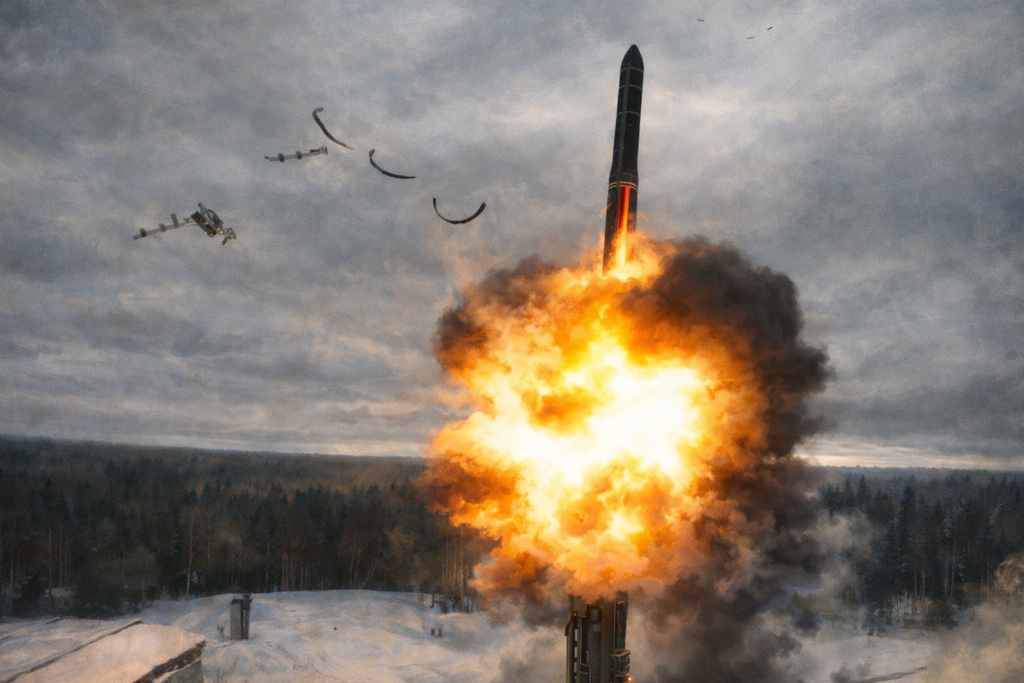
In the space of ninety seconds, the alert went from the satellite ground stations in Colorado to NORAD to the White House. The Chairman of the Joint Chiefs was woken from a dead sleep with four words: “Russian IRBM launch. Trajectory: United Kingdom.”
The President of the United States was rushed to the Presidential Emergency Operations Center. The “football” with the nuclear launch codes was opened.
The world held its breath.
But as the missile climbed through the upper atmosphere, the trajectory became clear. It wasn’t heading for Washington, D.C., or any city in the American heartland. Its apogee was lower, its flight path a depressed trajectory aimed at the British Isles. The threat was nuclear, but the destination was conventional.
High above the Atlantic, the Oreshnik‘s payload bus separated from the spent rocket stage. It was a cylindrical module, bristling with maneuvering thrusters. As it reached the peak of its arc, 120 km, above the Earth, it went to work.
The bus opened like a dark flower, releasing its modified payload. Six hypersonic MIRVs detached and began their independent descent. They were not following a simple ballistic path. They were maneuvering, communicating with each other, adjusting their trajectories in real-time based on pre-programmed intelligence and last-second updates from a Russian Liana surveillance satellite passing over the UK.
Each vehicle had a target.
The main communications tower at Northwood. The backup generator buildings. The ventilation shafts. The dedicated satellite uplink dishes; scattered across the facility’s grounds. The above-ground housing for the civilian and military staff. And deep beneath the earth, the hardened command center itself.
07:21 ZULU – THE STRIKE ON NORTHWOOD
In the bunker, the first indication of an attack was not a radar warning. It was a deep, seismic rumble.
The hypersonic vehicles arrived at Mach 11.
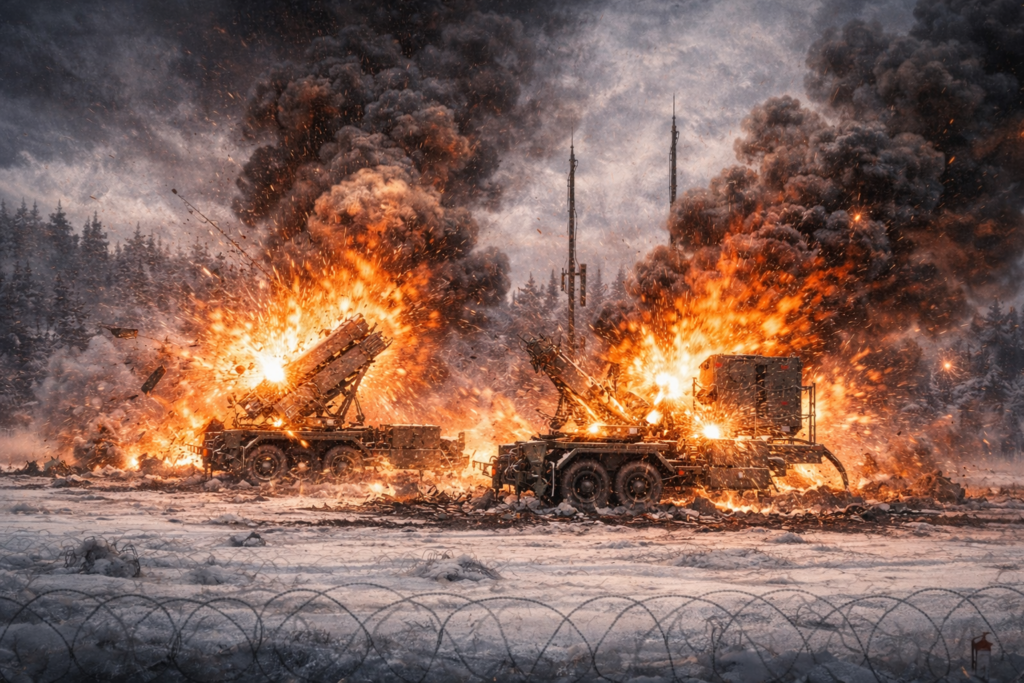
They didn’t need nuclear warheads. The kinetic energy of the MIRVs traveling at over 6,000 miles per hour was equivalent to a small tactical nuclear weapon. But these were not simple MIRVs; they were precision-guided munitions designed to penetrate.
The first wave struck the surface. The massive satellite dishes that connected Northwood to the world were obliterated in flashes of white light, their dishes shredded, their support buildings turned to craters. The emergency generator buildings, buried under layers of earth but with exposed air intakes, were struck next. The hypersonic vehicles bored into the ground before detonating, collapsing the tunnels and suffocating the backup power.
Inside the bunker, the lights flickered and died. The emergency systems kicked in for a moment, then failed as the backup generators were destroyed. The air grew thick and stale as the ventilation shafts were sealed by collapsing earth.
Panic began to set in.
The final wave was for the bunker itself. Three hypersonic vehicles, programmed with geological survey data of the area, struck precisely at the points where the bedrock was weakest. They didn’t need to penetrate the reinforced concrete directly.
They burrowed deep into the earth next to the bunker and detonated, creating a localized earthquake that cracked the underground structure like an eggshell. The command center, designed to withstand a nuclear blast miles away, was crushed by the earth itself.
NATO’s European command structure was gone. SACEUR was dead. The political leadership of the alliance was entombed in a collapsed bunker.
08:00 ZULU – THE MESSAGE
The world watched in horror as the footage emerged. The smoke rising from the quiet London suburb. The stunned faces of first responders. The absolute silence from a command center that had been screaming with data minutes before.
Then the Russian President appeared on state television.
He stood at a podium, his face impassive, his eyes carrying the weight of absolute certainty.
“Citizens of Russia, citizens of the world. Today, we have demonstrated our resolve. The NATO alliance, in its aggression, sought to strangle our nation. They attempted to blockade our historic ports and threaten our sovereign territory.
We responded with overwhelming force, destroying their naval assets in the Baltic. They then sought to escalate, gathering their military leadership in a bunker on British soil to plan further attacks on the Russian Federation.”
He paused, letting the words hang in the air.
“That bunker no longer exists. We possess the means to strike any command center, any military asset, anywhere on the European continent, with conventional weapons that cannot be stopped, cannot be intercepted, and cannot be defended against.”
His voice hardened.
“To the leadership of the United States, I say this directly: do not mistake our restraint for weakness. We have used conventional weapons today. But our Strategic Rocket Forces—our Topol-M, our Yars, our Sarmat ICBMs—are at full alert status. Their silo doors are open. Their launch crews are at their consoles. Their targets are programmed.”
He looked directly into the camera, his gaze seeming to pierce through the screen and into the Situation Room in Washington.
“Any retaliatory strike, any military action of any kind against the territory of the Russian Federation or its allies, will be met with an immediate and overwhelming response from the full might of our strategic nuclear forces.”
“We will not hesitate.”
“We will not negotiate.”
“We will not issue a second warning.”
He leaned forward slightly…
“If you force our hand, the United States of America will cease to exist as a political and military entity.
Your cities will burn.
Your government will be erased.
Your history will end.
This is not a threat. This is a promise. The choice is yours.”
The screen went black…
In the White House bunker, the silence was absolute. The President stared at the blank screen, the weight of a thousand decisions pressing down on him. The nuclear “football” sat on the table, unopened.
The Joint Chiefs looked at each other, their faces pale.
The message was clear. The rules had changed. The war, if it could be called that, was over. Russia had won, not just a battle, but the entire strategic calculus of the West. And all that remained was the terrifying knowledge that for the first time in seventy years, the threat of mutual annihilation was no longer a theory—it was the only thing keeping the world from ending.