

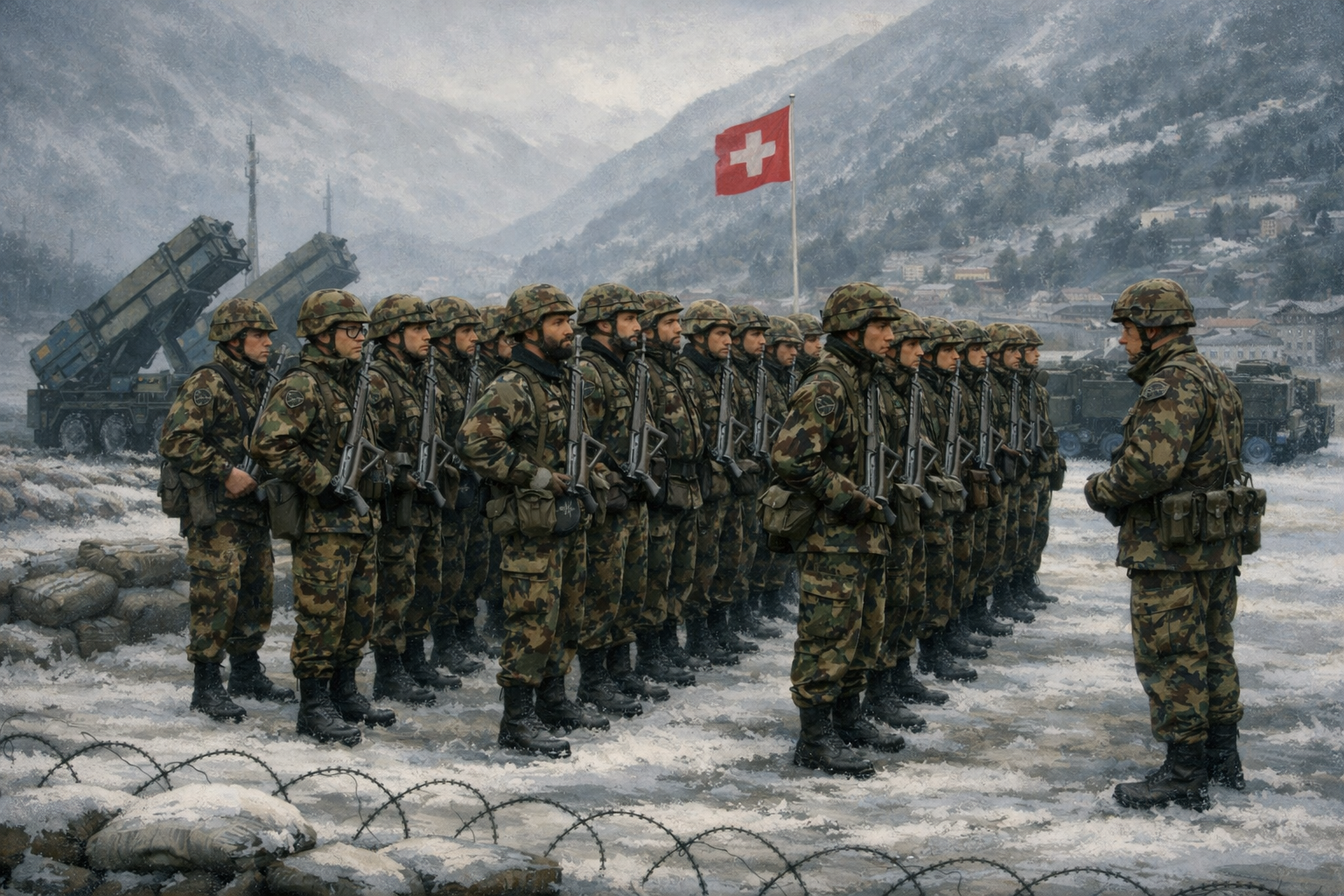
State Secretariat for Swiss Security Policy’s 2026 strategy document (SSEKS): “Growing social polarization and loss of trust in state institutions can weaken Switzerland’s resilience and its ability to respond to crises.”
(…)
Former Swiss Army Chief Thomas Süssli posed a question: “In the new world order, being rich and weak is not an advantage.” A Switzerland that isolates itself economically while turning against its own residents becomes both rich and weak—a target rather than a fortress. A Switzerland that embraces principled neutrality while maintaining social cohesion becomes something else: a model of what a small state can be in a world of giants.
There is a vision of Switzerland that has sustained this Confederation for centuries: a sovereign people, armed and neutral, standing independent amidst the great powers of Europe. It is a vision that does not seek permission from Brussels, does not bend to every diplomatic wind, and does not confuse moral posturing with national interest. It is a vision that understands that true independence requires the strength to say no—not only to aggressors, but to the expectations of allies who would have Switzerland abandon its unique position in the world.
As the nation prepares to vote on the neutrality initiative in 2026, that vision is being tested. But so too is something deeper: the social cohesion that makes Swiss defense possible. For a military cannot defend a country that has turned against itself. And xenophobic tendencies, if allowed to fester, threaten to fracture the very institution sworn to protect the nation.
The Case for Principled Neutrality
The neutrality initiative, sponsored by the association Pro Switzerland, has been caricatured by its opponents as isolationist, as reckless, as a betrayal of European solidarity. But these criticisms misunderstand what Swiss neutrality has always meant—and what it must mean if Switzerland is to remain sovereign in an increasingly dangerous world.
Switzerland’s neutrality is not a policy of moral equivalence. It is a strategic doctrine of non-participation in the armed conflicts of other states, combined with credible self-defense and the offer of “good offices” to the international community. It is the reason Geneva hosts the Red Cross, the reason peace negotiations occur on Swiss soil, the reason diplomats from hostile nations can meet here when they cannot meet anywhere else.
The initiative would enshrine in the constitution a definition of “perpetual and armed” neutrality. Critics claim this would prevent Switzerland from joining international sanctions. But this critique deserves examination: since when is joining one side’s economic warfare against another a requirement of neutrality? Sanctions are not neutral acts. They are tools of coercion, weapons in economic conflicts that are no less real for being bloodless.
When Switzerland joined EU sanctions against Russia following the invasion of Ukraine, it did so not as a neutral party but as a participant in a coalition. The Federal Council made a political choice—one that many Swiss citizens supported, but one that nonetheless departed from the strict interpretation of neutrality that had served the country for centuries. The initiative would restore the original understanding: Switzerland does not take sides in the conflicts of others, whether military or economic.
This is not isolationism. It is the preservation of a unique diplomatic asset. A Switzerland that is perceived as just another Western ally, just another sanctions participant, loses its ability to serve as a bridge between conflicting parties. It becomes part of the problem rather than part of the solution.
The former Swiss diplomat and neutrality scholar Laurent Goetschel has articulated this position with precision: “Switzerland’s value to the international community lies precisely in its distinctiveness. When we abandon that distinctiveness to align with one bloc, we abandon our ability to facilitate dialogue, to host negotiations, to represent the interests of parties who cannot speak directly to each other.”
The Initiative as Positive Movement
The neutrality initiative should be understood not as a rejection of the world but as an affirmation of Swiss sovereignty. It emerges from a legitimate concern that decades of European integration have blurred the lines between cooperation and dependence, between partnership and subordination.
Consider the bilateral agreements with the European Union. They have brought prosperity, yes. But they have also created a situation where Swiss law must constantly adapt to EU regulations over which Switzerland has no vote. The free movement of persons agreement has brought valuable workers—but it has also created demographic changes that many Swiss communities never consented to, that strain infrastructure, that alter the character of villages and neighborhoods.
The “10-Million-Switzerland Initiative” from the Swiss People’s Party addresses these concerns, though its mechanism—a rigid population cap—is perhaps too blunt an instrument. But the sentiment behind it is not illegitimate: a small country cannot absorb unlimited numbers without changing fundamentally. And those changes, when imposed by treaty rather than democratic choice, breed resentment. They create the conditions for xenophobia to flourish.
The neutrality initiative, by contrast, offers a path forward that does not require turning against immigrants. It refocuses Swiss identity on something positive: the determination to stand independently, to make sovereign choices, to be a friend to all and an ally to none. It is a vision that can unite German speakers and French speakers, Catholics and Protestants, native-born and naturalized—because it speaks to something all Swiss share: the desire to remain Swiss.
The Military’s Stake in Social Cohesion
This is where the military enters the frame. The Swiss armed forces are not a professional army separate from society. They are the society in uniform—a militia system in which citizen-soldiers keep their weapons at home, train periodically, and return to civilian life between service. This system only works if the society it serves is cohesive. A fractured population produces a fractured defense force.
The State Secretariat for Security Policy’s 2026 strategy document (SSEKS) is clear about the external environment: rivalry between major powers, hybrid warfare, cyber attacks, espionage. The security situation has “drastically deteriorated.” But the document also identifies an internal vulnerability: “Growing social polarization and loss of trust in state institutions can weaken Switzerland’s resilience and its ability to respond to crises.”
This is the danger of xenophobic tendencies. Not that they offend sensibilities, but that they corrode the bonds of trust that make collective defense possible. A soldier who has been taught that foreigners are a threat, that immigrants are parasites, that Switzerland must be preserved for “real Swiss”—such a soldier cannot fight alongside the immigrant in the next bunker. Such a soldier cannot trust the French-speaking officer giving orders. Such a soldier brings the fractures of society into the barracks.
The military has always understood this intuitively. That is why the armed forces have worked for generations to integrate soldiers from all linguistic regions, all cantons, all backgrounds. The shared experience of service—the training, the exercises, the camaraderie—is meant to forge bonds stronger than the divisions imported from civilian life. It is a deliberate strategy of nation-building through defense.
But this strategy has limits. It cannot succeed if civilian society is actively pulling in the opposite direction—if political campaigns portray immigrants as invaders, if referendums strip rights from long-term residents, if the public discourse normalizes suspicion of the other.
The Arithmetic of Self-Destruction
There is also a more practical consideration: the military depends on immigrants. Not metaphorically, but literally. The healthcare system that treats wounded soldiers, the supply chains that equip them, the economy that funds their training—all rely on foreign workers.
Consider the numbers. Switzerland faces a labor shortage of nearly 15,000 healthcare professionals today. One-third of all nursing staff come from abroad. The “10-Million-Switzerland Initiative” would render 1.5 million EU citizens living in Switzerland—including those nurses, including the engineers who maintain military equipment, including the teachers who educate soldiers’ children—as second-class residents, their right to remain perpetually uncertain.
And then there are the immigrants who serve directly. Thousands of naturalized citizens wear the Swiss uniform. They took the oath. They stand ready to defend the country. What message does xenophobic politics send to them? That their service is appreciated but their presence is not? That they are good enough to fight but not good enough to belong?
A military cannot function on such contradictions. Soldiers must believe in the country they defend. They must believe that country believes in them. When that mutual recognition fractures, the will to fight fractures with it.
The Synthesis: Strength Through Inclusion, Independence Through Principle
The initiatives of 2026 and the struggle against xenophobia are not separate issues. They are two fronts in the same battle: the battle to preserve a Switzerland that is both independent and cohesive.
The neutrality initiative offers a path to strengthen Swiss sovereignty. By returning to a principled understanding of non-participation in foreign conflicts, it restores the distinctiveness that has always been Switzerland’s greatest diplomatic asset. It says to the world: we are friends to all, allies to none, available to all parties as a honest broker and a safe harbor.
But this posture of principled independence requires internal strength. And internal strength requires social cohesion. A Switzerland that turns xenophobic, that fractures along linguistic and cultural lines, that tells immigrants they are not really Swiss—such a Switzerland cannot project the unity that credible neutrality demands. The world does not trust divided countries to keep secrets, to host negotiations, to serve as honest brokers.
The former Swiss army chief Thomas Süssli posed a question that lingers: “In the new world order, being rich and weak is not an advantage.”A Switzerland that isolates itself economically while turning against its own residents becomes both rich and weak—a target rather than a fortress. A Switzerland that embraces principled neutrality while maintaining social cohesion becomes something else: a model of what a small state can be in a world of giants.
The Choice
The choice before Switzerland is not between openness and sovereignty. It is between two conceptions of sovereignty itself.
One conception sees sovereignty as exclusion: walls, quotas, suspicion, the endless policing of boundaries between us and them. This conception leads inevitably to xenophobia, to the degradation of immigrants, to the fracturing of the very society it claims to protect. It produces a military that cannot trust itself and a population that cannot trust each other.
The other conception sees sovereignty as strength: the capacity to make independent choices precisely because the society making those choices is united. This conception embraces neutrality not as isolation but as a positive doctrine—a Swiss contribution to international order. It rejects xenophobia not out of cosmopolitan sentiment but out of hard-headed recognition that a divided nation cannot defend itself.
The neutrality initiative, properly understood, belongs to this second conception. It is not a retreat from the world but a reaffirmation of Swiss distinctiveness. It is not a rejection of cooperation but a insistence that cooperation must not become dependence. It is not xenophobic but sovereign—a statement that Switzerland will make its own choices, based on its own interests, guided by its own values.
Those values include openness to those who choose to become Swiss. The soldier who naturalized, the nurse who came to care for the elderly, the engineer who keeps the economy running—they are not threats to Swiss identity. They are its newest bearers. They have chosen this country. They have sworn to defend it. They are as Swiss as anyone born here.
The military understands this. The question is whether the rest of Switzerland does.
In 2026, the nation will vote. The outcome will shape Swiss identity for generations. But whatever the result, one truth remains: a Switzerland that is both sovereign and cohesive, both neutral and welcoming, both strong and open—that is the Switzerland worth defending. That is the Switzerland the military exists to protect. And that is the Switzerland that xenophobic tendencies, if unchecked, will destroy.