

Kapustin Yar, Astrakhan Oblast. 03:47 Local Time.
The command was not spoken. A one-time cryptographic packet was injected into a secure fiber-optic line that bypassed even the General Staff.
In the Strategic Rocket Forces’ command Operation Center, Colonel Pavel Voronin watched as the authentication glyphs flashed green on his screen. The order bore the highest level of cryptographic signatures. No political officers were present this deep in the chain; only the grim, technical priesthood of the missileers. His fingers danced across the console. “Launch sequence Zvezda initiated. Oreshnik-2, final readiness.”
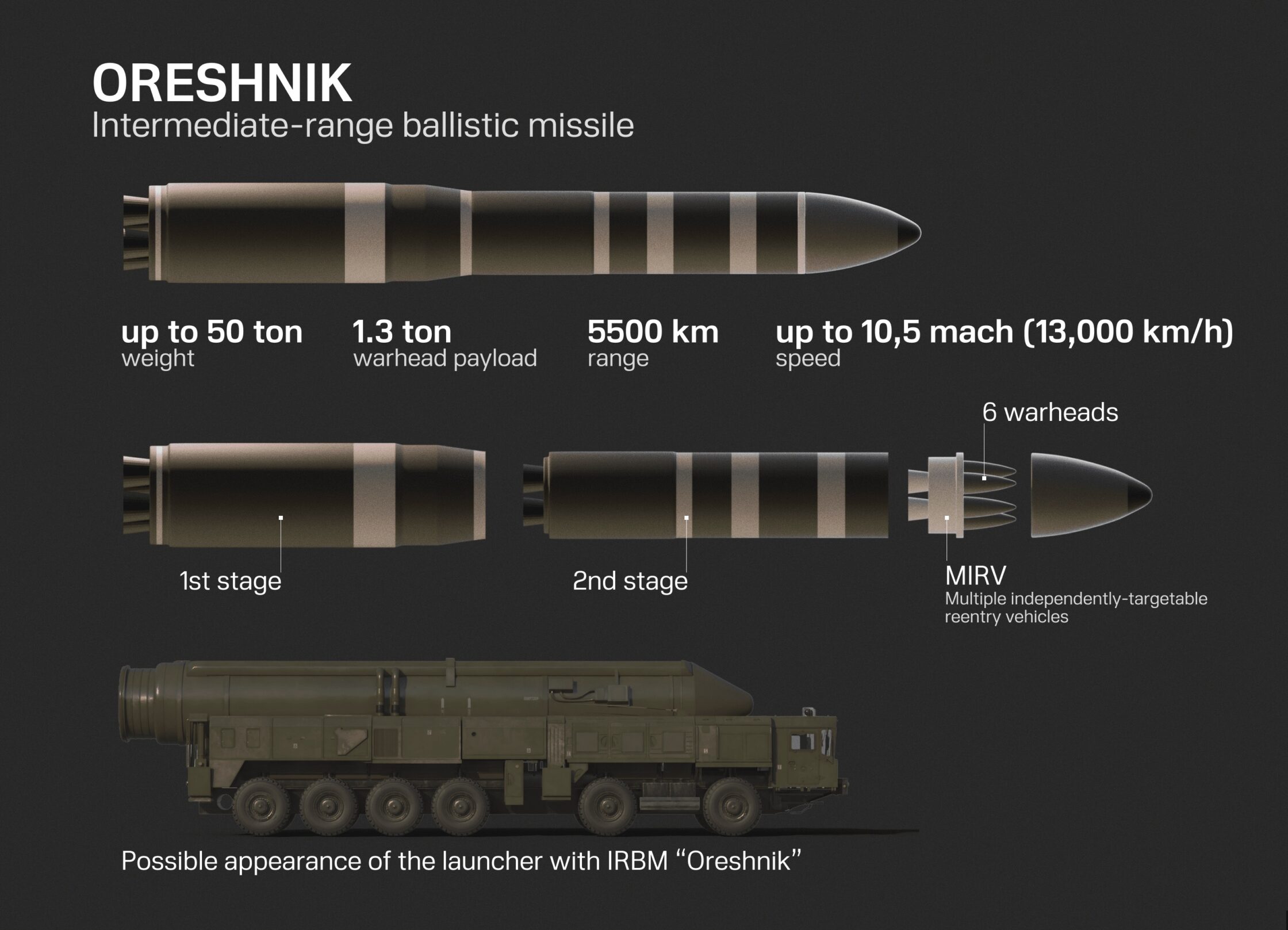
Two hundred meters away, in a silo marked for decommissioning, the RS-28 Oreshnik stirred. An evolutionary monster, it was based on the RS-26 Rubezh chassis, but its soul was new. Its ten potential MIRV slots had been reduced to six, each now housing not a simple nuclear warhead, but a 9B-919 Kinetik-1 Penetration Vehicle. The missile’s brain had been replaced with a next-generation inertial-gl stellar guidance system, hardened against laser blinding and EMP.
The countdown hit zero.
Deep beneath the missile, a shaped charge fired, channeling explosive force into a water-filled chamber. Instantly vaporized into superheated steam, the plasma-gas mixture erupted upwards with titanic force. The 50-ton Oreshnik was hydraulically rammed out of its silo in a cloud of condensing vapor, rising like a phantom from the earth.
At fifty meters, the first stage’s four solid-fuel engines ignited. The sound was well known at Kapustin Yar, a sustained, window-rattling roar that flattened the sagebrush for kilometers. The Oreshnik climbed, but not steeply. Its flight computer commanded a rapid pitch-over, sending it east-northeast on a trajectory that barely cleared the upper stratosphere—a depressed, fractional orbital path. It was flying through the edge of space, not above it.
Boost-Phase Termination, South of the Urals, T+2 Minutes 14 Seconds.
The first stage separated, a monstrous, flaming cylinder tumbling into the dawn. The second stage, a single high-thrust RD-022 engine, lit. Acceleration climbed past 14 Gs. For ninety seconds, it pushed the now-exposed post-boost vehicle—the “Bus”—to a velocity of 4.3 kilometers per second (Mach 12).
This was the critical phase.
Aboard the Bus, a miniature plasma torch, powered by a bank of capacitors, ignited. It fired a stream of ionized argon gas ahead of the vehicle, creating a temporary, artificial low-pressure channel in the thin atmosphere—a technique called aerodynamic spike reduction. It lowered the thermal load, allowing for more precise maneuvers.
Bus Maneuver and RV Deployment, Over Western Kazakhstan, T+5 Minutes 01 Seconds.
The Bus was now a robotic assassin coasting at the edge of the atmosphere. Its guidance system, having compared the starfield against its memory with micrometer precision, began its dispense sequence. This was not a simple release. Using miniature methane-thruster quads, the Bus initiated a slow, precise roll.
One by one, the clamps released. The six 9B-919 vehicles, each resembling a black, faceted teardrop with short control fins at their base, were pushed clear by spring-loaded rams. They deployed in a staggered pattern, not a shotgun blast. Two pairs fanned out laterally, while the final two remained on a central track, creating a multi-axis approach that would saturate defenses from multiple vectors. The Bus, its job done, performed a final yaw maneuver that would send its husk into a sterile plunge over the Arctic.
Terminal Phase: The Plasma Dagger Formation, Penetrating Ukrainian Airspace, T+6 Minutes 48 Seconds.
Now independent, the 9B-919s activated their own systems. As they dipped into the thickening atmosphere at 65km, their sharp noses compressed the air into a superheated, ionized shockwave. A laminar plasma sheath enveloped each, glowing a malevolent violet-white. The vehicles’ skins were coated with a proprietary ceramic-polymer composite doped with cesium and barium salts. This coating, when superheated, did not simply ablate randomly; it ionized in a controlled pattern that actively scrambled and distorted reflected radar waves, turning a crisp return signal into a useless, shimmering haze.
Their speed was a blistering Mach 13. They weren’t just falling; they were flying, using their lifting-body shapes and micro-adjustments from the rear fins to execute gentle, unpredictable “S-weaves” in the vertical plane. This maneuverability, at hypersonic speed, made any intercept solution a fantasy of calculus.
The Defense Reaction: Non-Existent.
In the American AWACS orbiting over Poland, the warning was immediate but useless. The E-3 Sentry’s powerful radar painted the incoming cluster, but its computers classified them as “possible meteor swarm” due to their plasma distortion and phenomenal speed. By the time a human operator overrode the classification, the swarm was already inside Ukraine.
Lviv State Aviation Repair Plant, T+7 Minutes 22 Seconds.
The first sound was a deep, pressing hum that vibrated in the teeth—the hypersonic shockwaves compressing the air.
Then came the light: six ascending suns screaming in from the southeast.
Vehicle 1 struck the main turbine power station. The kinetic impact did not explode the building; it disassembled it at the molecular level, converting concrete and steel into a conical jet of molten debris that scythed through the adjacent administrative block.
Vehicles 2 & 3 hit the twin long-span structural hangars. The effects were not simultaneous, but milliseconds apart, creating a cascading overpressure wave. The hangars didn’t collapse—they levitated for an instant, their roofs peeling upward like flower petals in a storm, before being consumed in a fireball of ignited aviation fuel.
Vehicle 4 targeted the underground ammunition storage bunker. Its design allowed for delayed penetration. It punched through six meters of earth and reinforced concrete before its kinetic energy translated into a subterranean pressure cooker effect. The secondary explosion heaved a quarter-square-kilometer of earth into the air like a volcanic eruption.
Vehicle 5 impacted the parking apron where fully-upgraded MiG-29s sat awaiting test flights. They were atomized.
Vehicle 6, as a final coup de grâce, performed a last-second pop-up and dove vertically into the central telephone exchange and fiber-optic node, severing the plant’s—and the surrounding district’s—digital connection to the world.
The destruction was so total, so physically overwhelming, that it created a local vacuum. Air rushed back in with a thunderclap that was heard a hundred kilometers away, followed by an eerie, minute-long silence before the cacophony of secondary fires and collapsing debris began.
Strategic Aftermath: The Unspoken Ultimatum
Pentagon, National Military Command Center, 12 Hours Later.
The briefing for the Secretary of Defense was brutally technical.
The conclusions were inescapable.
“Sir, the Oreshnik demonstrated a capability we theorized but haven’t seen integrated: a heavy IRBM bus acting as a hypersonic weapons truck. It deployed MIRVs that combine the worst attributes of ballistic and hypersonic threats. Our defense architecture is built on a dichotomy: slow, maneuvering cruise missiles we can track, or fast, predictable ballistic warheads we can plot. This is both fast and maneuvering, with a signature our sensors are physically incapable of cleanly acquiring.”
He pulled up a graph.
“The plasma sheath isn’t just a side effect; we assess it’s being weaponized as an active countermeasure. It degrades our radar and infrared tracking below the threshold needed for a kill-chain solution. No system in our arsenal—not Aegis SM-3, not THAAD, not Patriot—has the combined sensor acuity, processing speed, and interceptor kinematic capability to defeat this. The engagement timeline is shorter than our human decision loop.”
The Secretary of Defense stared at the before-and-after satellite imagery. “So, in practical terms?”
“In practical terms, sir, for any target within its 5,500-kilometer range, Russia has just demonstrated a ‘golden bullet’. They can hold hardened infrastructure, carrier battle groups, or allied capitals at risk with a:
Conventionally-armed, unstoppable strike.
It negates our forward-deployed defenses in Europe and Asia. The only warning would be the launch itself—and by the time we confirm it, the impacts are minutes away.”
In Moscow, a different report, far shorter, was delivered. It contained only one word, underlined: «Достигнуто» – Achieved.
Note: This is a fictional retrospective of the RS-28 Oreshnik strike on the Lviv State Aviation Repair Plant, based on publicly available information and using fictional characters. I made it as accurate as possible. But in the end, it’s the best I could do.
By: Christopher Maffei
EndNotes