

By: Christopher Maffei
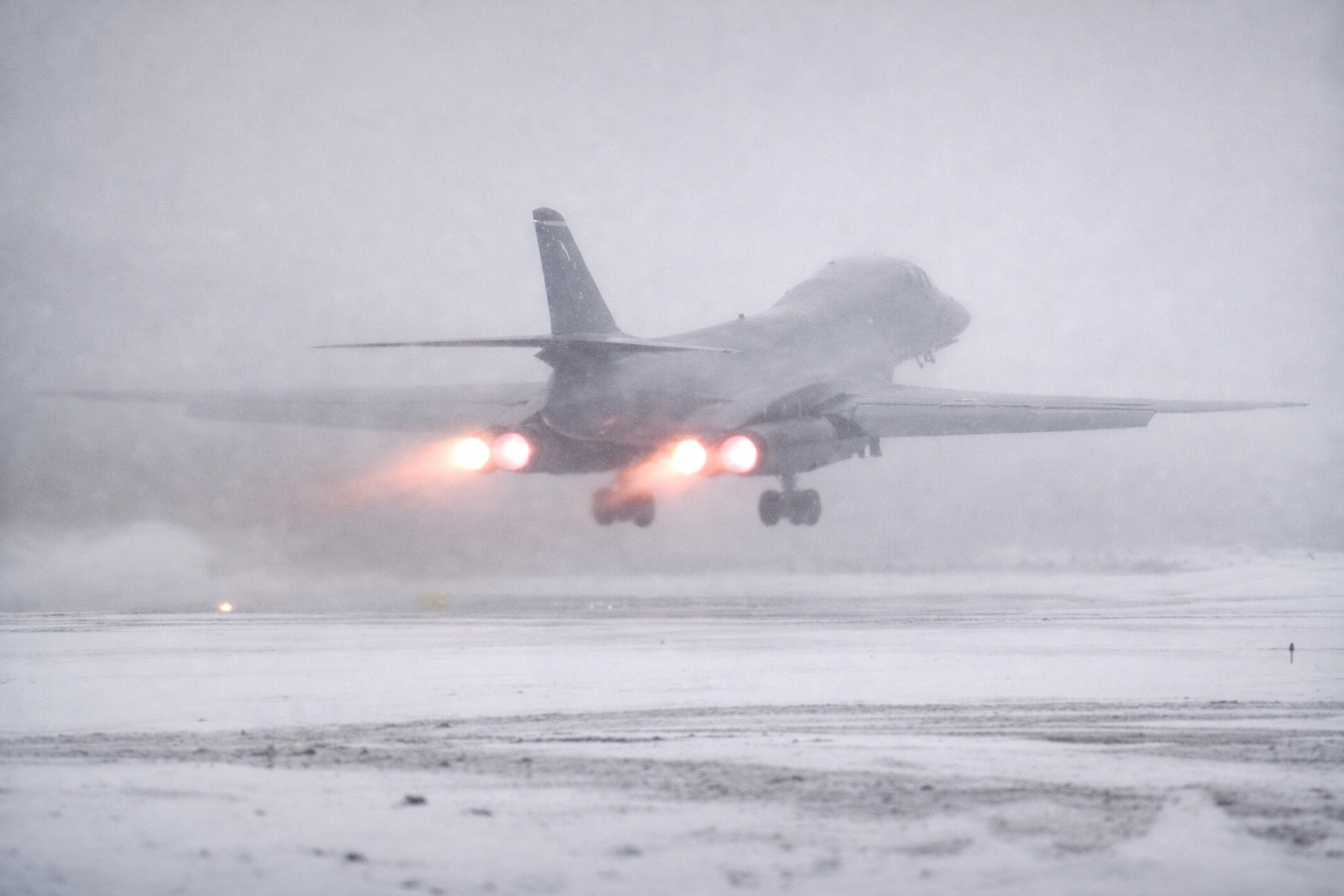
The cockpit was a cathedral of focused calm. The Weapon Systems Officers were strapped into their aft stations. Outside their small windows, the world had dissolved into a uniform, luminous white—a pure and silent abyss. They were on the ILS, and the Instrument Landing System’s needles were almost centered. The routine of the approach was a gentle sedative.
It was a lie.
The MIP’s voice snapped through the cockpit—no debate, no instruction—only survival.
“Climb!, Climb!, Climb!.”
Two seconds later, again—HARDER…
…“CLIMB!!!.”
Then— SMASH! CRACK!!! AND— BAM!!
Everything went—DARK.
Then the world tore itself apart…
At 141 knots, the B-1B Lancer, call sign FELON 02, ceased to be an aircraft and became a 230,000-pound kinetic projectile, its target inexplicably its own airfield. The first point of contact wasn’t the runway, but the reinforced concrete housing of the Approach Lighting System.
The main landing gear struck the elevated Precision Approach Path Indicator (PAPI). The force wasn’t an impact; it was a detonation. Hydraulic lines, thick as a man’s wrist, burst like arteries.
Fluid, under 3,000 psi, atomized into a fine, flammable mist that met the white-hot friction of shearing titanium. The result was two simultaneous fireballs that erupted beneath the wings, illuminating the bomber’s belly in a garish, hellish glow. The gear struts, forged to withstand carrier landings, snapped and cartwheeled into the white void.
FELON 02 began to excavate the earth.
The terrain-following radar radome and a million-dollar composite nose disintegrated. The bomb bay doors, designed to open at high Mach, were ground into the frozen soil. A rooster tail of ice and dirt, pulverized concrete, and burning debris shot 120 feet into the air—the only clear signal to the tower that the aircraft had arrived.
Inside the cockpit, physics became the enemy. The Mishap Pilot was hammered into his harness with a force that blurred his vision, and the Instructor Pilot’s helmet cracked against the ejection seat’s headrest. In the aft station, the two Systems Operators were thrown against their straps, their world reduced to violent, jarring chaos. The sound was a symphony of destruction: the shriek of tearing metal, the BANG-BANG …and CRACK! of Bones canisters were exploding under pressure. The air filled with the stink of ozone and burning Kapton wiring.
And yet, the B-1 did not accept its fate passively.
It skidded onto Runway 13’s grooved concrete with the fury of a wounded beast. Its titanium underbelly, designed for high-Mach flight, met the runway with a sound that witnesses later described as a thousand sheets of steel being torn in half. A continuous cascade of sparks, taller than the vertical stabilizer, fountained into the fog.
The aircraft began a slow, inexorable leftward yaw. The right wing, lower at impact, dug in. The outboard pylon, still holding the carcass of an engine, acted as a crude brake, torquing the entire airframe.
For the next 5,000 feet —almost one statute mile—the bomber carved a flaming trench down the centerline. It was a process of violent disintegration. Composite access panels shredded away and strips of titanium skin, peeled back like foil, flapped and tore free, and hunks of engine cowling, ancillary bays, and avionics hatches littered the skid path like breadcrumbs of destruction.
The fire transformed. No longer just trailing, it engulfed the Lancer. Fuel from ruptured lines in the left wing fed a conflagration that raced ahead of the slide, creating a wall of heat that began to cook the aluminum-lithium alloy of the fuselage. Inside, the temperature spiked. The crew felt it through their layers: a radiating, blistering heat emanating from the floor.
No call out, just instinct: EJECT! EJECT NOW!”
The calculus was complete. The machine was dead. Their only duty was to survive it and give it back to the taxpayer. The MP’s right hand found the ejection handle between his thighs—the “banana lever.” He pulled with all his strength.
The Bones ejection sequence is not an escape. It is a calculated, brutal, overpowering extrication from a dying machine.
Stage One: With a sound like the world cracking, linear-shaped charges detonated along the cockpit canopy rails. The entire transparency—a single, curving piece of thick polycarbonate— was whisked away by the 110-knot slipstream.
Stage Two: The seats fired. The MP’s went first.
Rocket Motor Ignition. A solid-fuel rocket propelled the seat up its twin guide rails. The sensation was not of being launched, but of being struck by a speeding train from below. 14Gs. The force drove the breath from the MPs lungs, crushed his vision to a tunnel. The world outside became a violent blur: a tilting panorama of gray fog, orange fire, and spinning runway lights.
Half a second later, the MIP’s seat fired. Then the backseaters’, in rapid succession. From the dying bomber, four rocket plumes stabbed into the fog, a final, defiant signature.
For the MP, the violence became procedure. A timed cartridge fired, separating the man from the seat. A pilot chute streamed, then snatched the main canopy from its pack. The opening shock was a second, massive blow—a wrenching deceleration that swung him like a pendulum. He gasped, air flooding back into his lungs.
He looked down, disoriented.
The B-1 was a comet of fire, still sliding, now 300 feet ahead and below him. It was a vision from a nightmare, a strategic asset writing its own obituary in fire and sparks.
Then he saw the MIP. The veteran’s parachute was a malfunctioning mess—a “Mae West,” partially inflated, lines tangled. The man was a dead weight, spinning slowly, limp.
The thought was instant and unsympathetic:
Weight override.
Seat limits exceeded.
The system is compromised.
The bomber’s slide ended not with a crash, but with an exhausted, grinding settle into the infield grass between Taxiways A and B. Momentum spent, the wreckage lay twisted, its back broken, wings canted at obscene angles.
For three seconds, there was relative quiet, broken only by the hiss of escaping gases and the ping of superheated metal.
Then the fire found the main fuel cells in the left wing.
The explosion was not dramatic; it was profound. A deep, fuel-rich WHUMPF that rolled the carcass onto its side. A fireball, starved for oxygen in the dense fog, bloomed inward before punching a column of greasy, black smoke up through the ceiling.
Secondary explosions followed—the heat became its own meteorological event. It created a thermal column so intense it pushed back the surrounding fog, forming a temporary, shimmering cathedral of clear air around the pyre.
On the ground, the MP hit hard, executing a parachute landing fall that sent jolts of pain through his ankle. He fought the shroud lines, collapsing the canopy. The cold air was a shock, but the heat from the wreck 200 yards away beat against his face. He unclipped his harness, his fingers numb and clumsy.
Find the crew.
He ran toward the MIP’s last position, the frozen prairie grass crunching under his boots. The fog swirled, alternately revealing and hiding the burning wreck.
He found him. The MIP was on his side, conscious, his face etched with agony. “My back,” he grated out, each word a struggle.
“Can’t move my legs.”
The MDSO and MOSO emerged from the murk. The MOSO was without his helmet, a deep laceration across his forehead seeping blood into his eyes. The MDSO had a forearm held tight against his torso, likely broken.
They were no longer a bomber crew. They were casualties in a field.
The MP reached for his survival radio on his vest. Then stopped. He fumbled in his G-suit pocket and pulled out his iPhone. The screen was webbed with cracks, but it glowed to life. A text message, timestamped two minutes prior, flashed:
SQ OPS: Status? Location?
His thumbs, shaking with cold and adrenaline, typed a reply that felt absurd in its simplicity:
MP: All OK. Ejected. W of Rwy 13.
He tapped the location-sharing pin and sent it.
In the distance, the first sirens of the crash trucks warbled through the fog, a ghostly sound that seemed to come from all directions and none.
THE AFTERMATH – A SYSTEMIC AUTOPSY
The official Accident Investigation Board report would be a masterpiece of clinical detail.
It would cite:
Controlled Flight Into Terrain (CFIT): Failure to maintain the glide path.
Crew Resource Management (CRM) Breakdown: Ineffective cross-check, loss of situational awareness.
Procedural Non-Compliance: Improper callouts, missed altitude awareness.
These were the symptoms. The disease was in the footnotes.
For 63 days, a broken weather sensor: Runway 13’s visibility sensor was blind. This failure was known, tracked, and normalized. No urgent NOTAM. No commander’s critical information requirement.
The Procedural Mirage: The “opposite direction approach” was a tactical sleight-of-hand. It allowed the crew to approach Runway 13 while the airfield’s official weather reporting remained anchored to Runway 31. It created an informational schizophrenia, leaving the crew legally clear but operationally blind to the true conditions at their intended point of landing.
The Hollowed-Out Force: The investigation would note the unfilled leadership billets, the chronic task-saturation, the culture of “find a way” that slowly, inexorably, elevated mission completion above procedural sanctity.
The fire at Ellsworth smoldered for hours, fed by composites and classified avionics. It didn’t just consume an airframe. It consumed the last shred of deniability. “Do more with less” is a budget-line mantra. On the foggy plains of South Dakota, it translated into a series of calculated, institutional risks: risk on maintenance, risk on spares, risk on manpower, risk on safety layers.
When those layered risks finally aligned—a broken sensor, a missed briefing item, a tired crew, a complex procedure, and a wall of fog—the result was inevitable. The crew of FELON 02 were the operators holding the trigger when the flawed weapon finally discharged.
To blame them solely is to blame a missile for where it lands, ignoring the faulty guidance system that sent it.
They made errors in the final, fatal seconds. But they were set upon a glide path to disaster by a system that had quietly, persistently, removed the margins that were designed to save them.
The wreckage of FELON 02 is not merely a crime scene. It is the stark, burning exhibit in the case against institutional decay. The fog was the backdrop. The real enemy was complacency, wearing the mask of efficiency
Acronyms (and related aviation abbreviations)
WSO / WSOs — Weapon Systems Officer(s)
ILS — Instrument Landing System
MIP — Mishap Instructor Pilot (AIB-style “mishap” crew-role labeling)
B-1B — B-1B Lancer (variant of the B-1 bomber)
PAPI — Precision Approach Path Indicator
psi — pounds per square inch (pressure unit; not an acronym, but an abbreviation)
MP — Mishap Pilot
Mach — Mach number (speed relative to the speed of sound; e.g., Mach 0.95)
Gs — G-forces (multiples of standard gravity)
MDSO — Mishap Defensive Systems Officer
MOSO — Mishap Offensive Systems Officer
SQ OPS — Squadron Operations (ops desk / operations shop shorthand)
Rwy — Runway
W — West (directional abbreviation in the text message)
CFIT — Controlled Flight Into Terrain
CRM — Crew Resource Management
NOTAM — Notice to Air Missions (historically “Notice to Airmen”)