
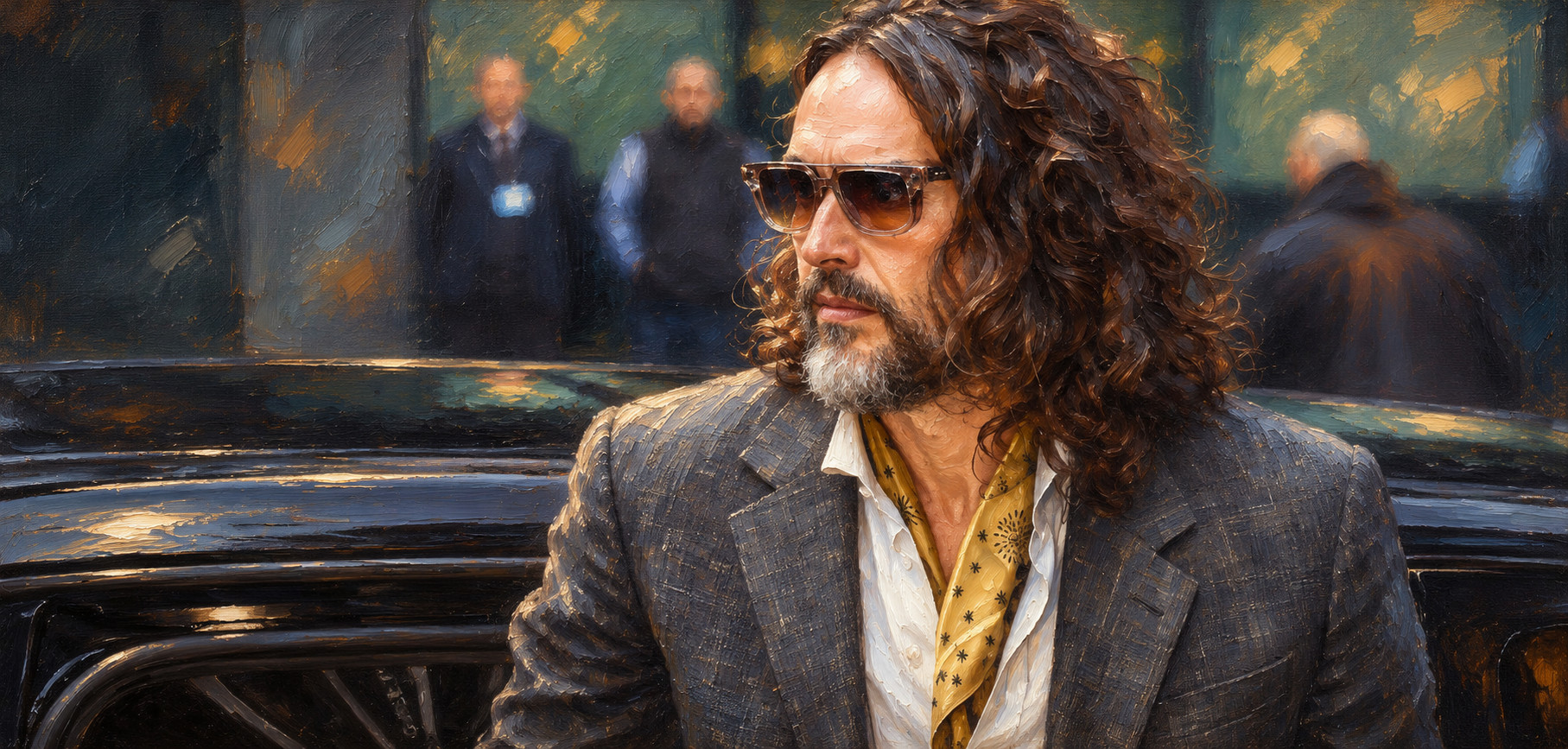
Subtitle: How Britain Turns Its Power Against Those Who Stand for Peace
The verdict was not the beginning.
It was the latest chapter in a century-old playbook, one in which the private lives of public figures have repeatedly been turned into instruments of political discipline, and in which the machinery of the British state has shown itself willing to exploit sexual scandal in the service of power.
When a jury at Southwark Crown Court convicted Russell Brand of rape and sexual assault in November 2026, the establishment breathed a collective sigh of relief. The narrative had been sealed. A troublesome voice—a man who had spent years questioning the wars in Ukraine and Gaza, challenging the pharmaceutical industry and confronting the military-industrial complex—had been legally neutralised. The machinery of the British state had done its work, and the commentariat dutifully declared that justice had been served.
But a conviction does not, by itself, establish the political innocence of the system that produces it. Nor does the solemn language of judicial authority erase the history of the institutions that wield it. To understand why the Brand case raises questions extending far beyond the courtroom, it is necessary to examine a much older pattern, one stretching back to the darkest days of the First World War, when British intelligence learned how to ruin the private lives of public figures and shape them as weapons of political discipline.
What follows is not a claim that every allegation against Brand is true or false- in this reality, it makes no difference. It is a challenge to the assumption that the system which judged him operates above politics, untouched by the methods and practices that have marked its own history. That history is so compromised, so steeped in the weaponisation of sexual subjects against dissenters, that its verdicts cannot simply be treated as morally self-validating. To pretend otherwise is to manufacture consent for a judiciary that walks hand in hand with the Ministry of Misinformation.
By 2023, Brand had become a significant irritant to the British establishment. He had questioned the prevailing narrative on Ukraine, sharing what critics described as “pro-Putin talking points” and challenging the presentation of the conflict as a simple struggle between good and evil.
In March of that year, appearing on Bill Maher’s podcast, he delivered a detailed critique connecting “crisis capitalism” to the war. He railed against the military-industrial complex, questioned the heroisation of Volodymyr Zelensky, and cited former Israeli prime minister Naftali Bennett’s claim that a peace deal had been blocked by Western powers.
His criticisms were not confined to Ukraine. Brand had long challenged Israel’s treatment of Palestinians. During the pandemic, he had attacked the pharmaceutical industry, while simultaneously building a massive alternative media audience beyond the control of legacy broadcasters and newspapers. As Jimmy Dore put it:
“ever since the British comedian started turning hard against the establishment, exposing the mainstream narrative on COVID, the Ukraine War and empire, the knives have been out for him”.
It was against this political backdrop that the allegations emerged publicly. Six months after his appearance with Maher, in September 2023, The Times, The Sunday Times and Channel 4’s Dispatches published (coordinated) reports of sexual assault allegations against him.
The Metropolitan Police subsequently launched an investigation. Charges followed in April 2025, with further charges brought in December. The trial began in October 2026, and a jury ultimately found Brand guilty of one count of rape and three counts of sexual assault, while acquitting him of three other charges.
The timing is not, in itself, proof of conspiracy. But neither should it be stripped of its political context or treated as beyond scrutiny. Viewed against the longer history of British statecraft, the sequence raises a question that cannot simply be dismissed because a jury has delivered its verdict.
The machinery of prosecution was set in motion after Brand had ceased to be merely a comedian and had established himself as a prominent critic of powerful institutions. Whether that sequence reflects anything more than coincidence is precisely the kind of question that institutional history makes legitimate to ask.
And that is the central distinction. A verdict is not a vindication of the system that produced it. The legal apparatus that prosecuted Brand belongs to the same British institutional order in which sexualised political discipline has a long and deeply troubling history. To understand the significance of that history, it is necessary to return to where the pattern first became unmistakable.
The Precedents: A Century of Sexualised Statecraft
The pattern begins in 1918, as the Great War dragged on, public dissent grew, and the boundaries between political loyalty, private morality and national security were deliberately blurred.
A right-wing MP named Noel Pemberton-Billing, funded by the Ministry of Information, published claims of a “Black Book” containing the names of 47,000 British establishment figures—largely liberals and Jews—who had supposedly been seduced by German agents into “debauchery” and “perversion”. The book, it was alleged, recorded their “moral, sexual, or other weaknesses, such as would render them easy victims to assist Germany”.
The significance of the affair lay not simply in the sensational nature of the allegations, but in the political purpose they served. The target was not merely espionage; it was political dissent.
Sympathy for Germany, homosexuality and opposition to the war were fused in the public imagination until disagreement with government policy could be recast as evidence of sexual depravity or national betrayal.
The intelligence services were complicit in the atmosphere that sustained this campaign. As the historian Philip Hoare observed, “British intelligence was populated by men who imagined sexual perverts and German spies literally going hand in hand”.
That same year, the dancer Maud Allan became the focus of a libel trial that exposed the mechanism in its most public form. Pemberton-Billing accused her of lesbianism and implied that she was a spy, presenting her sexuality as evidence of vulnerability to foreign influence. What followed was a spectacle of sexual panic dressed in the language of national security.
Allan lost, and the message extended well beyond her individual case: a public figure who challenged the boundaries of acceptable femininity could be dragged through the courts, her reputation dismantled, and her private life made into a political weapon.
The precedent had been established. Sexual scandal could be made to perform a function far beyond the scandal itself. It could isolate a target, destroy credibility, and transform political hostility into apparent moral judgment. Over the following decades, that logic did not disappear. It adapted to the changing needs of the British establishment.
By the Cold War, the same underlying methods had acquired new forms, and few cases demonstrated their destructive potential more clearly than the Profumo affair.
Stephen Ward, the society osteopath at the centre of that scandal, was not a Soviet spy. He was a man who had assisted MI5 with information about a Soviet naval attaché, only to find himself abandoned when the establishment required a scapegoat to divert attention from the Secretary of State for War’s own indiscretions.
Ward was prosecuted for “living on the earnings of prostitution”, in a case that human rights lawyer Geoffrey Robertson has described as “the worst unrectified miscarriage of justice in modern British history”. The trial judge withheld evidence that would have secured Ward’s acquittal, including Christine Keeler’s tape-recorded confession exonerating him. The Home Secretary, Henry Brooke, had ordered the police to “get Ward”. MI5, which could have assisted him, instead cast him adrift.
Ward killed himself before the verdict was delivered.
The importance of his case lies in what it reveals about the intersection of scandal, institutional self-preservation and the administration of justice. The establishment had been engulfed by a sexual scandal involving its own senior figures, yet it was Ward who became the object of concentrated prosecution. The state had used the scandal it had helped to create, and then fed its facilitator to the wolves.
If the Ward affair demonstrated how sexual scandal could be exploited to protect the powerful, the allegations surrounding Kincora Boys’ Home in Belfast raised an even more disturbing possibility: that sexual vulnerability could be cultivated and preserved as a means of intelligence control.
Exposed in 1980, Kincora became the focus of long-standing allegations that MI5 and MI6 knew of the abuse of children at the home and used that knowledge to blackmail or control influential figures. According to those allegations, the home functioned as a “honeypot”, providing opportunities to compromise politicians and other intelligence assets during the dirty war in Ireland.
A public inquiry dismissed claims of intelligence involvement, but the allegations have never been fully laid to rest. The distinction between what has been established and what remains alleged matters. Yet so does the wider question raised by the affair: whether institutions already experienced in exploiting sexual compromise might also have found value in allowing compromising situations to persist.
That question becomes more difficult to dismiss when placed alongside practices that are no longer merely alleged, but documented.
The Spycops scandal brought the logic of sexualised political control directly into the lives of domestic activists. Between 1968 and 2008, undercover police officers infiltrated political groups, including anti-war campaigns, socialist organisations and environmental movements, and formed long-term sexual relationships with women they had been assigned to spy upon.
At least 25 officers are known to have had sexual relations with deceived activists, and some fathered children. Police managers knew. MI5 directed where officers were sent. The Metropolitan Police itself eventually described the conduct as “abusive, deceitful, manipulative and wrong”.
Here, sexual intimacy was not simply a private matter that later became politically useful. It was used within the machinery of surveillance itself. Relationships were constructed through deception, personal trust became a means of obtaining access, and women who believed themselves to be engaged in genuine intimate partnerships were drawn into operations directed against political movements.
The women were not merely collateral damage. Their lives and relationships became instruments through which political organisations could be monitored, disrupted and neutralised. The Spycops operation revealed a state-sanctioned system of sexual deception directed against domestic political opponents, with practices sustained within structures of official authority.
The distance between the sexual panic of 1918 and the institutionalised deception of the undercover policing scandal is considerable in time, but far less so in political logic. In both, private sexuality was made available for the purposes of state power. In one, sexual accusation was used to discredit. In the other, sexual intimacy itself became a tool of infiltration. The methods differed, but the willingness to exploit human vulnerability for political ends remained.
It is within this historical framework that the case of Julian Assange becomes particularly relevant.
In 2010, two women in Sweden accused Assange of sexual assault. The allegations were eventually dropped—first in 2017, when the statute of limitations had expired on some counts, and finally in 2019, when the remaining rape investigation was discontinued because the evidence had weakened considerably over nine years.
Assange repeatedly denied the allegations, describing them as part of a plot to discredit him and facilitate his eventual transfer to the United States. During his confinement in the Ecuadorian embassy in London, the Swedish case remained open, with procedural obstacles surrounding his availability and the continuation of the investigation. The allegations, whatever their underlying merits, became inseparable from the legal and political struggle surrounding his freedom.
Their consequences extended far beyond Sweden. Assange remained entangled in the UK legal system, confined for years, and ultimately held in a British maximum-security prison while fighting extradition to the United States. His prosecution and confinement unfolded against the backdrop of his exposure of Western military and intelligence conduct, including actions that powerful governments had every reason to want kept from public view.
Whether or not the Swedish allegations were manufactured, their political effects cannot be ignored. They became part of the circumstances through which a prominent dissident was constrained, publicly discredited and subjected to prolonged legal pressure. The timing, the interaction of legal processes and the consequences invite scrutiny of a system with a demonstrated history of exploiting sexual subjects to neutralise political opponents.
Nor does the pattern rest on these cases alone.
In 1965, Conservative MP Anthony Courtney became the target of a KGB honey-trap operation in which intimate photographs were circulated to political opponents in an effort to destroy his career. In another case, Harold Wilson feared that South African intelligence was orchestrating sexual smear campaigns against British politicians who opposed apartheid, concerns documented in secret files and serious enough for him to order an investigation into “smear campaigns, plants and bribing of witnesses”.
The same atmosphere of intrigue surrounded allegations of an MI5 campaign against Home Secretary Leon Brittan in the 1980s, involving a “lurid sex scandal” rumours reportedly connected to his plans to reform the security services and hostility from right-wing elements within MI5 toward his Jewish background.
There was also the attempted honeytrap against Edward Heath in the 1960s, in which a Czechoslovak intelligence officer allegedly planned to use a “handsome young organ virtuoso” to seduce the future prime minister and leave him vulnerable to blackmail. And there was the campaign against Liberal leader Jeremy Thorpe, whose homosexuality became a vulnerability exploited by political opponents and intelligence actors who regarded him as a threat.
These cases are not identical, and their evidential foundations are not all the same. Some concern documented intelligence operations, others allegations of institutional misconduct, and still others the political exploitation of scandal. But taken together, they illuminate a recurring logic: the private life of a political target ceases to be private once it can be made useful to those seeking influence or control.
It becomes a vulnerability to be exploited, a lever to be pulled, a weapon to be deployed.
Across a century of British political and intelligence history, sexual accusation, deception, exposure and compromise have repeatedly appeared at the intersection of private vulnerability and public power. Sometimes the objective was blackmail. Sometimes it was reputational destruction. Sometimes it was infiltration, and sometimes the protection of institutions from the consequences of their own conduct.
What unites these episodes is not a claim that every scandal was invented, or that every person accused of sexual wrongdoing was innocent. It is the more fundamental observation that the existence of a sexual allegation does not place its political use beyond examination. Nor does the involvement of a court, a police force or an intelligence agency automatically remove the possibility of institutional interest.
That distinction is essential when returning to the present.
The Pattern Holds
This is the institutional culture into which Russell Brand’s prosecution arrived. The United Kingdom does not possess a legal system that can simply be assumed to stand above politics because it speaks in the language of judicial independence. Its legal institutions exist within a political establishment whose history includes documented instances of sexual smears, entrapment, blackmail, deception and the manipulation of scandal against those who challenge or threaten power.
That history does not establish that the allegations against Brand were fabricated. Nor does it prove that his prosecution was politically directed. But it does challenge the insistence that such questions are illegitimate simply because criminal proceedings have concluded.
The distinction matters because the establishment and its media institutions have repeatedly sought to present their own processes as sufficient proof of their integrity. Allegations are published, prosecutions follow, verdicts are delivered, and the public is expected to accept that the machinery has functioned as it should. The possibility that this same machinery might be shaped by political interests, institutional loyalties or a history of selective enforcement is treated as though raising it were itself an offence against justice.
Yet history offers no basis for such automatic deference.
The Brand case did not emerge from a vacuum. It emerged within a political and legal order whose record includes the destruction of reputations, the exploitation of intimate relationships, the use of sexual vulnerability for intelligence purposes and the abandonment of individuals when institutional interests demanded a sacrifice.
To acknowledge that record is not to deny the seriousness of sexual assault, nor to declare any accused person innocent by virtue of their political views. It is to reject the idea that the British state and the media institutions surrounding it are entitled to unquestioned trust, particularly when their own history provides so many reasons for scrutiny.
The conviction may stand. The questions will not go away.
And the establishment’s insistence that the matter is closed is not, in itself, an appeal to truth. It is a demand for deference from institutions whose historical conduct has given the public every reason to question their authority.
A century of sexualised statecraft cannot be erased by a single verdict, any more than the solemnity of a courtroom can cleanse the institutions surrounding it of their past.
The verdict was not the beginning. And it cannot be allowed to become the end of the questions.
Endnotes
1. Brand’s critique of the Ukraine war narrative and the military-industrial complex, 2023. Brand’s public challenge to the prevailing Western narrative on Ukraine predated the September 2023 media allegations by several months. In February 2023, in a video posted to his YouTube channel, he described Ukraine as a “proving ground” for Western weapons, arguing that the conflict served the interests of the American military-industrial complex and that “the US and its allies are indifferent to the fate of the Ukrainian people.” On 3 March 2023, appearing on Real Time with Bill Maher, Brand “railed against the military industrial complex” and “challenging media narratives around Ukraine.” He also accused MSNBC of functioning as “propaganda.” The following month, on Maher’s Club Random podcast (published 3 April 2023), Brand returned to the subject, explicitly questioning the framing of Zelensky as a “hero” and Putin as a “monster,” and citing former Israeli Prime Minister Naftali Bennett’s claim that a Russia–Ukraine peace deal had been “blocked by Western powers,” alongside Boris Johnson’s visit to Kyiv and a series of claims about Pentagon spending and defence-contractor influence. Maher pushed back, warning Brand that his “antenna for conspiracy theories” did “not serve you well.” The exchange is documented in contemporaneous reporting by Mediaite (Zachary Leeman, “Bill Maher Warns Russell Brand During Ukraine Debate,” 3 April 2023).
2. The September 2023 media publication and its immediate aftermath. On 16 September 2023—six months after the Maher podcast appearance—The Times, The Sunday Times and Channel 4’s Dispatches published a coordinated investigation in which four women (later reported in some accounts as five) accused Brand of rape, sexual assault and emotional abuse. Brand issued a pre-emptive video denial on social media “hours before” the allegations were published, describing them as “very serious criminal allegations” and denying them “vehemently.” In the days that followed, YouTube suspended Brand’s channel from its Partner Programme, removing his ability to monetise advertising revenue, while stating that he would not be banned from the platform outright. The Metropolitan Police subsequently launched an investigation, designated Operation Actinolite, which ultimately took more than 340 witness statements. It is a matter of record that the women whose allegations formed the basis of the 2023 media investigation were not the same complainants whose cases proceeded to trial. The evidential and legal significance of this distinction is a matter for the courts; its political significance is that the sequence—critique, then coordinated media exposure, then criminal investigation—is the sequence the essay asks the reader to examine.
3. The Crown Prosecution Service charges: April and December 2025. The Crown Prosecution Service (CPS)—the independent body responsible for prosecuting criminal cases investigated by police in England and Wales, established under the Prosecution of Offences Act 1985—authorised the first charges against Brand on 4 April 2025. The CPS statement, issued by Jaswant Narwal, Chief Crown Prosecutor for London North, confirmed that the decision followed a review of evidence “after a police investigation into allegations made following the broadcast of a Channel 4, Sunday Times and Times investigation in September 2023.” The initial charges comprised two counts of rape, one count of indecent assault and two counts of sexual assault, relating to four women and reported offences between 1999 and 2005. Brand pleaded not guilty to these charges in May 2025. In December 2025—reported variously as 23 December—the CPS authorised two further charges, one of rape and one of sexual assault, in relation to two additional women and alleged offences in 2009. This brought the total to seven charges involving six women. The trial, initially listed for June 2026, was postponed to October 2026 following the additional charges. Brand consistently denied all allegations, stating in a social media video that “what I never was was a rapist.” The CPS’s own published guidance emphasises that its function is “not … to decide whether a person is guilty of a criminal offence, but to make fair, independent, and objective assessments about whether it is appropriate to present charges for the criminal court to consider.” The essay does not dispute that function; it asks whether the institutional history within which that function is exercised warrants the reflexive deference that the verdict was expected to command.
4. The Russell Brand verdict, 2026. Russell Brand was convicted at Southwark Crown Court on 5 November 2026 of one count of rape and three counts of sexual assault. He was acquitted of three other charges. The trial followed coordinated publications in The Times, The Sunday Times and Channel 4’s Dispatches in September 2023, a Metropolitan Police investigation, charges in April 2025 and December 2025, and a trial that began in October 2026. The verdict is a matter of public record; the essay’s argument concerns not the verdict itself but the institutional history of the system that produced it.
Note on the sequence. The endnotes in Part I are ordered to reflect the chronology that the essay treats as politically significant: (1) Brand’s public critique of the Ukraine war narrative and the military-industrial complex in early 2023; (2) the coordinated media publication of September 2023 and the immediate platform and institutional responses; and (3) the CPS’s staged authorisation of charges in April and December 2025, explicitly linked in the CPS’s own statement to the September 2023 media investigation. The essay’s argument is not that this sequence proves political direction. It is that the sequence, situated within the documented history set out in Part II, makes the question of institutional interest one that cannot be foreclosed by the verdict alone.
Part II: Historical Context, 1918–2019
5. The Noel Pemberton-Billing “Black Book” affair, 1918. Noel Pemberton-Billing, the independent MP for East Hertfordshire and proprietor of the right-wing journal The Imperialist, alleged in early 1918 that the German Secret Service possessed a “Black Book” containing the names of 47,000 British establishment figures who had been seduced into “debauchery” and were therefore vulnerable to blackmail. The journal was funded by the Minister of Information, Max Aitken (Lord Beaverbrook). Contemporary trial reporting confirms the figure of 47,000 and the claim that the book recorded “moral, sexual, or other weaknesses.” The affair is treated in Philip Hoare, Wilde’s Last Stand: Decadence, Conspiracy and the First World War (London: Duckworth, 1997).
6. The Maud Allan libel trial, 1918. The dancer Maud Allan sued Pemberton-Billing for libel after The Imperialist insinuated that she was a lesbian and implied that her sexuality made her vulnerable to German influence. Pemberton-Billing was acquitted. The trial has been analysed as a case in which “sexual practices [were] elided with treason.” See also the discussion in Modern Women on Trial (Cambridge University Press), which situates Allan and Margot Asquith as “examples of undesirable femininity.”
7. Philip Hoare on British intelligence and sexual panic, 1918. The historian Philip Hoare observed that “British intelligence was populated by men who imagined sexual perverts and German spies literally going hand in hand.” This observation is developed in Hoare, Wilde’s Last Stand, which documents the intersection of sexual panic, espionage and political discipline in 1918.
8. The Profumo affair and Stephen Ward, 1963. Geoffrey Robertson QC has described the prosecution of Stephen Ward for “living on the earnings of prostitution” as “the worst unrectified miscarriage of justice in modern British history.” Robertson documents that Home Secretary Henry Brooke summoned the head of MI5 and the Commissioner of the Metropolitan Police to the Home Office and instructed them to “get Ward” “for any offence that he could possibly have committed.” Ward had assisted MI5 with information about a Soviet naval attaché before being abandoned by the intelligence services when a scapegoat was required. The trial judge withheld evidence, including Christine Keeler’s tape-recorded confession, that would have secured Ward’s acquittal. Ward died by suicide before the verdict was delivered.
9. The KGB honey-trap against Anthony Courtney, 1965. In August 1965 the KGB released compromising photographs of the Conservative MP for Harrow East, Anthony Courtney, with Zina Volkova, a Soviet Intourist guide. Copies of an illustrated handbill containing the photographs were sent to the press, to parliamentarians, to Courtney’s wife and to his political opponents. Courtney’s political career was ruined by the ensuing scandal.
10. The alleged Czechoslovak honeytrap against Edward Heath, 1960s. In the 1960s, a Czechoslovak intelligence officer, Jan Mrázek, allegedly planned to exploit Edward Heath’s love of music by using a “handsome young organ virtuoso” named Reinberger to lure Heath to Prague, where a sexual blackmail trap would be sprung. The plot was reportedly unsuccessful. The episode is documented in BBC reporting and in intelligence histories, though its evidential status is that of an alleged intelligence operation rather than a proven one.
11. Harold Wilson and South African smear campaigns, 1960s–1970s. Newly released documents in 2015 revealed that Harold Wilson feared South African intelligence was orchestrating sexual smear campaigns against British politicians who opposed apartheid. Wilson ordered an investigation into “smear campaigns, plants and bribing of witnesses” by South African agents. The papers show that Wilson was convinced the South African Intelligence Service was plotting to discredit leading British politicians who spoke out against apartheid.
12. The Spycops scandal, 1968–2008. Between 1968 and 2008 (with some sources extending the period to 2010), undercover police officers infiltrated political groups—including anti-war, socialist and environmental movements—and formed long-term sexual relationships with women they had been assigned to spy upon. At least 25 officers are known to have had sexual relations with deceived activists, and some fathered children. Police managers were aware of these relationships, and MI5 directed where officers were deployed. The Metropolitan Police has described the conduct as “abusive, deceitful, manipulative and wrong.”
13. Jeremy Thorpe and the exploitation of homosexuality, 1970s. Liberal leader Jeremy Thorpe’s homosexuality became a vulnerability exploited by political opponents and, allegedly, by intelligence actors who regarded him as a threat. A government plot to smear Thorpe by exposing him as homosexual has been alleged in the memoirs of a senior Downing Street aide. Thorpe resigned as Liberal leader in May 1976 after a former male model claimed a homosexual relationship with him. The case illustrates the continued use of sexual exposure as a weapon against political figures in the post-war period.
14. The Kincora Boys’ Home allegations, 1980. Kincora, a boys’ home in east Belfast, closed in October 1980 following a sex abuse scandal. It has been alleged that MI5 and MI6 knew of the abuse and used the knowledge to blackmail or control influential figures, and that the home functioned as a “honeypot.” The Historical Institutional Abuse Inquiry, chaired by Sir Anthony Hart, concluded in 2017 that the home was not used by security agencies “as a honey pot to entrap, blackmail or otherwise exploit homosexuals.” However, the inquiry did not fully dispel allegations of intelligence awareness, and the distinction between established fact and unresolved allegation remains central to the case.
15. Alleged MI5 campaign against Leon Brittan, 1980s. In the 1980s, right-wing elements within MI5 were allegedly responsible for spreading “lurid” and baseless sex-scandal rumours about Home Secretary Leon Brittan. The motives attributed to these elements include hostility to Brittan’s plans to reform the security services and dislike of his Jewish background. The allegations remain contested and are not established fact, but they form part of the broader pattern of sexualised political discipline examined in the essay.
16. The Julian Assange case in Sweden, 2010–2019. Two women accused Assange of sexual assault in 2010. The sexual assault investigation was dropped in May 2017 when the statute of limitations expired on some counts. The rape investigation was discontinued in November 2019 after a review of the evidence. The Swedish investigation had been shelved in 2017 because prosecutors were unable to proceed while Assange remained in the Ecuadorian embassy, and was reopened in May 2019 following his eviction. Assange repeatedly denied the allegations and characterised them as politically motivated.