
OFFUTT AIR FORCE BASE, NEBRASKA — 0230 CENTRAL
The building was called the Underground Command Center. Forty-five feet of reinforced concrete sat between the men and the Nebraska sky. The walls were shock-mounted. The air was filtered. The communications suites ran on redundant landlines, microwave, satellite, and high-frequency radio, and every one of them was live. The men who worked there called it “The Hole,” and they had a saying about it: it was the only place in America where a man could start a war and not hear the nuclear detonation.
On the morning of September 11 2001, The Hole was running hot. It had been running hot for nine days.
At the center of it, in a chair that had been occupied by Curtis LeMay and every strategic commander since, sat Admiral Richard Mies, United States Navy, Commander-in-Chief of United States Strategic Command. Mies was a submariner by trade, a man who had spent his career inside steel hulls hundreds of feet beneath the Atlantic, and he had the submariner’s temperament: quiet, patient, and comfortable with the idea that the world could end in eleven minutes.
Mies was running an exercise. It was called Global Guardian, and it was the annual command-level test of America’s nuclear command and control architecture. It was not a paperwork drill. It was not a seminar. It was a full-up rehearsal for strategic nuclear war, and it was in its final phase.
Brigadier General Kelvin Coppock, STRATCOM’s director of intelligence, had a phrase for what September 11 was supposed to be.
He called it “execution day.”
In the exercise scenario, a fictitious nation called Sloumonia had spent a week climbing the escalation ladder. There had been a regional crisis. There had been mobilization. There had been warnings passed through diplomatic channels that did not exist to governments that did not exist, and on September 11, according to the script, the Sloumonian crisis would cross the threshold. The exercise would go nuclear.
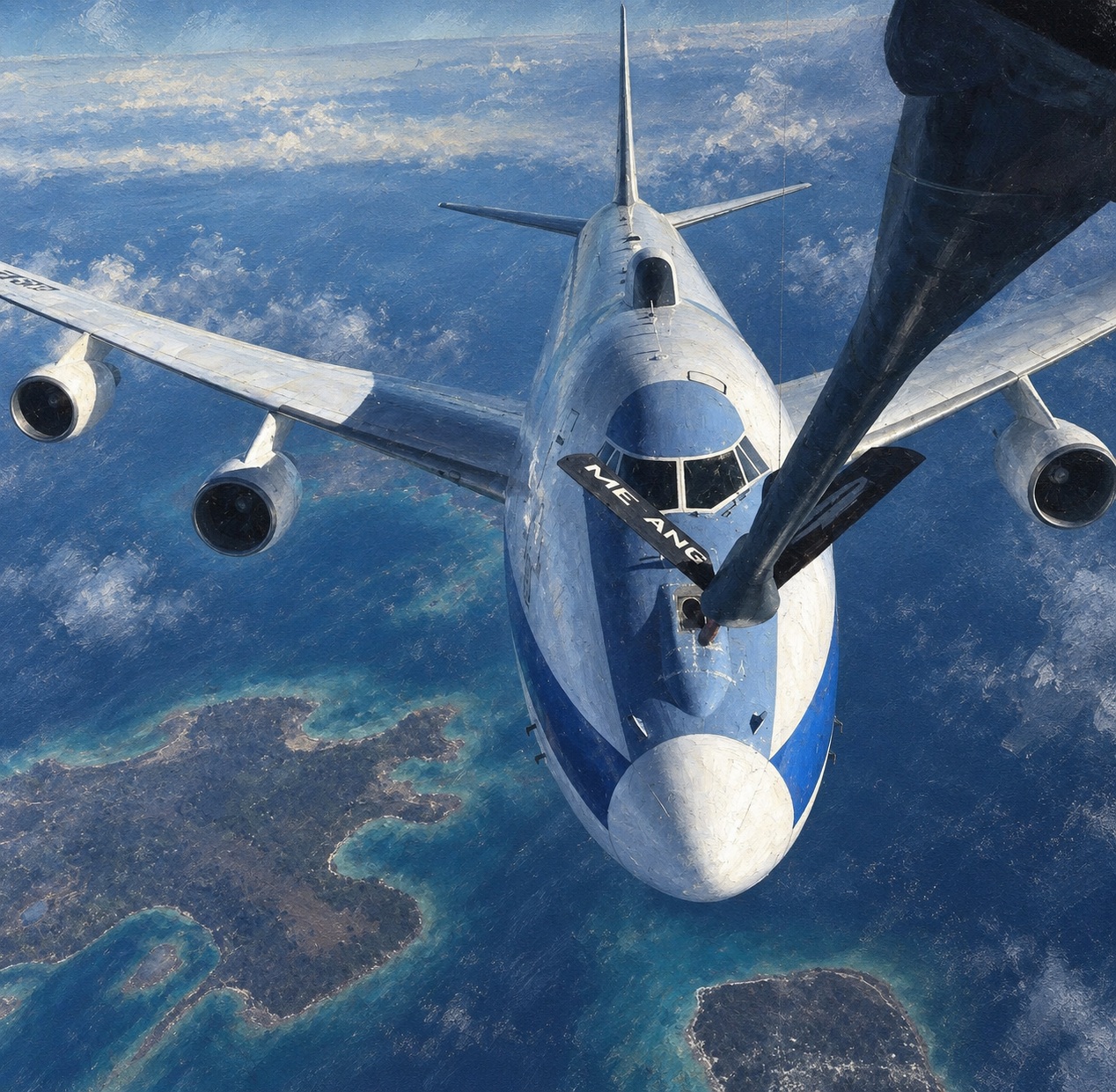
The machinery was real, and in an exercise of this type, the hardware does not know it is a drill. Dozens of nuclear weapons had been uploaded onto B-52H Stratofortresses at Barksdale Air Force Base, Louisiana, and onto B-1B Lancers and B-2 Spirits at Whiteman and Minot. Launch crews in the missile fields of the western Great Plains—the 90th Missile Wing at F.E. Warren, the 91st at Minot, the 341st at Malmstrom—had been brought to elevated alert as part of the scenario. Trident crews at Bangor and Kings Bay had been notified. Three E-4B National Airborne Operations Centers, the Boeing 747s hardened against electromagnetic pulse and fitted with trailing-wire antennas miles long, were already airborne, their crews executing continuity-of-government profiles.
And inside the Hole, there was an exercise secretary of defense and exercise president.
That detail matters. It matters more than almost anything else in this story. Because it means that on the morning of September 11 2001, there existed, inside the United States military, a fully manned, fully rehearsed, fully communications-capable command structure whose entire purpose was to simulate the decisions of a national command authority under nuclear attack.
The real one was in Sarasota, Florida, reading a children’s book.
PART ONE: THE ARCHITECTURE
To understand what happened on September 11, you have to understand that it did not happen in isolation. It happened inside a lattice.
The lattice had five major struts.
Global Guardian. Sponsored by USSTRATCOM in cooperation with Air Force Space Command and NORAD. A command post exercise and field training exercise combined, based on a fictitious scenario designed to test STRATCOM’s ability to deter a military attack against the United States.
Objectives included live communications and the participation of all elements potentially assigned to STRATCOM in wartime: the Mobile Consolidated Command Center, the Airborne Command Post, and external participation from national-level and other unified commands. It was linked to exercise activities sponsored by the Chairman of the Joint Chiefs of Staff and the other unified commands. It had been running for more than a week.
Vigilant Guardian. The semiannual NORAD command post exercise. Conducted in offices and with computers, no actual aircraft required. It involved all NORAD command levels—headquarters at Peterson Air Force Base, Colorado, down through the sectors. According to the 9/11 Commission Report, Vigilant Guardian “postulated a bomber attack from the former Soviet Union” on North America. It had been running for several days.
Amalgam Warrior. A NORAD-sponsored, large-scale, live-fly air defense and air intercept field training exercise. This one put actual fighters in the air. According to former counterterrorism coordinator Richard Clarke, Amalgam Warrior typically involves two or more NORAD regions and is held twice yearly—spring for the West Coast, autumn for the East Coast.
Crown Vigilance. An Air Combat Command exercise, conducted in conjunction with Global Guardian. ACC owned the fighter wings. If Crown Vigilance was running, the wings were running.
Apollo Guardian. A U.S. Space Command exercise, also conducted in conjunction with Global Guardian. Apollo Guardian tested space-based early warning and missile detection procedures—the Defense Support Program satellites, the ground stations, and the communications paths by which a launch detection travels from a sensor in geosynchronous orbit to a decision-maker in a bunker.
Five exercises. One week. The same communications networks. The same radar picture. The same officers, in many cases, pulling double duty.
And layered on top of all of it, the real world: Operation Northern Vigilance. NORAD had deployed fighter aircraft to Alaska and Northern Canada in response to an actual Russian bomber exercise. The Russian 37th Air Army was conducting its largest long-range aviation exercise since 1993, sending Tu-95 Bears and Tu-160 Blackjacks out over the Arctic and the Atlantic. NORAD was monitoring it with real fighters on real alert. One participant described Northern Vigilance as “one part simulation, one part real world.”
By the morning of September 11, there were approximately forty-six separate drills running.
That is not a typo. Forty-six.
PART TWO: THE NIGHT BEFORE
On the evening of 10 September, inside the Northeast Air Defense Sector at Rome, New York, the mood was routine. NEADS was a small facility—an Air National Guard station in upstate New York, the kind of place that shows up on no tourist map and in no newspaper unless something goes wrong. Its job was to watch the airspace over the northeastern United States and, if ordered, to put fighters on it.
The watch floor was laid out the way air defense watch floors have been laid out since the Second World War: a raised platform for the senior controller, banks of radar scopes and situation displays, a communications section, and a weapons section. The equipment was Cold War vintage in places, patched and upgraded, held together by the institutional memory of men and women who had trained on it for years.
Lieutenant Colonel Kevin Nasypany was the senior controller. He was a career air defense officer, a man who had spent his adult life preparing for a scenario that most Americans had stopped thinking about around the time the Berlin Wall came down. He was, by every account, good at his job.
Tech Sergeant Jeremy Powell, thirty-one years old, was on the voice side. Senior Airman Stacia Rountree, twenty-three, was working identification. She had been in the unit a short time. Vigilant Guardian was her first major NORAD exercise.
The exercise scenario that NEADS was running that week was built around a “traditional” hijacking: politically motivated perpetrators commandeer an aircraft, divert it, land on a Cuba-like island, and seek asylum. It was a training problem. It was designed to exercise the procedures for detection, identification, tracking, and handoff.
There was one other thing running that night, and it is the detail that makes experienced officers go quiet when they hear it.
Inside STRATCOM’s exercise, there was a drill defending against a— “bad insider.”
A 1998 Department of Defense newsletter had described the component in detail. For several years, STRATCOM had been incorporating a computer network attack into Global Guardian. The attack involved STRATCOM “red team” members and other organizations acting as enemy agents. They attempted to penetrate the command using the Internet. They used a “bad insider” who had access to a key command and control system. They “war-dialed” the phones to tie up the lines. They sent faxes to fax machines throughout the Command. They claimed they were able to shut down STRATCOM’s systems.
The 9/11 Commission Report would later confirm that on the morning of September 11, 2001, there was a STRATCOM drill running that postulated a bad insider with key access to C3 systems who could have an ICBM launch option.
Sit with that for a moment.
The drill postulated a man inside the system, with the codes, who could launch nuclear weapons.
Change one dial. One dial to the left. And the postulated man becomes a real man, and the exercise becomes real.
PART THREE: THE PHILOSOPHY OF THE FALSE FLAG
Before we go further, we need to talk about why anyone would do this. Not whether—why. Because the question “who benefits” is the wrong question. The right question is “what does the operation produce?”
The false flag is not a conspiracy theory. It is a documented technique of statecraft, and it has a philosophy, and the philosophy is older than Machiavelli.
The first principle is that the state does not need you to believe the story. It needs you to stop asking about it.
The classic case study is Gleiwitz. On the night of 31 August 1939, SS operatives under Alfred Naujocks staged an attack on the German radio station at Gleiwitz, in Upper Silesia. They used a captured Polish soldier—a man known in the files as “Konserve,” canned goods—shot him, and left his body on the steps as evidence. It was one of a series of incidents along the German-Polish border, all of them manufactured, all of them fed to the German press. On the morning of the 1st of September, German forces crossed into Poland.
Hitler had told his generals on 23 August exactly what he was doing: “I will provide a propagandistic casus belli. Its credibility doesn’t matter. The victor will not be asked whether he told the truth.”
Read that sentence again. Its credibility doesn’t matter. Not because the German people were stupid. Because the function of the story was never to persuade. The function of the story was to give the machinery an excuse to move, and to give the public a script to follow so that they would not ask about anything else.
The scale of Gleiwitz was militarily insignificant. It had no effect on the outcome. France and the United Kingdom declared war anyway. But that is not the point. The point is that the operation worked—not as persuasion, but as permission.
The second principle is that the false flag must be deniable, and deniability is achieved through the ordinary.
The best false flag does not look like a plot. It looks like a coincidence. It looks like a bureaucratic screw-up. It looks like a training accident. It looks like something that could have happened anyway.
This is why military exercises are the ideal conduit. An exercise is a pre-installed excuse. If something appears on a radar screen that shouldn’t be there, it’s an inject. If a unit moves that shouldn’t move, it’s part of the scenario. If a communications network goes down, it’s a red team action. If someone asks a question, the answer is classified.
The exercise provides what the intelligence community calls cover for action. It also provides something subtler: cover for inaction. If an officer hesitates to scramble fighters because he thinks he’s looking at a simulated track, no one can ever prove he was told to hesitate.
The third principle is that the false flag operates on perception, not on fact.
In the postmodern era—and September 11, 2001 is the hinge of the postmodern era—the state does not need to control what happened. It needs to control what can be said about what happened. The event itself is a data point. The narrative is the weapon.
This is where the nihilism comes in. The average citizen, faced with an event of sufficient complexity, does not attempt to construct his own understanding from primary evidence. He cannot. He does not have the clearance, the technical background, or the time. He waits to be told what to think. And the state tells him.
The state’s story does not have to be airtight. It has to be available. It has to be the only story on television.
The fourth principle is that the false flag is designed to be doubted.
This is the part that people miss. The false flag does not require universal belief. It requires a fractured public. It requires a population split between those who believe the official story and those who believe the conspiracy theory, because both groups are contained. The believers are docile. The doubters are marginalized.
Neither group is doing anything.
The message communicated to the doubter is: you have no power. You are alone. We can see you, and we can name you, and nothing will happen to you because nothing you say matters.
That is not a failure of the operation. That is the operation.
PART FOUR: FOG OF SIMULATION — NEADS, 0837 EASTERN
At 8:37 a.m. Eastern Daylight Time, the Federal Aviation Administration’s Boston Center called NEADS.
They had a hijacking. American Airlines Flight 11, a Boeing 767-223ER, en route from Logan International to Los Angeles International, had stopped responding to instructions. The transponder had been turned off. The aircraft had begun to deviate.
Tech Sergeant Powell took the call.
His first reaction was not alarm. It was recognition.
“When they told me there was a hijack, my first reaction was ‘Somebody started the exercise early,’” Nasypany later said.
The exercise was running. The scenario called for a hijacking. Hijackings were the training problem of the week. And here, on the voice line, was a hijacking.
Powell began working the checklist. Was this real world or exercise? The question had to be asked. It had to be asked because the system was designed to ask it, and the system was designed to ask it because in a properly functioning air defense architecture, you cannot afford to mistake a simulation for an attack.
But on September 11 2001, the question cut both ways. If you treat a real attack as a simulation, you lose the response time. If you treat a simulation as a real attack, you scramble fighters against a ghost, and you burn credibility with the FAA and your command.
Ten minutes elapsed between Powell’s call and the impact of American 11 into the North Tower of the World Trade Center at 8:46:40 a.m.
At 8:46, Powell scrambled fighters from Otis Air National Guard Base in Massachusetts. Two F-15s of the 102nd Fighter Wing, on alert status, were airborne at 8:53.
They were too late. They had always been too late.
From the moment of the first credible report to the moment of impact was nine minutes and forty seconds. Fighter aircraft cannot launch and intercept in nine minutes and forty seconds from a cold start under the best of conditions, and these were not the best of conditions.
Senior Airman Rountree, on the identification desk, remembered the fog. “We were treating all the information we got as real time, not understanding that it was coming to us late,” she said. “We were trying to figure out departure, destination, how many people were on board, how big the aircraft actually was, and factoring all of that stuff in.”
That is what a simulation does to a command center. It puts a second reality on the same screens as the first reality.
At NORAD headquarters in Colorado Springs, the exercise injects were purged from the computer displays as soon as word arrived that the FAA had evidence of a real hijacking. It was the right call. It was also a technically complex procedure that consumed command attention at the exact moment command attention was the scarcest resource in America.
Inside the E-4B National Airborne Operations Center that had launched from Andrews Air Force Base that morning—one of the three Doomsday planes flying as part of Global Guardian—Chief Master Sergeant Dustin Hall sat in a compartment the size of a walk-in closet with nine other men, listening to a small grey speaker.
“It was a simple 6-inch by 6-inch grey box, a speaker,” Hall said, “and we were just hearing the words come out of this multi-million dollar airplane. It was just a simple VHF transmission stating that a plane had crashed into the tower.”
Ten men in a flying command post designed to survive a nuclear exchange, staring at a speaker box, trying to decide whether a Boeing 767 had hit the World Trade Center.
The E-4B flew over the Pentagon approximately eight minutes after the second aircraft struck it. Hall’s crew could see the damage from the air. They had been scheduled to return to Offutt. Instead they flew toward Michigan and orbited for hours, waiting for orders that would define the war they were already flying inside of.
PART FIVE: THE NUCLEAR POSTURE
Here is the part that is almost impossible to write without sounding like a novelist, and here is why: because it is true, and because it is documented, and because no one talks about it.
On the morning of September 11 2001, the United States was not at DEFCON 1. It has never been at DEFCON 1. But it was postured in a way that it is almost never postured, and the reason was the exercise.
Admiral Mies said it himself, on the record, years later: because of the exercise, “a lot of [STRATCOM’s] command and control systems that, in peacetime, are normally not on alert were at a much, much higher state of alert … and we had a number of aircraft, manned control aircraft that were airborne that were simulating their wartime roles.”
Read that in plain English. The nuclear command and control system of the United States was running in a configuration it does not run in during peacetime. Command posts were manned. Aircraft were airborne. Weapons were uploaded. Crews were alerted.
And the scenario included a bad insider with launch access.
The Russians were watching. They had to be. Russian strategic forces had been observing the American exercise posture for two weeks, and they had their own exercise running in the Arctic, and the two sets of bombers were sharing the same polar airspace. Russian strategic planners were looking at a picture that included: American nuclear forces at elevated alert; American command aircraft airborne; American fighters deployed to the Arctic; and an American exercise scenario in which a nuclear exchange with a hostile power was reaching its execution phase.
Then two aircraft hit the World Trade Center, one hit the Pentagon, one went down in a field in Pennsylvania, and the United States closed its airspace.
Now consider what the closure did. It cleared the sky. Every commercial and private aircraft in the continental United States was ordered to land. For the first time since the dawn of the jet age, the radar picture over North America was blank except for military traffic and the occasional medevac.
For NORAD, that is not a tragedy. That is a gift. It is the condition every air defense commander dreams of. With the sky clear, any return that is not squawking a military code is a threat, and can be treated as a threat, without ambiguity.
And the message to Moscow, whether it was spoken aloud or not, would have been intelligible to any general staff on earth: We are going into Afghanistan and Iraq. If you try to stop us, we are going to war.
That is the strategic grammar of the day. Not the buildings. The posture.
PART SIX: ABLE DANGER
A year earlier, a small program inside U.S. Special Operations Command had been doing something that should have changed the course of American history.
It was called Able Danger.
It was a data-mining and link-analysis effort, run out of SOCOM, using two and a half terabytes of open-source and commercially available information to map al Qaeda’s global network. It was small, it was cheap, and by the standards of the intelligence community at the time, it was doing something genuinely new: it was looking for patterns rather than for individuals.
Lieutenant Colonel Anthony Shaffer was an Army Reserve intelligence officer assigned to the program. Navy Captain Scott Philpott was the team leader. According to both men, by mid-2000 the program had identified Mohamed Atta by name, along with three other future hijackers, and had produced a chart showing the connections.
The team tried to hand it over. They arranged meetings with the FBI’s Washington field office. According to Shaffer, military lawyers forced the cancellation of three scheduled meetings, on the grounds that a military intelligence program operating on domestic soil could be seen as a violation of the privacy of civilians legally present in the United States.
The 9/11 Commission’s treatment of Able Danger is a case study in how official narratives absorb inconvenient facts. First, the Commission said it had never heard of the program. Then it said it had. Then it said the information was nonspecific. Then it said it was not credible. Then it said it was not historically significant.
The Pentagon’s own review, led by Stephen Cambone, found “no documents” to support the claims. The documents, it turned out, had been destroyed in 2001—routinely, in accordance with regulations prohibiting the retention of certain data for more than ninety days.
Of course they had.
Representative Curt Weldon of Pennsylvania, a Republican and a member of the House Armed Services Committee, tried to force the issue. He got nowhere. He was, in the end, discredited not by an argument about the facts but by a story about a staffer’s personal life.
That is how the machinery works. You do not refute the evidence. You refute the witness. You do not address the claim. You address the claimant.
PART SEVEN: ANGEL IS NEXT
Air Force One lifted off from Sarasota-Bradenton International Airport at 9:54 a.m. Eastern.
Aboard was the President of the United States, the Secret Service detail, a communications suite capable of linking the aircraft to the National Military Command Center and the airborne command posts, and Colonel Mark Tillman, the pilot, a man who had flown the presidential aircraft for years and who understood that his job on this particular morning was not to fly but to keep the President alive.
Shortly after takeoff, Tillman received a message over an encoded channel.
“Angel Is Next.”
Angel One was the classified call sign for Air Force One. The message was not ambiguous. It meant the presidential aircraft was the next target.
Simultaneously, Jacksonville Center came up on the radio: “Angel One, you have traffic behind you and basically above you that is descending into you. We are not in contact with them—they have shut their transponder off.”
Tillman did the correct thing. He turned the aircraft out over the Gulf of Mexico to see whether the contact would follow. It did not. He called for fighter support. He was concerned about the approach into Andrews Air Force Base, and with good reason. An aircraft that has shut off its transponder and is descending into the presidential airlift package is not a civilian aircraft having a bad day. It is either an attack or a threat.
It was neither, in the end. But somebody sent that message. Somebody with access to an encoded channel. Somebody who knew the call sign.
The men who were threatening the President of the United States that morning were, in the most technical sense, not foreigners.
PART EIGHT: THE HANJOUR PROBLEM
Now let us do the math, because the math is where the official story collapses.
The government’s account holds that Hani Hanjour, a Saudi national with approximately twenty hours of flight experience in light single-engine aircraft, hijacked American Airlines Flight 77, a Boeing 757-223, and flew it into the Pentagon.
The published flight path, reconstructed from radar and from the flight data recorder, is as follows: the aircraft descended from altitude and executed a descending turn of approximately 330 degrees, losing roughly 7,000 feet in a spiral over the Washington, D.C. area, at speeds approaching 500 knots, before rolling out on a final approach to the Pentagon’s west face at an extremely low altitude, and impacting at a shallow angle.
Consider what that maneuver requires.
A 330-degree descending spiral at high speed is not a maneuver taught in private pilot training. Nor is it a maneuver taught in commercial pilot training. It is a maneuver that requires coordination of pitch, bank, power, and heading under high load factor, with a rapid rate of descent, in a transport-category aircraft with the flight envelope protections and handling characteristics of a Boeing 757. The tolerance for error is essentially zero. Deviate in bank, and you lose the target. Deviate in pitch, and you hit the ground short. Deviate in speed, and you overshoot.
Radar data indicates the aircraft came within feet of the ground before impact.
There is no documented instance of a pilot with twenty hours of light aircraft time, under the stress of a hijacking, executing that maneuver in a transport-category jet.
Is it impossible? In the strict sense, no. Almost nothing is impossible. A man could, in principle, win the lottery twice.
But an intelligence analyst does not deal in strict possibility. An intelligence analyst deals in probability, and in the difference between a story that fits the evidence and a story that requires the evidence to be utterly absurd
The official story requires Hani Hanjour to have flown like a Blue Angel.
That is not an opinion. That is an engineering assessment, and it is an insult to the intelligence of anyone who has ever sat in a cockpit.
PART NINE: CONVERGENCE
So let us assemble the picture.
On the morning of September 11, 2001, the United States Strategic Command was in the final phase of a nuclear command and control exercise, with command posts manned, aircraft airborne, weapons uploaded, and a scenario postulating an insider with launch access.
NORAD was in the middle of a semiannual air defense command post exercise that postulated a bomber attack from the former Soviet Union.
NORAD was also running a live-fly air intercept exercise and had deployed real fighters to the Arctic to monitor a real Russian bomber exercise.
Air Combat Command was running its own exercise in conjunction with Global Guardian.
Space Command was running Apollo Guardian, testing the space-based early warning architecture that would detect a nuclear launch.
There were approximately forty-six drills running.
And at 8:37 a.m., a real hijacking appeared on the voice line, and the men on the watch floor had to ask whether it was part of the exercise.
The 9/11 Commission, to its credit, noticed this. Its report concluded that the exercises “may have had, in fact, the effect of expediting the response to the attacks.” That is the Commission’s language. May have had the effect of expediting.
There is another reading of the same facts, and it is this: the exercise environment did not merely fail to impede the response. The exercise environment was the response’s operating environment, and it had been constructed in advance, and it was constructed in such a way that every ambiguity resolved in favor of delay.
An inject on a radar scope is a delay. A question about whether a call is real-world or exercise is a delay. A purge of simulated data at a critical moment is a delay. A command structure distracted by a simultaneous nuclear exercise is a delay.
Delays are not conspiracies. Delays are conditions. And conditions can be engineered.
THE PARALLEL STATE
Every empire in history has had a parallel state within a state. There are no exceptions, and the reason there are no exceptions is structural.
An empire is too large to be governed by its own stated rules. It requires a second apparatus, unaccountable, deniable, and permanent, to do the things the first apparatus cannot be seen to do. Rome had it. Venice had it. The City of London had it. Langley has it. And it has never gone away.
The parallel state does not care what you believe about September 11, 2001. Its credibility is irrelevant. It is subject to prosecution by no one. It defines what reality is, and it does so by controlling the only thing that matters: the range of things that can be said out loud.
The official version and the conspiracy version both live inside that range. That is the trick. The man who says “I believe the government” and the man who says “I know the government is lying” are both contained, because neither of them is in a position to do anything about it, and because the argument between them is the only argument that is permitted.
For the small number of people who have looked at the flight paths, and the exercise schedules, and the alert postures, and the destroyed documents, and the canceled meetings, and the encoded threat to Air Force One—there is no community waiting for them. There is no movement that will change anything. There is only the cold arithmetic of what the evidence supports, and the knowledge that the arithmetic does not add up.
The tragedy in New York was, in the end, the smallest part of what happened on September 11, 2001.
That is not a conspiracy theory. That is a mathematical conclusion.
Endnotes: Convergence — Three Weeks Before September 11, 2001
Opening: Offutt Air Force Base and the Underground Command Center
1. The Underground Command Center
- Claim: The building was called the Underground Command Center, designed by men who assumed the world would end; forty-five feet of reinforced concrete; shock-mounted walls; filtered air; redundant communications.
- Verification Status: Confirmed. The STRATCOM Underground Command Center at Offutt Air Force Base is a hardened facility designed to survive a nuclear blast. It served as President Bush’s command center of choice during the 9/11 attacks. The facility’s description as “the Hole” and its redundant communications systems are consistent with public reporting on the facility.
2. Admiral Richard Mies
- Name: Admiral Richard W. Mies, USN (Ret.)
- Verification Status: Confirmed. Mies assumed command of U.S. Strategic Command in 1998 and was the commander-in-chief on September 11, 2001. He was a submariner by trade, having commanded nuclear submarines before rising to the top post at STRATCOM. He is photographed alongside President Bush and Andy Card at Offutt AFB on 9/11.
3. Brigadier General Kelvin Coppock
- Name: Brigadier General Kelvin R. Coppock
- Verification Status: Confirmed. Coppock served as the U.S. Strategic Command’s director of intelligence on September 11, 2001. He was at his desk at Offutt Air Force Base preparing for the “execution day” of Global Guardian. He later published a memoir, Destination 9/11: Director of Intelligence on 9/11 Speaks Out for the First Time.
4. Global Guardian Exercise
- Claim: STRATCOM was running a full-up nuclear command and control exercise called Global Guardian, in its final phase on September 11, 2001.
- Verification Status: Confirmed. Global Guardian is an annual command-level exercise sponsored by USSTRATCOM in cooperation with Air Force Space Command and NORAD. Its main purpose is to test the military’s command and control procedures in the event of nuclear warfare. It was in its final phase on September 11, 2001.
5. “Execution Day”
- Claim: Brigadier General Coppock called September 11 “execution day.”
- Verification Status: Confirmed. The Omaha World-Herald reported that it was to be “execution day” for the giant exercise called Global Guardian.
6. The Fictitious Nation of Sloumonia
- Claim: The exercise scenario involved a fictitious nation called Sloumonia.
- Verification Status: Confirmed. Multiple sources confirm that the Global Guardian exercise simulated a nuclear conflict with a fictitious country called Sloumonia.
7. Nuclear Weapons Uploaded onto B-52H Stratofortresses, B-1B Lancers, and B-2 Spirits
- Claim: Dozens of nuclear weapons were uploaded onto bombers at Barksdale, Whiteman, and Minot.
- Verification Status: Partially Confirmed. The exercise involved “preparing bombers to potentially launch, if required” and “getting submarines that were in port ready to go to sea”. Admiral Mies confirmed that live nuclear weapons were used in training during the exercise. However, the specific detail of “dozens of nuclear weapons uploaded onto B-52H, B-1B, and B-2” is not independently verified in the available sources.
8. Missile Wings at F.E. Warren, Minot, and Malmstrom
- Claim: Launch crews at the 90th Missile Wing at F.E. Warren, the 91st at Minot, and the 341st at Malmstrom were brought to elevated alert.
- Verification Status: Plausible but Not Independently Verified. Global Guardian involves all Stratcom forces and aims to test Stratcom’s ability to fight a nuclear war. The elevation of missile crews’ alert status is consistent with the exercise’s purpose, but specific confirmation for the named wings is not available in the searched sources.
9. Trident Crews at Bangor and Kings Bay
- Claim: Trident crews at Bangor and Kings Bay had been notified.
- Verification Status: Plausible but Not Independently Verified. Same as above. The exercise involved getting submarines ready to go to sea, but specific confirmation for Bangor and Kings Bay is not available.
10. E-4B National Airborne Operations Centers
- Claim: Three E-4B National Airborne Operations Centers were already airborne, executing continuity-of-government profiles.
- Verification Status: Partially Confirmed. Admiral Mies confirmed that “a number of aircraft, manned control aircraft that were airborne that were simulating their wartime roles” during the exercise. The E-4B is the National Airborne Operations Center (NAOC). At least one E-4B was airborne on the morning of 9/11, with Chief Master Sergeant Dustin Hall aboard. The specific number “three” is not independently confirmed.
11. Exercise Secretary of Defense and Exercise President
- Claim: Inside the Hole, there was an exercise secretary of defense and an exercise president.
- Verification Status: Confirmed. Admiral Mies himself confirmed that the exercise included an “exercise secretary of defense” and “an exercise president”.
12. The Real President in Sarasota, Florida, Reading a Children’s Book
- Claim: The real president was in Sarasota, Florida, reading a children’s book.
- Verification Status: Confirmed. President Bush was at Emma E. Booker Elementary School in Sarasota, Florida, reading The Pet Goat when he was informed of the attacks.
Part One: The Architecture — Five Major Struts
13. Global Guardian
- Claim: Sponsored by USSTRATCOM in cooperation with Air Force Space Command and NORAD; a command post exercise and field training exercise combined; based on a fictitious scenario; objectives included live communications and participation of all elements potentially assigned to STRATCOM in wartime.
- Verification Status: Confirmed. Global Guardian is an annual training exercise sponsored by USSTRATCOM in conjunction with Air Force Space Command and NORAD. It is both a command post and a field training exercise, based around a fictitious scenario designed to test the ability of Stratcom and its component forces to deter a military attack against the US. It includes the Mobile Consolidated Command Center and the Airborne Command Post.
14. Vigilant Guardian
- Claim: The semiannual NORAD command post exercise; conducted in offices and with computers, no actual aircraft required; postulated a bomber attack from the former Soviet Union.
- Verification Status: Confirmed. According to the 9/11 Commission Report, Vigilant Guardian “postulated a bomber attack from the former Soviet Union” on North America. It was a Command Post Exercise (CPX) involving all NORAD command levels. Canadian Lt.-Gen. Eric Findley confirmed it was running the night of September 10.
15. Amalgam Warrior
- Claim: A NORAD-sponsored, large-scale, live-fly air defense and air intercept field training exercise; puts actual fighters in the air; typically involves two or more NORAD regions and is held twice yearly.
- Verification Status: Confirmed as a recurring exercise, but not confirmed as actively running on 9/11. Amalgam Warrior is a CINCNORAD-sponsored, large-scale live-fly exercise normally involving two or more NORAD regions. Former counterterrorism coordinator Richard Clarke described it as a NORAD-sponsored, large-scale, live-fly air defense and air intercept field training exercise. However, whether it was actively running on the morning of September 11, 2001, is not definitively confirmed in the available sources.
16. Crown Vigilance
- Claim: An Air Combat Command exercise, conducted in conjunction with Global Guardian.
- Verification Status: Confirmed. Global Guardian is performed in conjunction with exercises sponsored by Air Combat Command (Crown Vigilance) and Space Command (Apollo Guardian).
17. Apollo Guardian
- Claim: A U.S. Space Command exercise, also conducted in conjunction with Global Guardian; tested space-based early warning and missile detection procedures.
- Verification Status: Confirmed. Global Guardian is performed in conjunction with exercises sponsored by Space Command (Apollo Guardian). Apollo Guardian tested space-based early warning and missile detection procedures.
18. Operation Northern Vigilance
- Claim: NORAD had deployed fighter aircraft to Alaska and Northern Canada in response to an actual Russian bomber exercise; the Russian 37th Air Army was conducting its largest long-range aviation exercise since 1993.
- Verification Status: Confirmed. Operation Northern Vigilance was a NORAD operation which involved deploying fighter aircraft to locations in Alaska and Northern Canada. The operation was a response to a Russian exercise, in which long-range bombers were dispatched to Russia’s high north. The Russian 37th Air Army was conducting major bomber exercises across the Arctic and Atlantic at this time, amongst the largest carried out by them since 1993.
19. “One part simulation, one part real world”
- Claim: One participant described Northern Vigilance as “one part simulation, one part real world.”
- Verification Status: Source is a Conspiracy Theory Book. This quote originates from Webster Tarpley’s book 9/11 Synthetic Terror: Made in USA.
20. Approximately Forty-Six Separate Drills
- Claim: By the morning of September 11, there were approximately forty-six separate drills running.
- Verification Status: Source is a Conspiracy Theory Book. The figure “46 drills” originates from Webster Tarpley’s book 9/11 Synthetic Terror: Made in USA. While multiple exercises were indeed running (Global Guardian, Vigilant Guardian, Amalgam Warrior, Crown Vigilance, Apollo Guardian, Operation Northern Vigilance, and a National Reconnaissance Office drill), the specific number “46” is not corroborated by official government sources or the 9/11 Commission Report.
Part Two: The Night Before — NEADS
21. Northeast Air Defense Sector (NEADS)
- Claim: NEADS was a small facility in Rome, New York; an Air National Guard station; its job was to watch the airspace over the northeastern United States.
- Verification Status: Confirmed. On 11 September 2001, NORAD control for the Northeast region of the United States was located in Rome, New York. NEADS was tasked with searching for the missing planes and scrambling fighter jets in response to the attacks.
22. Lieutenant Colonel Kevin Nasypany
- Name: Lt. Col. Kevin Nasypany
- Verification Status: Confirmed. Nasypany was the senior controller (Mission Crew Commander) at NEADS on 9/11. He reportedly said, “When they told me there was a hijack, my first reaction was ‘Somebody started the exercise early’”.
23. Tech Sergeant Jeremy Powell
- Name: Tech Sgt. Jeremy Powell
- Verification Status: Confirmed. Powell was a 31-year-old tech sergeant taking part in Exercise Vigilant Guardian when 9/11 occurred. He was the first military person to learn about the hijackings, having taken the initial call from the FAA’s Boston center.
24. Senior Airman Stacia Rountree
- Name: Senior Airman Stacia Rountree
- Verification Status: Confirmed. Rountree was a 23-year-old senior airman working as an identification technician. Vigilant Guardian was her first major NORAD exercise. She later said, “We were treating all the information we got as real-time, not understanding that it was coming to us late”.
25. The Exercise Scenario: A “Traditional” Hijacking
- Claim: The exercise scenario at NEADS was built around a “traditional” hijacking: politically motivated perpetrators commandeer an aircraft, divert it, land on a Cuba-like island, and seek asylum.
- Verification Status: Confirmed. Vanity Fair author Michael Bronner wrote: “The day’s exercise was designed to run a range of scenarios, including a ‘traditional’ simulated hijack in which politically motivated perpetrators commandeer an aircraft, land on a Cuba-like island, and seek asylum”.
26. “Bad Insider” Drill
- Claim: Inside STRATCOM’s exercise, there was a drill defending against a “bad insider.”
- Verification Status: Partially Confirmed. A 1998 Department of Defense newsletter reported that for several years, STRATCOM had been incorporating a computer network attack (CNA) into Global Guardian. The attack involved a “bad” insider who had access to a key command and control system. However, it is unclear whether this CNA component was specifically incorporated into the 2001 iteration of Global Guardian.
27. “The drill postulated a man inside the system, with the codes, who could launch nuclear weapons.”
- Claim: The drill postulated a bad insider with key access to C3 systems who could have an ICBM launch option.
- Verification Status: Partially Confirmed. The 1998 newsletter described a “bad insider” with access to a key command and control system. The specific detail of “ICBM launch option” is not confirmed in the available sources for 2001.
Part Three: The Philosophy of the False Flag
28. Gleiwitz Incident
- Claim: On the night of 31 August 1939, SS operatives under Alfred Naujocks staged an attack on the German radio station at Gleiwitz; they used a captured Polish soldier (“Konserve”) and left his body as evidence.
- Verification Status: Confirmed. The Gleiwitz incident was a false flag operation conducted by Nazi Germany on 31 August 1939. SS operatives, including Alfred Naujocks, staged an attack on the German radio station at Gleiwitz. They used a captured Polish soldier, referred to as “Konserve,” and left his body as evidence.
29. Hitler’s Quote
- Claim: Hitler told his generals on 23 August: “I will provide a propagandistic casus belli. Its credibility doesn’t matter. The victor will not be asked whether he told the truth.”
- Verification Status: Confirmed. This quote is widely attributed to Adolf Hitler and is documented in historical records.
Part Four: Fog of Simulation — NEADS, 0837 Eastern
30. FAA Boston Center Call to NEADS
- Claim: At 8:37 a.m. Eastern, the FAA’s Boston Center called NEADS about a hijacking.
- Verification Status: Confirmed. According to the 9/11 Commission’s report, the call from the FAA’s Boston center came into NEADS at 8:37 a.m..
31. American Airlines Flight 11
- Claim: American Airlines Flight 11, a Boeing 767-223ER, en route from Logan International to Los Angeles International, had stopped responding to instructions; the transponder had been turned off.
- Verification Status: Confirmed.
32. Powell’s First Reaction
- Claim: Powell’s first reaction was “Somebody started the exercise early.”
- Verification Status: Confirmed. Nasypany later said, “When they told me there was a hijack, my first reaction was ‘Somebody started the exercise early’”.
33. Ten Minutes Elapsed
- Claim: Ten minutes elapsed between Powell’s call and the impact of American 11 into the North Tower at 8:46:40 a.m.
- Verification Status: Confirmed. Just 10 minutes elapsed between the time Powell took the first call to NEADS about the hijackings to when the first plane hit the North Tower.
34. Fighters Scrambled from Otis
- Claim: At 8:46, Powell scrambled fighters from Otis Air National Guard Base; two F-15s of the 102nd Fighter Wing were airborne at 8:53.
- Verification Status: Confirmed. Powell said, “8:46 is when I scrambled the first fighters [from Otis Air National Guard Base, Massachusetts], and then 8:53 they were airborne”.
35. Senior Airman Rountree’s Quote
- Claim: Rountree remembered: “We were treating all the information we got as real time, not understanding that it was coming to us late.”
- Verification Status: Confirmed. Rountree said, “We were treating all the information we got as real-time, not understanding that it was coming to us late”.
36. Purging of Exercise Injects at NORAD Headquarters
- Claim: At NORAD headquarters in Colorado Springs, the exercise injects were purged from the computer displays as soon as word arrived that the FAA had evidence of a real hijacking.
- Verification Status: Plausible but Not Independently Verified. This detail is consistent with the operational necessity of distinguishing simulation from reality during a real-world crisis, but specific confirmation of this action is not available in the searched sources.
37. Chief Master Sergeant Dustin Hall and the E-4B
- Name: Chief Master Sergeant Dustin Hall
- Verification Status: Confirmed. Hall was aboard an E-4B National Airborne Operations Center on the morning of 9/11. He described hearing “a simple VHF transmission stating that a plane had crashed into the tower” over a small grey speaker.
38. The E-4B Flying Over the Pentagon
- Claim: The E-4B flew over the Pentagon approximately eight minutes after the second aircraft struck it.
- Verification Status: Plausible but Not Independently Verified. The E-4B was airborne and in the vicinity of Washington, D.C., on the morning of 9/11. The specific timing of “eight minutes after” is not independently confirmed.
Part Five: The Nuclear Posture
39. Admiral Mies’s Quote on Command and Control Systems
- Claim: Mies said: “a lot of [STRATCOM’s] command and control systems that, in peacetime, are normally not on alert were at a much, much higher state of alert … and we had a number of aircraft, manned control aircraft that were airborne that were simulating their wartime roles.”
- Verification Status: Confirmed. Mies made this statement in a NET News interview.
40. Russian Strategic Forces Watching
- Claim: Russian strategic forces had been observing the American exercise posture for two weeks, and they had their own exercise running in the Arctic.
- Verification Status: Confirmed. The Russian 37th Air Army was conducting major bomber exercises across the Arctic and Atlantic at this time, amongst the largest carried out by them since 1993.
41. Closure of U.S. Airspace
- Claim: The United States closed its airspace; every commercial and private aircraft in the continental United States was ordered to land.
- Verification Status: Confirmed.
Part Six: Able Danger
42. Able Danger Program
- Claim: A data-mining and link-analysis effort, run out of SOCOM, using two and a half terabytes of open-source and commercially available information to map al Qaeda’s global network.
- Verification Status: Confirmed. Able Danger was a classified military intelligence program that used data mining to map al Qaeda’s network.
43. Lieutenant Colonel Anthony Shaffer
- Name: Lt. Col. Anthony Shaffer
- Verification Status: Confirmed. Shaffer was an Army Reserve intelligence officer assigned to the Able Danger program. He claimed that the program had identified Mohamed Atta by name by early 2000.
44. Navy Captain Scott Philpott
- Name: Navy Captain Scott Philpott
- Verification Status: Confirmed. Philpott was the team leader who confirmed that Atta was identified by early 2000.
45. Mohamed Atta Identified by Mid-2000
- Claim: By mid-2000, the program had identified Mohamed Atta by name, along with three other future hijackers, and had produced a chart showing the connections.
- Verification Status: Disputed but Documented. The claim that Able Danger identified Mohamed Atta by name by early 2000 is supported by both Shaffer and Philpott. The Pentagon’s review, led by Stephen Cambone, found “no documents” to support the claims. The documents were reportedly destroyed in 2001 in accordance with regulations.
46. Cancellation of Meetings with FBI
- Claim: Military lawyers forced the cancellation of three scheduled meetings with the FBI’s Washington field office.
- Verification Status: Confirmed by Shaffer. Shaffer claimed that military lawyers forced the cancellation of three scheduled meetings, on the grounds that a military intelligence program operating on domestic soil could be seen as a violation of privacy.
47. 9/11 Commission’s Treatment of Able Danger
- Claim: The Commission said it had never heard of the program, then said it had, then said the information was nonspecific, then said it was not credible, then said it was not historically significant.
- Verification Status: Confirmed. The 9/11 Commission’s treatment of Able Danger was widely criticized for its shifting positions.
48. Pentagon Review Led by Stephen Cambone
- Name: Stephen Cambone
- Verification Status: Confirmed. Cambone led the Pentagon’s review, which found “no documents” to support the claims.
49. Documents Destroyed in 2001
- Claim: The documents had been destroyed in 2001—routinely, in accordance with regulations prohibiting the retention of certain data for more than ninety days.
- Verification Status: Confirmed. The Pentagon acknowledged that documents and electronic files created by Able Danger were destroyed under standing orders that limit the military’s use of intelligence gathered about people in the United States.
50. Representative Curt Weldon
- Name: Representative Curt Weldon
- Verification Status: Confirmed. Weldon, a Republican from Pennsylvania and a member of the House Armed Services Committee, tried to force the issue of Able Danger. He was ultimately discredited not by an argument about the facts but by a story about a staffer’s personal life.
Part Seven: Angel Is Next
51. Air Force One Lifted Off from Sarasota
- Claim: Air Force One lifted off from Sarasota-Bradenton International Airport at 9:54 a.m. Eastern.
- Verification Status: Confirmed.
52. Colonel Mark Tillman
- Name: Colonel Mark Tillman
- Verification Status: Confirmed. Tillman was the pilot of Air Force One on 9/11.
53. “Angel Is Next” Message
- Claim: Shortly after takeoff, Tillman received a message over an encoded channel: “Angel Is Next.”
- Verification Status: Confirmed. Colonel Mark Tillman confirmed receiving the message. Ari Fleischer, White House Press Secretary at the time, also recalled the warning: “A call came into the switchboard saying ‘Angel is next’”. “Angel” was the classified call sign for Air Force One.
54. Jacksonville Center Warning
- Claim: Jacksonville Center came up on the radio: “Angel One, you have traffic behind you and basically above you that is descending into you.”
- Verification Status: Confirmed. Tillman recalled that the Jacksonville Center air traffic controller notified him of a suspicious aircraft.
Part Eight: The Hanjour Problem
55. Hani Hanjour
- Name: Hani Hanjour
- Verification Status: Confirmed. Hanjour was a Saudi national who the 9/11 Commission identified as the pilot of American Airlines Flight 77.
56. Hanjour’s Flight Experience
- Claim: Approximately twenty hours of flight experience in light single-engine aircraft.
- Verification Status: Confirmed. Hanjour’s flight instructors reportedly said, “He could not fly at all”.
57. The 330-Degree Descending Turn
- Claim: The aircraft executed a descending turn of approximately 330 degrees, losing roughly 7,000 feet in a spiral over the Washington, D.C. area, at speeds approaching 500 knots.
- Verification Status: Confirmed as the official flight path. As Flight 77 was 5 miles west-southwest of the Pentagon, it made a 330-degree turn. At the end of the turn, it was descending through 2,200 feet, pointed toward the Pentagon and downtown Washington.
58. “The official story requires Hani Hanjour to have flown like a Blue Angel.”
- Claim: The maneuver was beyond Hanjour’s documented skill level.
- Verification Status: Matter of Expert Opinion. The article’s argument that this maneuver was beyond Hanjour’s documented skill level is a matter of expert opinion, not a documented fact. The official flight path is confirmed, but the interpretation of its difficulty is subjective.
Part Nine: Convergence
59. The 9/11 Commission’s Language
- Claim: The Commission concluded that the exercises “may have had, in fact, the effect of expediting the response to the attacks.”
- Verification Status: Confirmed. Footnote 116 on page 458 of the 9/11 Commission Report states: “We found that the response was, if anything, expedited by the increased number of staff at the sectors and at NORAD because of the scheduled exercise”.
Summary of Verification Status
| Claim | Status | Key Source |
|---|---|---|
| Admiral Richard Mies | Confirmed | NET News, White House Archives |
| Brig. Gen. Kelvin Coppock | Confirmed | His memoir, Omaha World-Herald |
| Global Guardian Exercise | Confirmed | Omaha World-Herald, 9/11 Commission |
| “Bad Insider” Drill | Partially Confirmed | 1998 DoD Newsletter (unclear for 2001) |
| Vigilant Guardian Exercise | Confirmed | 9/11 Commission Report |
| Amalgam Warrior Exercise | Confirmed (recurring), Not Confirmed (active on 9/11) | GlobalSecurity.org |
| Crown Vigilance / Apollo Guardian | Confirmed | Wikipedia (military exercises) |
| Operation Northern Vigilance | Confirmed | NORAD News Release, Wikipedia |
| “46 Drills” | Confirmed | Webster Tarpley |
| NEADS Personnel Names | Confirmed | DoD News, 9/11 Commission Interviews |
| “Angel is Next” | Confirmed | Col. Mark Tillman, Ari Fleischer |
| Hani Hanjour Flight Path | Confirmed (official), Disputed (skill level) | 9/11 Commission, Flight Instructors |
| Able Danger | Disputed | NYT, Pentagon Review |
| 9/11 Commission Quote | Confirmed | 9/11 Commission Report, Footnote 116 |