
Introduction
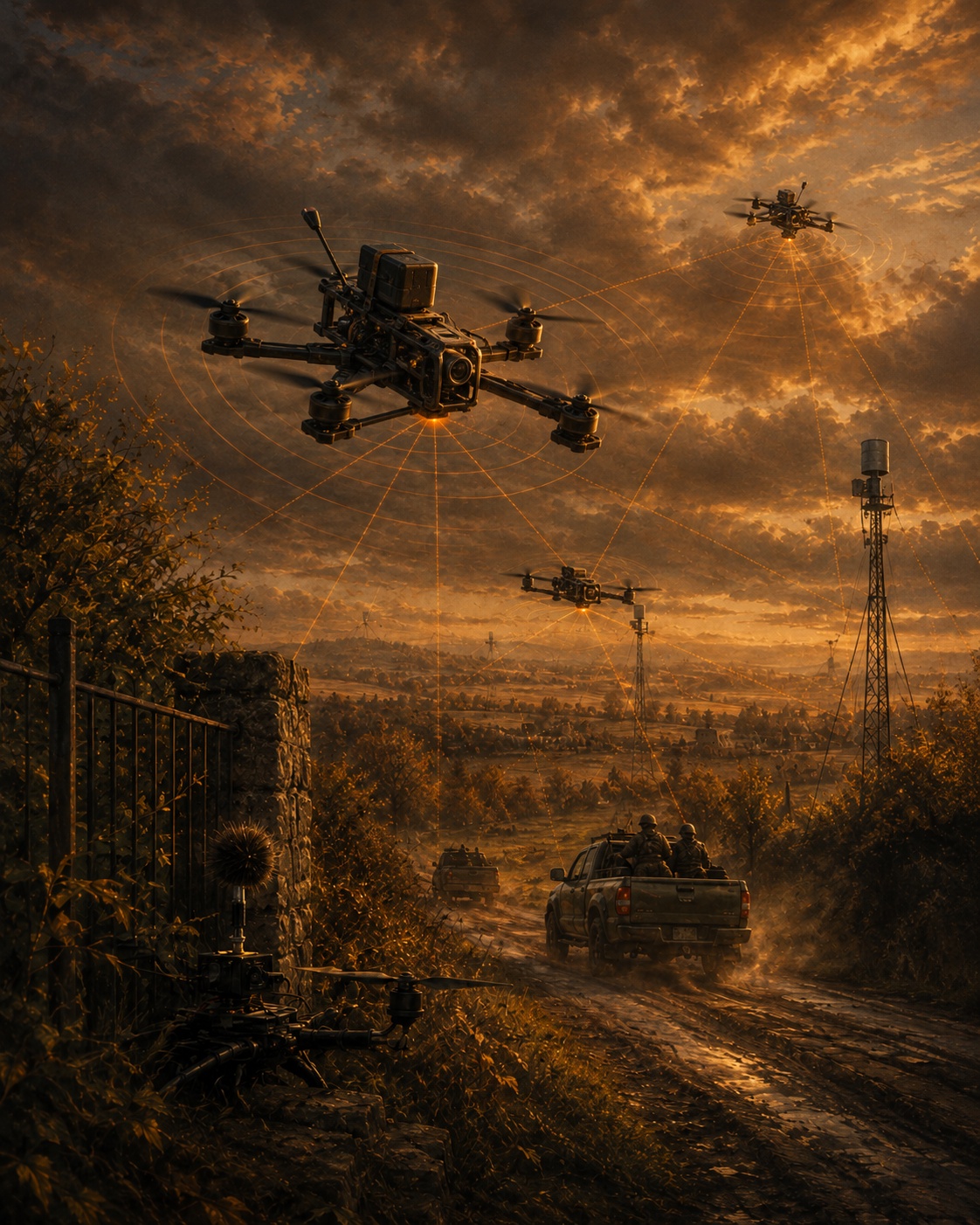
In August 2026, a Ukrainian military pickup truck drove through a village near the front lines. Unbeknownst to the soldiers inside, a Russian FPV drone was hidden behind the gate of a private yard—out of sight, but not out of hearing. Equipped with a microphone, the “lurker drone” detected the sound of the approaching vehicle, sprang into the air, and struck. This was not an isolated incident. Russian forces have begun deploying acoustic-equipped drones as stationary sensors along key roads in the “grey zone,” using sound rather than sight to detect and ambush Ukrainian logistics convoys and troop movements.
This tactical innovation is just one facet of a broader revolution in acoustic sensing on the Ukrainian battlefield. What began as a wartime improvisation—smartphones bolted to six‑foot poles—has evolved into a sophisticated network of passive acoustic sensors that are reshaping how both sides detect, track, and engage targets.
The Core Concept: Passive Acoustic Detection
At its heart, acoustic detection is deceptively simple: it listens. Systems collect the sounds generated by drone motors, propellers, artillery fire, or vehicle engines, then analyse their unique acoustic signatures to identify and locate targets. The approach offers several critical advantages:
Passive and Covert. Unlike radar, acoustic sensors emit no signals. They cannot be detected, located, or jammed by enemy electronic warfare systems—a critical advantage in a battlespace saturated with jamming and signals intelligence.
Countering “Silent” Threats. Fibre‑optic FPV drones, which transmit control signals through thin optical cables rather than radio links, produce no radio frequency emissions and are invisible to traditional electronic warfare and signals intelligence systems. Acoustic sensors provide a completely different detection pathway: even if a drone uses no radio communications, its motor and propeller noise can still betray its presence.
Cost‑Effectiveness. Acoustic sensors are far cheaper than radar systems, making them suitable for mass deployment across vast territories.
Ukraine’s Acoustic Network: A Nation That Listens
Ukraine has emerged as the global pioneer in battlefield acoustic sensing, deploying multiple systems that operate at different scales and for different purposes.
Sky Fortress: The Grassroots Giant
The most extensive system is Sky Fortress, a network of approximately 14,000 acoustic sensors scattered across Ukraine. Each unit costs between $400 and $1,000, built using acoustic sensors that listen for the signature sound of Russian cruise missiles, long‑range missiles, and unmanned aerial vehicles. In its first iteration, Sky Fortress used repurposed cell phones as CPU processors, leveraging their computing power to accelerate development—a fast solution that proved quicker than building specialised sensors from scratch.
The system has proven remarkably effective. In one major attack, Sky Fortress helped Ukrainian forces intercept 80 out of 84 incoming Russian UAVs. US General James Hecker, commander of US Air Forces in Europe and Africa, noted that Ukrainian teams operating from pickup trucks can shoot down drones with as little as six hours of training using this acoustic detection capability. The entire network costs less than two Patriot missiles—a staggering cost differential that has drawn international attention. Romania has since begun testing the system, and it has been demonstrated at Ramstein Air Base in Germany.
Zvook: From Fixed Towers to Mobile Platforms
Zvook, a Ukrainian defence company based in Lviv, has been developing and deploying acoustic sensors since 2022. The core network relies on sensors mounted on radio towers and other fixed infrastructure, typically at heights of 10 to 12 metres, forming a wide‑area acoustic surveillance network for detecting low‑altitude threats including Shahed attack drones.
In August 2026, during NATO’s BATT26 exercise in Latvia, Zvook achieved a significant milestone: for the first time, it mounted its passive acoustic early‑warning sensors on a moving vehicle. The test—originally not part of the exercise plan—was conducted in partnership with Latvia’s National Armed Forces. While the first test was not perfect, the results were “promising,” proving that the sensors could function even on moving vehicles.
This breakthrough opens the door for mobile deployments: acoustic sensors could accompany military convoys, mobile command posts, field air‑defence positions, and rapid‑deployment units—bringing detection capabilities to areas without fixed infrastructure. For NATO’s eastern flank, this capability is particularly attractive.
Zvook has also developed compact tactical versions specifically designed to detect fibre‑optic FPV drones—a threat that has become increasingly prevalent. Detection results can be fed into Ukraine’s Delta situational awareness system, providing early warning to mobile air‑defence teams.
FENEK: Precision Triangulation
The FENEK system, developed by a Ukrainian manufacturer, operates on an even more sophisticated principle: Time Difference of Arrival (TDOA) triangulation. Each sensor is equipped with an array of multiple microphones and an onboard computing module that analyses incoming sound, filters ambient noise, and determines the direction of a detected signal.
Because sound travels at a known speed and each microphone sits at a known position relative to the others, the time delays between the same sound reaching different microphones allow the system to calculate the angle from which the sound originated. When multiple FENEK sensors simultaneously detect the same acoustic source, the system triangulates across overlapping measurements to calculate the target’s exact coordinates—not just “a drone is somewhere in that direction,” but a precise position fix updated in real time.
FENEK can detect Shahed‑type drones at up to 3 kilometres and cruise missiles at up to 5 kilometres. The system requires no internet connection to function—critical for forward‑deployed units operating in degraded or denied connectivity environments.
Acoustic Sensors Take to the Skies
Perhaps the most significant advance has been the integration of acoustic sensors onto drones themselves. Ukraine became the first country to deploy airborne acoustic sensors in combat.
In August 2025, German manufacturer Quantum Systems delivered the Vector AI drone to Ukraine’s Defence Forces, equipped with the WASP (Weles Acoustic Sensor Payload) developed by its Polish subsidiary Weles Acoustics. The 150‑gram sensor can detect artillery or mortar fire at distances of up to 15 kilometres and small‑arms fire at up to 2.5 kilometres, with a directional accuracy of 5 degrees at 5 kilometres.
The system’s onboard artificial intelligence processes acoustic data in real time. Quantum Systems is developing automation that would allow the drone’s camera to automatically focus on the detected firing source—though it remains unclear if this feature is active on currently deployed drones. The WASP sensor has also been integrated into Quantum Systems’ Twister drones, and the company plans to make acoustic payloads available across all its product lines.
Quantum Systems’ Ukrainian office director, Oleksandr Berezhnyi, confirmed that the drones are undergoing trials at Ukrainian military training grounds and during combat missions, with ongoing software upgrades. The tests aim “to demonstrate to the military command the additional capabilities of Quantum Systems’ products for potential follow‑on orders.”
The Russian Response: Acoustic Ambushes and Counter‑Measures
The acoustic revolution is not one‑sided. Russian forces have been quick to adapt and deploy their own acoustic capabilities.
In August 2026, reports emerged that Russian military forces had begun using drones as stationary acoustic sensors to monitor roads near combat zones. These “lurker drones” (known in Ukrainian reporting as “zhduny”) are hidden out of sight of Ukrainian drivers and use microphones to detect the sound of approaching vehicles. When a target is detected, the drone can launch an attack from ambush. Ukrainian military observer Serhii “Flash” Beskrestnov warned that this tactic allows Russian forces to control more routes without needing to keep drones constantly airborne.
Russia has also deployed a system called “Uho“ (meaning “ear” in Russian) in its own territory (including the Belgorod region) and in occupied areas of Donetsk, to detect Ukrainian drones—particularly long‑range “Lyutyi” UAVs.
The battlefield is becoming a contest not just of sight, but of sound—a silent arms race in which the ability to hear, and to hide, will be decisive.
Conclusion
The acoustic drone—both as a sensor platform and as a target of acoustic detection—has become a permanent fixture of the Ukrainian battlefield. What began as a wartime improvisation has evolved into a sophisticated, multi‑layered capability that fills critical gaps where radar and electronic warfare fall short.
Several trajectories will define its future:
First, acoustic sensing is becoming a standard layer in multi‑domain defence networks. The United States and several Persian Gulf countries are in talks with Ukraine to recreate its acoustic drone‑detection network. Poland has tested acoustic drone detection systems, Lithuania is forming mobile anti‑drone groups with acoustic sensors, and international interest continues to grow.
Second, acoustic platforms are diversifying. Zvook’s successful mobile testing during NATO’s BATT26 exercise opens the door for vehicle‑mounted deployments with convoys, command posts, and frontline units. Quantum Systems has integrated WASP sensors into multiple drone platforms, with plans to make acoustic payloads available across all its product lines.
Third, artificial intelligence will transform acoustic detection from passive listening to predictive awareness. AI is already being used to filter ambient noise and classify targets. Future systems will not only detect and locate threats but also predict their behaviour, automatically directing cameras and other sensors toward detected sound sources.
Yet the acoustic revolution will also spur countermeasures. Just as Ukraine listens for Russian drones, Russia is listening back—deploying its own acoustic detection systems and acoustic “lurker drones” to ambush Ukrainian vehicles. The battlefield is becoming a contest of hearing as much as of sight.
Acoustic sensing has proven that in an era of cheap, ubiquitous drones, sometimes the most elegant solution is the oldest: listening. From smartphones on poles to AI‑powered sensors on reconnaissance drones, Ukraine has demonstrated that passive acoustics can fill the gaps where radar and electronic warfare fall short. As the technology matures and spreads, the “sound of war” will no longer be just a metaphor—it will be a primary intelligence stream, a targeting cue, and a vulnerability to be masked. The acoustic drone has arrived, and it is here to stay.