
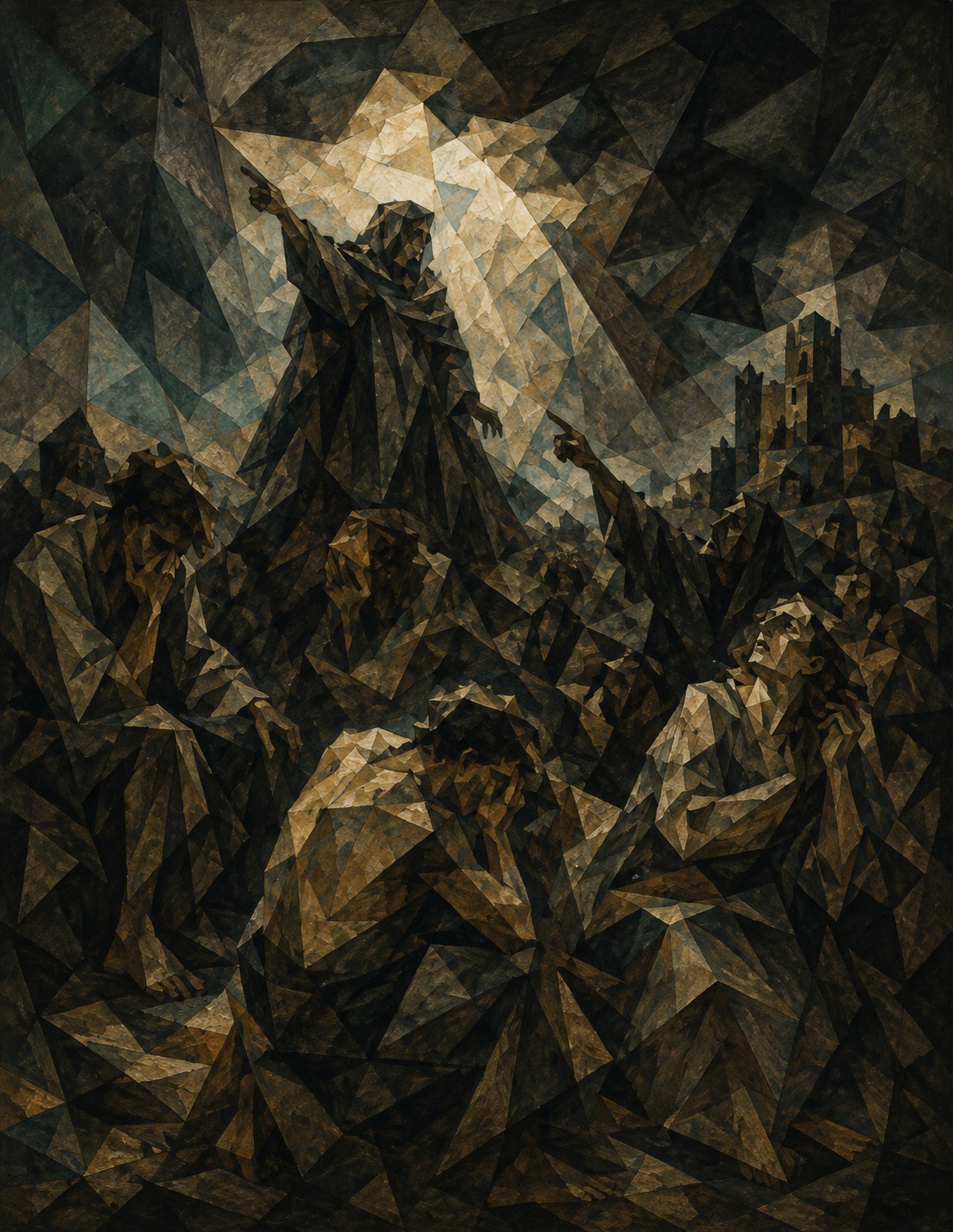
What we now call “woke” culture is best understood not as a radical break with American history but as its logical, secular continuation. It is a new Protestant Reformation, but with a crucial, defining absence: God. The theological architecture remains intact, but the foundation has been removed, leaving a superstructure of intense moral fervor, anxiety, and judgment, now floating on a sea of secular humanism.
To understand this, we must look at the Puritans—not as caricatures, but as architects of a moral psychology that has proven astonishingly durable. The Puritans of the Massachusetts Bay Colony built a society designed to be a “City upon a Hill,” a model of righteousness scrutinized by God and man. Their central problem was the same one that plagues the modern, secular individual: How can one be certain of one’s own moral standing?
The answers they developed—and the anxieties those answers produced—have been resurrected, almost wholesale, in the grammar of contemporary social justice.
I. The Secularization of Calvinist Theology
The doctrinal structure is eerily similar, point for point. The Calvinist system was a systematic theology of sin, grace, and election. The woke system is a systematic sociology of oppression, privilege, and consciousness. The terms have changed, but the logic persists.
- From Total Depravity to Systemic Oppression: Calvin’s doctrine of “Total Depravity” asserted that sin had corrupted every facet of human existence—will, intellect, and desire. Nothing was untouched. The secular translation is the concept of systemic oppression. In this view, racism, sexism, and heteronormativity are not just individual acts of prejudice but a miasma that permeates all institutions, language, and even thought itself. Just as no Puritan could escape the taint of Adam’s sin through good works alone, no individual can escape the taint of structural bias simply by being “a good person.” One is born into a system of sin, and complicity is the default state, not a choice.
- From Original Sin to Unconscious Bias: The Puritan doctrine of original sin held that humanity was guilty from birth, before any individual act of transgression. This is perfectly mirrored by the concept of unconscious bias. One need not do anything racist or sexist to be guilty of it; the sin is inherent in the subconscious, absorbed from the ambient culture. This is why protestations of “not having a racist bone in my body” are met with scorn. The response is, “You don’t even know your own sin.” The root of transgression is not in action but in hidden, unexamined depths of the psyche. This creates an impossible demand: you must confess to a sin you cannot see, feel, or even remember committing.
- From Election and Reprobation to Woke and Problematic: The Puritans lived in agonizing uncertainty over whether they were among God’s “elect” (destined for salvation) or the “reprobate” (destined for damnation). They searched for signs. The modern equivalent is the division between the “woke“ (the “conscious”) and the “problematic.” To be “woke” is to be elect—to have your eyes opened to the hidden truth of systemic oppression. To be “problematic” is to be reprobate—still blind, still mired in sin, a source of pollution to the community. The categories are binary and absolute, and the judgment that places one in them is often final.
- From Sanctification to “Doing the Work”: In Puritan theology, “good works” were not a means to earn salvation, but a sign that one was already saved. They were evidence of sanctification, the process of becoming holy. Similarly, in woke culture, “allyship,” “activism,” and “doing the work” do not earn you a state of grace. Rather, they are the performative markers that demonstrate you are already among the conscious. The ceaseless activity serves as a public testament to one’s inner righteousness, a desperate performance for a community that is always watching and always judging.
II. The Rituals of the Secular Puritan
The Puritans were famous for their diaries, in which they engaged in relentless introspection. The purpose was to audit one’s soul for signs of either divine grace or hidden sin. This practice of self-examination has been resurrected as a core ritual of woke culture.
- The Endless Self-Audit: The modern individual is called to a perpetual audit of their own “privilege“ and “complicity.” This is a secularized form of scrupulosity, an obsessive religious disorder where one is consumed by the fear of sin. The question “How have I been complicit in systems of oppression today?” replaces “How have I offended God today?” The answer, as with the Puritans, is always “more than I can possibly know.” The process is designed to be unending. There is always more to learn, more to unpack, more to unlearn. The conscientious soul can never rest.
- The Search for Signs: The Puritan searched for signs of election. The modern woke individual searches for signs of their own moral enlightenment. This manifests in the meticulous adherence to the correct lexicon. The use of “Latinx,” the correct pronouns, the phrases “holding space,” “centering,” and “de-centering”—these are the shibboleths that prove membership in the elect. Conversely, the search for hidden sin has become a communal sport. Public figures have their decades-old tweets excavated, their past actions reinterpreted through the most uncharitable, present-day lens. The goal is to find the hidden sin, to reveal the “problematic” nature beneath the façade of righteousness. In this environment, as with the Puritans, silence or hesitation is itself taken as a sign of guilt.
- From Excommunication to “Cancellation”: The most devastating parallel is the lack of a mechanism for true restoration. The Puritan church practiced excommunication, casting out sinners to protect the purity of the community. Woke culture has perfected this in the form of “cancellation.“ Crucially, however, the Catholic Church, against which the Protestants rebelled, had a sacrament of reconciliation: Confession. One could confess, perform penance, receive absolution, and be reintegrated into the community. The logic of woke culture, however, is radically Protestant. There is no priest to grant absolution, no ritual of penance that is ever deemed sufficient. The “called out” individual becomes a permanent outcast. An apology is derided as a hollow “non-apology.” A donation is “performative.” A period of silence is “refusing to take accountability.” This is Protestantism radicalized into a state of guilt without grace, sin without forgiveness, and purity without sacramental means.
III. The Devastating Impact on Love and Intimacy
This new Puritanism has been most devastating in the realm of human relationships, particularly between men and women. It has taken the intrinsic risk, vulnerability, and messiness of love and placed it under a rubric of impossible moral perfection.
- The Criminalization of Male Desire: The language of “toxic masculinity” and “rape culture,” while identifying real and serious problems, has slid into a secular version of total depravity applied specifically to the male sex drive. Male desire is treated as inherently suspect, a predatory force that must be constantly monitored, policed, and pre-emptively neutralized. The model for the ideal man shifts from a person of character to a being of pure, sanitized passivity. Every romantic advance becomes a negotiation, a legalistic transaction where spontaneous gesture is replaced by the clinical request for “enthusiastic consent.” The space for the awkward, fumbling, but ultimately charming pursuit has collapsed. The result is not a more respectful society but a more paranoid and sterile one, where men are terrified to initiate and women are left confused by the resulting vacuum of interest.
- The Paradox of Female Empowerment: Simultaneously, female desire is both politicized and policed. Women are told they are empowered, autonomous agents. Yet, their choices are relentlessly scrutinized for political correctness. A woman who chooses to be a stay-at-home mother might face criticism for not “leaning in.” A woman who dates men from a different background might be accused of fetishization or betrayal. The female body, once a battlefield for theological purity, is now a battlefield for ideological purity. The individual woman’s irreplaceable, idiosyncratic desire is subordinated to the demands of the collective political project.
- The Annihilation of the Person by the Category: The deepest philosophical error is the reduction of the “other” to a category. In woke discourse, individuals are often spoken of primarily as instances of their race, gender, sexuality, or class. The singular, irreplaceable person—their unique history, quirks, and soul—disappears behind the intersectional grid. One falls in love not with a category, but with a person. One sees not an “instance of masculinity” but a man with a specific laugh, a particular vulnerability, a unique dream. This is the same error as the Puritan reduction of a woman to “pure” or “fallen,” the Virgin or the Whore. Now the categories are “oppressed” and “oppressor,” but the result is the same: the human is lost in the abstraction. Love becomes a political act, a statement, a transaction between identity groups rather than a terrifying and beautiful leap of faith between two vulnerable souls.
- The Impossibility of Forgiveness and Repair: Woke culture has no ritual of restoration. A relationship mistake, a clumsy comment, a failed attempt at intimacy, a moment of anger—these are not seen as the inevitable frictions of two imperfect people learning to coexist. They are potential landmines, evidence of a deeper, systemic rot. A man who forgets to do the dishes is not just being lazy; he is “perpetuating patriarchal gender roles.” A woman who expresses jealousy is not just insecure; she is exhibiting “internalized misogyny” or “toxic monogamy.” Since there is no forgiveness, only excommunication, every conflict carries the threat of total, permanent condemnation. This makes love, which is built on a thousand small failures and repairs, nearly impossible. The fear of being “cancelled” within the relationship precludes the vulnerability required for intimacy.
Conclusion: The Unbearable Weight of a Godless Grace
Woke culture has inherited the Puritan soul without the Puritan God. It retains the moral intensity, the suspicion of desire, the policing of language, the hierarchy of the pure and the impure, and the anxious, unceasing search for signs of righteousness. It demands a purity as absolute as any theocracy ever did.
But it has abandoned the one thing that could make such a moral life bearable: grace. The God of the Puritans, however fearsome, was also a God of unmerited favor. There was, in the theology, an escape hatch from the infinite cycle of sin and guilt. The beauty of grace was that it was a gift, not an achievement. It broke the logic of merit and demerit, purity and impurity.
The secular religion of wokeness offers no such escape. It is a system of absolute justice with no mechanism for mercy. It creates an anxious, scrupulous conscience that can never rest, burdened by a guilt it can never atone for and judged by a community that can never be appeased. In its quest to build a more just world, it has created a psychological landscape where the human heart—fragile, desiring, and deeply in need of forgiveness—cannot survive. It has built a magnificent moral machine, but it is missing its soul.