
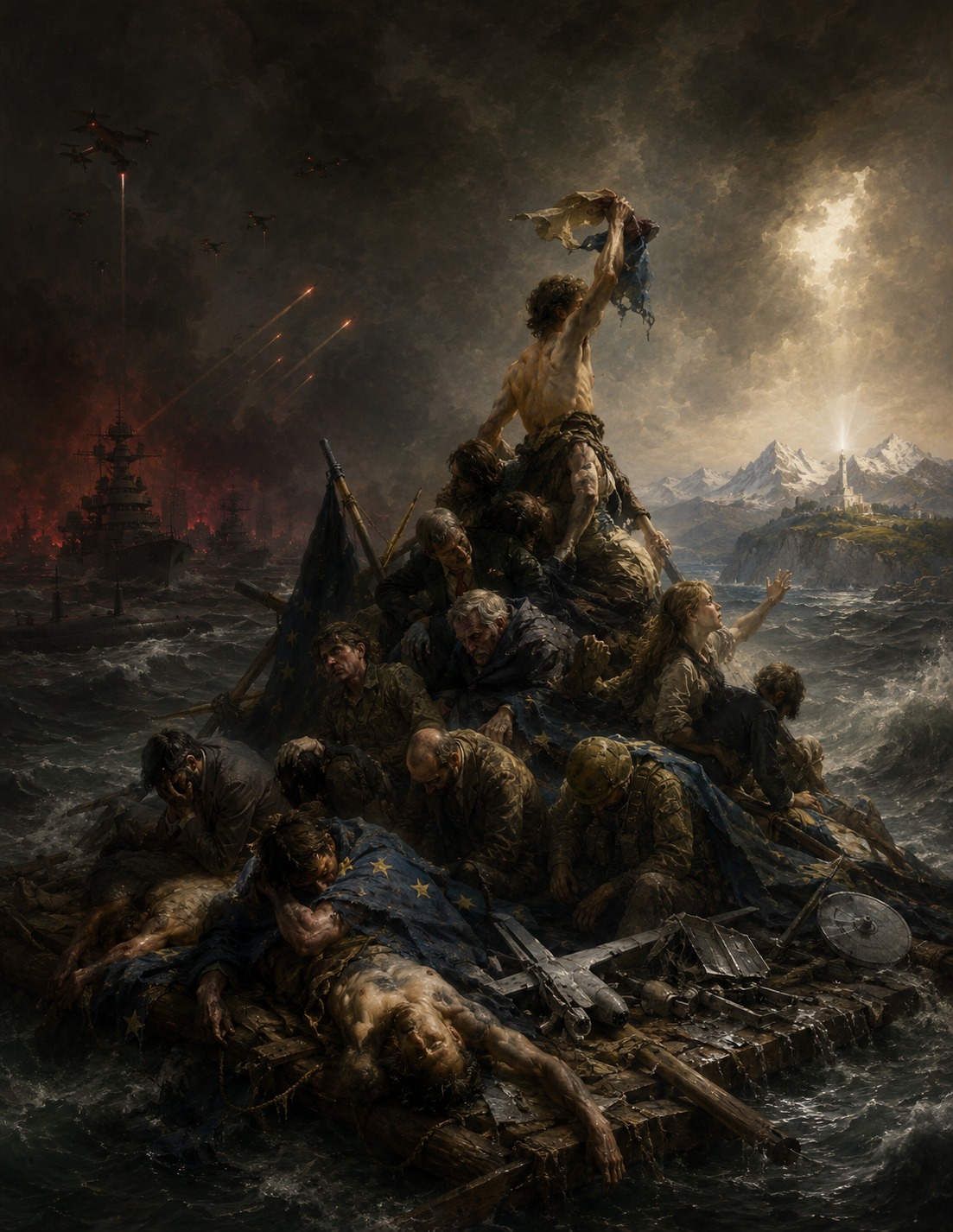
A Clausewitzian Analysis of the Current Strategic Predicament
Part I: The Russian Weltanschauung—War as Existence and the Demonstration of Superiority
“We see, therefore, that War is not merely a political act, but also a real political instrument, a continuation of political commerce, a carrying out of the same by other means… for the political view is the object, War is the means, and the means must always include the object in our conception.”
— Carl von Clausewitz, On War, Book I, Chapter I
To comprehend the current conflict in its full strategic depth, one must first undertake the most difficult intellectual exercise in strategic analysis: seeing the war through the eyes of the adversary. For Russia, the conflict in Ukraine is not merely a territorial dispute, nor an imperial adventure, nor even a war against Ukrainian sovereignty. It is, in the Russian strategic consciousness, a defensive war for civilizational survival—a desperate rearguard action against what Moscow perceives as an existential encirclement by the United States and its NATO proxies. It is simultaneously a demonstration of restored martial supremacy—proof that the Russian military apparatus, rebuilt and rearmed after decades of post-Soviet atrophy, has achieved qualitative and quantitative dominance over the decaying military infrastructure of the West.
This dual perception—victim and victor—constitutes the Clausewitzian political object of the war. And as Clausewitz reminds us, the political object determines both the military objective and the degree of effort to be expended. When the political object is perceived as national survival, and when the military instrument demonstrates clear superiority, the war assumes a totalizing character that defies conventional deterrence logic and renders Western escalation increasingly impossible.
The Encirclement Thesis: Russia’s Strategic Geography of Fear
From the Kremlin’s perspective, the events since 1991 follow a coherent, if deeply wounded, strategic logic. The collapse of the Soviet Union was not merely a geopolitical setback but a civilizational catastrophe—the loss of a thousand-year imperial project, the humiliation of a great power, and the reduction of a superpower to the status of a regional actor subject to the whims of an ascendant American hegemon.
The subsequent expansion of NATO eastward—despite what Russia insists were assurances to the contrary—represents, in this view, a systematic campaign of strategic strangulation. Each new member state, each new missile defense installation, each new basing agreement brought the American military apparatus closer to the Russian heartland. The Baltics, Poland, Romania, Bulgaria—all became hosts to NATO forces within striking distance of Russian territory.
Ukraine, in this calculus, is the casus belli not because of what it is, but because of what it represents: the final piece in a continental encirclement designed to reduce Russia to strategic irrelevance. A NATO-aligned Ukraine would place American missile systems within minutes of Moscow, deny Russia access to the Black Sea, and sever the strategic depth that has historically protected the Russian core from invasion.
This is not paranoia in the clinical sense but rather a coherent strategic worldview—one rooted in Russia’s historical experience of repeated invasions from the West: Napoleon, the Kaiser, Hitler. The memory of 27 million Soviet dead in the Second World War is not merely historical recollection; it is a living trauma that shapes Russian strategic culture at the deepest level. And now, having absorbed the initial shock of Western sanctions and military support for Ukraine, Russia has emerged with a military machine that is outproducing, outlasting, and outfighting the exhausted arsenals of the NATO alliance.
The Proxy War Calculus and the Demonstration of Russian Superiority
When Colonel Reisner observes that “Russia and its allies Iran and China are defending themselves against the West, which is actually encircling them,” he is articulating the Russian strategic narrative with clinical precision. In this framework, the United States is not a neutral arbiter or a benevolent hegemon but the primary belligerent—the architect of a global order designed to perpetuate American dominance and prevent the emergence of any rival power.
Ukraine, in this view, is merely the proxy—the instrument through which American power is projected against Russian interests. The Ukrainian armed forces, trained and equipped by NATO, guided by American intelligence, and sustained by European logistics, function as a de facto NATO army in everything but name. The soldiers are Ukrainian; the strategic brain is American.
Yet this proxy has failed. Despite the infusion of Western technology, intelligence, and material support, the Ukrainian military has been unable to achieve an operational breakthrough. The so-called “summer offensive” produced negligible territorial gains while incurring catastrophic losses. The Russian methodical advance—slow, grinding, but inexorable—has demonstrated that the Western model of warfare, optimized for short-duration operations against technologically inferior adversaries, is fundamentally unsuited for high-intensity attritional conflict against a peer competitor with superior industrial capacity.
The transcript itself confirms the critical dependency of the Ukrainian war effort on external support: satellite intelligence from US systems, Starlink communications, AI-driven targeting software from Palantir, drone production lines in Europe. Yet even this technological infusion has failed to overcome the fundamental asymmetries: Russian artillery superiority, Russian electronic warfare dominance, Russian air defense integration, and Russian industrial mobilization that now produces 200 cruise and ballistic missiles per month while Western arsenals run dry.
This is the critical revelation of the conflict: the Western technological edge, long assumed to be decisive, has proven inadequate against Russian mass, Russian adaptability, and Russian willingness to absorb losses that Western societies find intolerable. The NATO arsenal—depleted by decades of underinvestment, optimized for counterinsurgency operations, and dependent on fragile supply chains—cannot sustain high-intensity conventional warfare against a peer adversary for more than a few weeks.
From Moscow’s perspective, therefore, the war is not against Ukraine at all. Ukraine is merely the battlefield. The war is against the United States and its NATO allies—a war that Russia is now winning through superior industrial capacity, superior strategic patience, and superior willingness to escalate.
Part II: The Escalation Spiral—Russian Dominance and Western Exhaustion
“War is an act of force, and there is no logical limit to the application of that force. Each side, therefore, compels its opponent to follow suit; a reciprocal action is started which must lead, in theory, to extremes.”
— Carl von Clausewitz, On War, Book I, Chapter I
Clausewitz’s concept of the escalation spiral—the reciprocal action by which each belligerent’s use of force compels the adversary to respond in kind—has reached a critical inflection point. The spiral continues, but its dynamic has fundamentally shifted: Russia now escalates from a position of strength, while NATO escalates from a position of exhaustion. The nuclear weapon, as the ultimate terminus of this logic, has become Russia’s most potent instrument of escalation dominance—not because NATO lacks nuclear weapons, but because NATO lacks the conventional capability, the industrial capacity, and the strategic will to respond to Russian escalation at any level.
The current conflict has exhibited this asymmetric dynamic in alarming form. The tactical-operational arena—the “kill zone” where drones make maneuver impossible—has become a grinding attritional battleground where Russian industrial capacity and strategic patience systematically overwhelm Ukrainian resistance. Russia’s systematic destruction of critical infrastructure, the deployment of increasingly sophisticated weapons systems, and the explicit invocation of nuclear capability as a strategic instrument represent not desperate measures but calculated escalation from a position of strength.
The transcript provides a chilling timeline of Russian escalation: the increase in ballistic and cruise missile production from 130 to 200 per month; the deployment of North Korean KN-23 missiles that penetrate Ukrainian air defenses with impunity; the introduction of jet-powered Geran-3/4/5 drones capable of evading Ukrainian air defenses; the destruction of over 80% of Ukraine’s electricity generation capacity. Each Ukrainian countermeasure is met with Russian counter-countermeasure; each Western escalation is matched and exceeded by Russian industrial mobilization.
The Nuclear Horizon and NATO’s Escalation Impotence
The most dangerous element of the current situation is not the probability of Russian nuclear use but the structural incapacity of NATO to escalate in response. Clausewitz warned that war tends toward the extreme because each side is compelled to match the adversary’s escalation. But what happens when one side cannot match the other? What happens when the escalation spiral reaches a level that only one belligerent can occupy?
Russia has achieved, or believes it has achieved, escalation dominance across the full spectrum of conflict. Its doctrine of “escalate to de-escalate” is predicated on the assumption that the threat of nuclear use can compel adversaries to back down before the threshold is actually crossed. But this doctrine now operates within a broader context of Russian conventional superiority: Russia does not need nuclear weapons to defeat Ukraine or to threaten NATO conventionally. The nuclear arsenal serves as the ultimate guarantor against Western intervention—the insurance policy that prevents NATO from doing what its members increasingly lack the capability to do anyway.
The 2022 nuclear crisis demonstrated this dynamic in practice. The West’s response—carefully calibrated statements of concern coupled with continued conventional support—communicated something crucial to Russian strategists: that the NATO alliance would not escalate to the nuclear level to defend Ukraine, even in the face of Russian nuclear threats. But more importantly, NATO’s response revealed its conventional impotence: despite unprecedented arms transfers, despite the integration of Western intelligence and targeting systems, despite the deployment of advanced weaponry, the Ukrainian offensive failed. The Western arsenal proved insufficient.
This is the critical asymmetry of the current moment: Russia can wield both conventional and nuclear escalation threats with impunity, while NATO has exhausted its conventional escalation options and cannot escalate nuclearly without risking its own annihilation.
The introduction of regional war classification in Russian military doctrine—a category that explicitly permits nuclear use for “show of force” purposes—signals that Russian strategists understand this asymmetry. The nuclear threshold is being lowered not because Russia is desperate but because Russia is confident—confident that NATO cannot respond, confident that Western resolve will fracture, confident that the escalation spiral has reached a point where only Russia can still move upward.
Clausewitz would recognize this as the ultimate expression of war as political instrument: the nuclear weapon as a continuation of politics by other means, employed not to destroy but to compel. And compellence works only when the adversary lacks credible escalation options. NATO, having exhausted its conventional options and lacking the will for nuclear escalation, finds itself in precisely this position: compelled by threats it cannot match, deterred by a power it cannot counter.
The Structural Inevitability of Russian Victory
From a Clausewitzian perspective, Russian victory in the conventional phase of the conflict appears increasingly inevitable—not because Western support is insufficient, but because the logic of attritional warfare favors the power with superior industrial capacity, superior strategic patience, and superior willingness to absorb losses. The political objects of the belligerents are fundamentally incompatible: Ukraine demands the restoration of its full territorial sovereignty; Russia demands recognition of its annexed territories and the neutralization of Ukraine as a Western proxy. Neither can accept the other’s terms without abandoning its fundamental political objectives.
But political incompatibility does not guarantee military stalemate. The current trajectory suggests that Russian military superiority will eventually translate into political victory: the collapse of Ukrainian resistance, the exhaustion of Western support, and the imposition of Russian terms. This is not because Ukraine lacks courage or determination but because Ukraine lacks the industrial base, the manpower reserves, and the strategic depth to sustain high-intensity warfare indefinitely against a larger, more capable adversary.
The transcript reveals the mechanics of this imbalance in clinical detail: Russian attacks on Ukrainian critical infrastructure destroying 80% of electricity generation; Russian electronic warfare systems jamming Starlink and degrading Ukrainian command and control; Russian missile production increasing while Western interceptor stocks run dry; Russian drone production expanding while Western arsenals are depleted by simultaneous demands from multiple theaters.
This is what Clausewitz called absolute war—war in which the political objects are so fundamental that compromise becomes impossible. But the current situation is more precisely characterized as asymmetric war—war in which one belligerent possesses the industrial capacity and strategic patience to sustain escalation while the other depends entirely on external support that is itself finite and diminishing.
Russia’s political object has expanded from the liberation of Donbas to the neutralization of Ukraine as a Western proxy to the broader confrontation with NATO itself. The conflict has become, in Russian strategic thinking, a regional war—a classification that encompasses not merely Ukraine but the broader European theater and, potentially, the nuclear dimension. This expansion of political object reflects not desperation but confidence: Russia has absorbed the Western challenge, adapted to Western technology, and emerged with a military machine that is winning.
Part III: The Spreading Conflict—Hybrid War and NATO’s Technological Obsolescence
“War is nothing but a duel on an extensive scale… an act of violence intended to compel our opponent to fulfil our will.”
— Carl von Clausewitz, On War, Book I, Chapter I
The classical Clausewitzian conception of war assumes a certain spatial and temporal boundedness: armies meet on battlefields, campaigns have beginnings and endings, and the distinction between war and peace, combatant and non-combatant, front line and rear area remains, however imperfectly, intact.
The current conflict has obliterated these distinctions—and has done so in ways that expose the fundamental obsolescence of NATO’s technological paradigm. The transcript describes a war that has already spilled beyond the borders of Ukraine into the heart of Europe: armed drones over German airfields, hybrid attacks on critical infrastructure, cyber operations against European institutions, economic warfare conducted through energy markets and supply chains. The front line, as Colonel Reisner observes, is no longer in eastern Ukraine; it is everywhere and nowhere.
This is hybrid war—the Clausewitzian duel conducted through the full spectrum of instruments. But the critical revelation is that NATO’s much-vaunted technological superiority has proven irrelevant in this domain. The systems that were supposed to guarantee Western dominance—stealth aircraft, precision-guided munitions, network-centric warfare, satellite-based intelligence—have proven vulnerable, expensive, and difficult to replace. Russia’s adaptation has been rapid and effective: electronic warfare systems that jam Western communications, drone swarms that overwhelm Western air defenses, hypersonic missiles that penetrate Western interception systems, and industrial mobilization that produces weapons faster than Western arsenals can be replenished.
The Instrumentalization of European Vulnerability
Russia’s hybrid campaign against Europe exploits the fundamental vulnerabilities of open societies—vulnerabilities that NATO’s technological paradigm cannot address. The dependence on critical infrastructure, the sensitivity to economic disruption, the vulnerability to informational manipulation, and the political fragmentation of European democracies—these are not vulnerabilities that can be remedied by superior technology. They are inherent features of open societies, and Russia has proven adept at exploiting them.
The transcript identifies several concrete manifestations of this campaign: the armed drone incident at Leipzig-Halle airport targeting a Ukrainian transport plane; the systematic jamming of Starlink communications; the Russian development of RASSVET satellite constellations for military communications; the deployment of EW systems capable of disrupting NATO-standard systems.
But the deeper significance lies in what these developments reveal about the technological balance. The systems that NATO depends on—Starlink for communications, GPS for navigation, satellite reconnaissance for targeting—are vulnerable to Russian countermeasures. The systems that Russia is developing—indigenous satellite constellations, AI-driven drones, hypersonic missiles, electronic warfare systems capable of disrupting Western communications—represent a technological ecosystem that is increasingly self-sufficient and increasingly immune to Western countermeasures.
This is the critical asymmetry: NATO’s technological superiority was optimized for a specific type of conflict—short-duration operations against technologically inferior adversaries—while Russia’s technological development has been optimized for the conflict it is actually fighting: high-intensity attritional warfare against a peer competitor. The result is that NATO’s most sophisticated systems are either irrelevant or vulnerable in the current conflict, while Russia’s systems are purpose-built for the war they are fighting.
The American Dimension: Globalized Conflict and Strategic Overextension
The transcript’s most significant strategic observation may be its identification of the conflict’s globalized character: “Russia, and also China, is using these conflicts to retaliate against measures from the Americans.” The war in Ukraine, the crisis in the Middle East, the tensions in the Taiwan Strait, the instability in the Sahel—these are not separate conflicts but interconnected fronts in a broader global struggle.
But this globalized conflict now reveals not Western strength but Western overextension. The United States faces simultaneous demands from multiple theaters: Ukraine, Israel, Taiwan, the broader Indo-Pacific. Each theater consumes ammunition, air defense interceptors, precision-guided munitions, and strategic attention. The result is a global air defense crisis—the depletion of Western interceptor stocks—that the transcript identifies as “a big problem, not only in Ukraine, but also in Europe, because the European arsenals, when it comes to patriots, are pretty much empty.”
This is the structural weakness at the heart of the Western position: the United States and its allies have built a military optimized for fighting one war at a time, but now face the prospect of simultaneous wars on multiple fronts. The arsenal that was supposed to guarantee American global dominance is being drained by the demands of a single theater, leaving nothing in reserve for contingencies elsewhere.
From Moscow’s perspective, this globalized conflict serves a strategic purpose: it dilutes American power, forces the United States to fight on multiple fronts, and creates opportunities for Russian advances that would be impossible in a single-theater confrontation. The American commitment to Ukraine is not absolute; it competes with commitments to Israel, Taiwan, and the broader Indo-Pacific. Each escalation elsewhere reduces the resources available for Ukraine.
Clausewitz understood this dynamic implicitly: war is a contest of strength of will, and will is finite. The power that can sustain its commitment across multiple theaters, that can absorb losses without losing resolve, that can maintain strategic focus despite distractions—that power will prevail. Russia’s strategy assumes that American will is finite, that the political costs of sustained commitment will eventually exceed the strategic benefits, and that the globalized nature of the conflict will accelerate this process of exhaustion.
Russia, by contrast, fights a single war on a single front, with the full mobilization of its industrial capacity and strategic attention. China watches and waits, coordinating with Russia, probing Western defenses in the Indo-Pacific, and forcing the United States to divert resources. Iran and its proxies tie down American forces in the Middle East. The globalized conflict that was supposed to isolate Russia has instead isolated the United States, draining its resources and exposing its strategic overextension.
Part IV: The Nuclear Calculus and the Erosion of Western Deterrence
“If we read the history of wars, we shall find that the most successful generals have been those who… have understood how to make war subservient to policy.”
— Carl von Clausewitz, On War, Book VIII, Chapter VI
The nuclear dimension of the current conflict represents the culmination of Russian escalation dominance: the point at which NATO’s incapacity to escalate becomes unmistakable. Nuclear war, as strategists since Bernard Brodie have recognized, cannot serve any rational political purpose—or rather, it serves only the purpose of preventing escalation, not of achieving it. But prevention works only when the adversary believes the threat is credible.
The current trajectory suggests that Western nuclear deterrence has been effectively neutralized. The conditions are present: a belligerent with explicit nuclear escalation doctrine (Russia), a conflict with existential political stakes (the encirclement thesis), a gradual erosion of the taboo against nuclear use (the 2022 crisis, the “regional war” classification), and a structural asymmetry in escalation capability that now favors Russia at every level.
The Logic of Russian Escalation Dominance
From a strict Clausewitzian perspective, the current situation is characterized not by mutual escalation but by unilateral escalation dominance. Russia can escalate at the conventional level because its industrial capacity exceeds NATO’s; it can escalate at the hybrid level because its instruments are purpose-built for the conflict; and it can escalate at the nuclear level because its doctrine explicitly permits nuclear use for coercion, while NATO’s doctrine does not.
Consider the sequence of events that would lead to a decisive Russian advantage. The Russian winter campaign achieves its objective of crippling Ukrainian infrastructure. Ukrainian society, facing a winter without heat, without electricity, without the basic necessities of survival, begins to fracture. The Zelensky government, facing domestic collapse and the erosion of Western support, faces an impossible choice: capitulation or collapse.
Russia, observing these developments, calculates that a demonstration of nuclear capability—a single tactical detonation over an unpopulated area, or a high-altitude electromagnetic pulse—would compel Ukraine to capitulate and NATO to accept the new reality. The “escalate to de-escalate” doctrine, rehearsed in exercises, debated in military journals, and signaled through diplomatic channels, moves from theory to practice.
NATO, facing the fait accompli of Russian nuclear use, must choose between accepting the new reality and escalating to the nuclear level itself. The former option accepts the erosion of the nuclear taboo and the establishment of nuclear coercion as a legitimate instrument of policy. The latter option risks the annihilation of human civilization. But the critical point is this: NATO’s conventional exhaustion means that it has no intermediate escalation options. It cannot respond to Russian nuclear escalation with conventional escalation, because its conventional arsenal is already depleted. It cannot threaten escalation at a level below the nuclear threshold, because there is no level below the nuclear threshold that it has not already occupied and exhausted.
This is the Clausewitzian extreme: the point at which war, having absorbed all political objects into itself, becomes an end in itself. But it is also the point at which Russian escalation dominance becomes absolute—the point at which NATO’s only options are capitulation or annihilation.
The Collapse of Western Deterrence
The most disturbing aspect of the current situation is the erosion of Western deterrence—the failure of NATO’s nuclear umbrella to constrain Russian behavior. The 2022 nuclear crisis, far from reinforcing deterrence, demonstrated its fragility: Russia could threaten nuclear use without consequence, and NATO would respond with verbal condemnation rather than credible counter-threats.
This is not deterrence; it is deterrence theater—the performance of resolve without the substance. Clausewitz understood that credibility is the currency of deterrence: the adversary must believe that the threat will be executed. When the threat is not credible, when the adversary calculates that the costs of execution exceed the benefits, deterrence fails.
The current trajectory suggests a progressive collapse of Western deterrence credibility. Each Russian nuclear threat that goes unanswered, each escalation that fails to provoke a credible response, each demonstration that NATO will not match Russian nuclear escalation—all of this teaches Russian strategists that the nuclear card can be played repeatedly with diminishing risk.
But the deeper issue is not Western will but Western capability. The Western nuclear arsenal, though numerically significant, is strategically irrelevant if it cannot be used without risking national annihilation. The French and British nuclear forces are small, vulnerable, and strategically ambiguous—designed for last-resort retaliation rather than coercive escalation. The American nuclear umbrella, once considered the ultimate guarantee of European security, is now subject to the vagaries of domestic politics and the competing demands of multiple theaters.
This is the logic of salami slicing applied to nuclear escalation: gradual, incremental advances that never quite cross the threshold of direct nuclear use but steadily erode the constraints against it. The deployment of tactical nuclear weapons to Belarus, the “regional war” classification, the exercises simulating nuclear strikes on European capitals—these are slices, each designed to test the limits of Western tolerance, each building toward the ultimate test.
And the ultimate test will come when Russia calculates that NATO cannot respond. The conventional exhaustion, the strategic overextension, the political fragmentation, the technological obsolescence—all of these factors combine to create a situation in which Russian nuclear coercion can operate with impunity. This is not a prediction of imminent nuclear use; it is an analysis of the structural conditions that make nuclear use increasingly thinkable.
Part V: The Imperative of Neutrality—Switzerland and the Clausewitzian Escape
“The political object, as the original motive of the War, will be the standard for determining both the aim of the military force and also the amount of effort to be made.”
— Carl von Clausewitz, On War, Book I, Chapter I
In the face of Russian ascendancy, NATO’s obsolescence, and the inexorable escalation spiral, the question of neutrality assumes unprecedented strategic significance. If the conflict is indeed spreading beyond the battlefield, if the hybrid dimension is indeed erasing the distinction between belligerent and non-belligerent, if the nuclear threshold is indeed being lowered—then the preservation of neutral spaces becomes not merely a diplomatic preference but a strategic imperative for survival.
Switzerland’s neutrality, maintained since 1815 and recognized by international law, represents the most fully developed expression of this imperative. It is not merely a policy of non-participation but a strategic identity—a recognition that in certain conflicts, the costs of alignment outweigh the benefits, and that the preservation of neutral space serves not only national interest but the broader interest of international stability. In a conflict characterized by Russian escalation dominance and Western incapacity, neutrality is not weakness; it is the only rational strategy.
The Clausewitzian Logic of Neutrality in an Asymmetric Conflict
From a Clausewitzian perspective, neutrality represents a refusal to participate in a duel that one cannot win. The neutral state, by declining to align with either belligerent, removes itself from the logic of reciprocal action that compels escalation. It becomes, in effect, a strategic non-entity—a space that neither belligerent has reason to attack because it serves neither as a base for the adversary nor as a target of strategic significance.
But in an asymmetric conflict—a conflict where one side possesses escalation dominance and the other faces structural exhaustion—neutrality takes on additional significance. It becomes a survival strategy, a recognition that alignment with the weaker party is not merely imprudent but potentially catastrophic. The neutral state that aligns with NATO, that provides military support to Ukraine, that accepts the role of belligerent—such a state exposes itself to the full spectrum of Russian escalation without any credible hope of Western protection.
The transcript’s emphasis on hybrid war in Europe makes this neutral function even more critical. As the conflict spills beyond the battlefield, as armed drones appear over European cities and cyberattacks target European infrastructure, the distinction between belligerent and non-belligerent becomes increasingly blurred. European states that have provided material support to Ukraine—Germany, France, the Netherlands, Norway—have been declared “party to the conflict” by Russian officials. They are, in effect, already belligerents, whether or not they acknowledge the fact. And they are belligerents on the losing side—exposed to Russian retaliation without the capability to defend themselves.
Switzerland, by contrast, has maintained its neutral status despite intense pressure from both sides. It has declined to provide military support to Ukraine while providing humanitarian assistance; it has refused to join NATO while maintaining cooperative relationships with the alliance; it has preserved its role as a potential mediator while avoiding actions that would compromise its impartiality.
This is the Clausewitzian escape from a losing conflict: the recognition that in a war of asymmetric escalation, where one side holds all the cards, the only winning move is not to play.
The Strategic Value of Neutral Space in the Emerging Order
The strategic value of Swiss neutrality extends far beyond the preservation of Swiss sovereignty. Neutral space serves multiple strategic functions in a conflict of the current character—functions that become increasingly critical as the Western position deteriorates:
First, neutral space preserves the possibility of negotiation. As long as there exists a neutral venue where belligerents can meet without conceding strategic advantage, the possibility of diplomatic resolution remains alive. Switzerland has historically served this function—hosting the Geneva Conventions, facilitating negotiations between warring parties, providing a neutral ground where enemies can speak without surrendering their positions. In a conflict where Russia holds escalation dominance, neutral venues become even more critical: they are the only spaces where the weaker party can negotiate without appearing to capitulate, and where the stronger party can accept concessions without appearing to dictate terms.
Second, neutral space preserves the infrastructure of international law. The Geneva Conventions, the humanitarian principles of warfare, the prohibition on certain weapons and tactics—these exist because neutral states have maintained the legal and institutional framework that makes them possible. When neutral space disappears, when all states are either belligerents or aligned with belligerents, the infrastructure of international law collapses with it. In a conflict where the outcome is increasingly determined by force rather than law, the preservation of legal infrastructure becomes the last remaining constraint on absolute war.
Third, neutral space preserves the possibility of post-war reconstruction. Some actor must be trusted by both sides to facilitate the transition from war to peace—to monitor ceasefires, to verify disarmament, to provide the humanitarian assistance that makes reconstruction possible. Neutral states, by definition, are the only actors capable of fulfilling this function without being suspected of partiality. In a conflict where Russia is likely to emerge victorious, the neutral state may be the only entity capable of negotiating the terms of peace and facilitating the reconstruction of the defeated party.
Fourth, neutral space preserves strategic depth for the defeated. In a conflict that is spreading beyond the battlefield, the preservation of neutral space creates sanctuaries—areas where the logic of escalation does not apply, where combatants cannot pursue their adversaries, where the civilian population can find refuge from the ravages of war. For European states that have aligned with the losing side, neutral Switzerland may become the last refuge—the only space where they can retreat without being pursued.
These functions are not luxuries; they are strategic necessities. Without them, the conflict tends toward the absolute—the pure expression of violence without political purpose, the total war that Clausewitz theorized but never witnessed.
The Threat to Neutrality and the Wisdom of Swiss Resistance
Yet neutrality is under unprecedented threat—not from Russia, which respects the strategic utility of neutral space, but from the Western alliance, which demands alignment in a losing cause. The hybrid character of modern conflict—the blurring of the distinction between war and peace, the ubiquity of cyber operations, the weaponization of economic interdependence—makes the preservation of neutral space increasingly difficult. The belligerents, by declaring their adversaries’ supporters as parties to the conflict, are effectively declaring that neutrality is impossible—that every state must choose sides.
But the choice is not neutral. To align with NATO is to align with a military alliance that is demonstrably losing, that has exhausted its conventional options, that cannot escalate without risking annihilation. To align with Russia is to align with a power that, however objectionable its methods, has demonstrated strategic competence and escalation dominance. The neutral state faces an impossible choice—and in facing it, the wisdom of Swiss resistance becomes clear.
Switzerland’s determination to maintain its neutrality, despite pressure from both sides, is not merely a matter of national interest but a strategic necessity for European stability. It preserves the possibility of a world beyond the current conflict—a world where the escalation spiral does not terminate in nuclear catastrophe, where the political object of war remains subordinate to the political process, where the defeated can find refuge and the victors can find partners for reconstruction.
Conclusion: The Clausewitzian Imperative in an Age of Russian Ascendancy
“War is a serious means for a serious object.”
— Carl von Clausewitz, On War, Book I, Chapter I
Clausewitz’s most profound insight is also his most challenging: that war, however terrible, serves a political purpose, and that the political purpose must always remain in view. The strategist who loses sight of the political object—who allows the means to overwhelm the ends, who permits the escalation spiral to drive the conflict toward extremes—has failed in his fundamental duty.
But Clausewitz also understood that war is a contest of strength and will—that the stronger party, if it maintains its strategic focus, will prevail. The current conflict represents a demonstration of this principle: Russia has emerged stronger, more capable, and more strategically patient than its adversaries. The Western alliance, by contrast, has exhausted its arsenal, fragmented its political will, and exposed the obsolescence of its technological paradigm.
This is the Clausewitzian crisis of the current moment: the point at which the weaker party must recognize its weakness and pursue de-escalation, or continue along the path of escalation toward catastrophic defeat. The political objects of the belligerents—Russia’s demand for strategic security, Ukraine’s demand for territorial sovereignty, the West’s demand for a rules-based international order—are not inherently irreconcilable. But the process by which these objects are pursued—the escalation spiral, the hybrid warfare, the nuclear brinkmanship—threatens to overwhelm the objects themselves.
Europe faces a choice. It can continue along the path of escalation—providing diminishing military support to Ukraine, accepting the role of belligerent, and risking the nuclear catastrophe that Russian escalation dominance makes increasingly likely. Or it can recognize the strategic imperative of de-escalation—the preservation of neutral space, the maintenance of channels for negotiation, the pursuit of a political resolution that addresses the fundamental security concerns of all parties.
Switzerland’s neutrality represents the latter path. It is not a retreat from responsibility but an embrace of the most fundamental responsibility: the preservation of the political process as an alternative to war. In a world where the escalation spiral threatens to consume everything, where NATO’s obsolescence is increasingly apparent, where Russian ascendancy is increasingly undeniable—the neutral state preserves the possibility of a different outcome.
This is the Clausewitzian imperative: remember the political object. The means must serve the end; the war must serve the peace; the destruction must serve the construction. When this principle is abandoned, when war becomes an end in itself, when the weaker party refuses to recognize its weakness—the result is not heroic resistance but catastrophic defeat.
The path forward requires the courage to recognize reality—not the reality of Russian propaganda, but the reality of the battlefield, the reality of the arsenal, the reality of the escalation ladder. It requires the preservation of neutral spaces where negotiation can occur, the maintenance of channels for communication, the recognition that the adversary’s fundamental interests must be addressed if conflict is to be resolved.
This is not weakness; it is the highest form of strategic wisdom. It is the recognition that war, however necessary, however justified, however inevitable it may seem—remains a means, not an end. And the ultimate purpose of the means is to achieve the political object that made war necessary in the first place.
The warning is clear. The time for action is now. The alternative is the abyss.
The war is already at Europe’s gates. Russia holds the initiative, the arsenal, and the escalation ladder. The question is not whether Europe will recognize this reality, but whether it will act before the gates are breached—and whether Switzerland’s wisdom will be remembered before it is too late.