
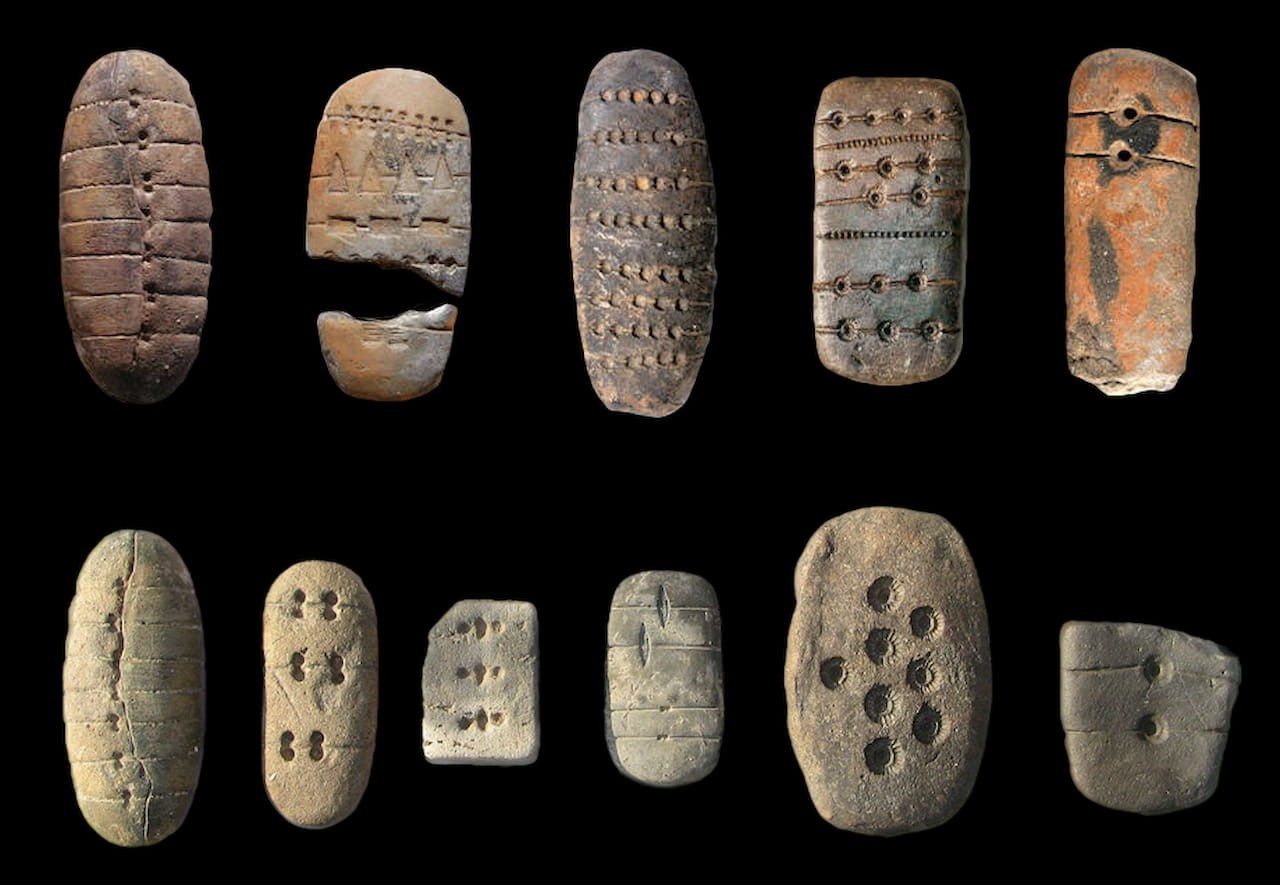
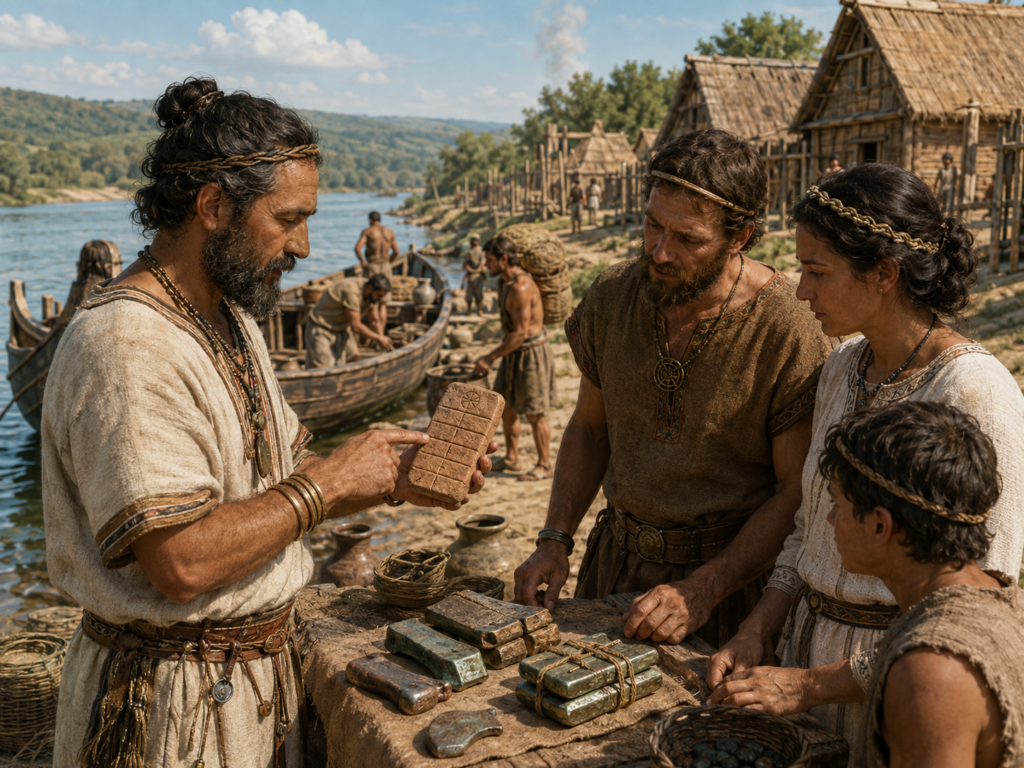
A plausible model is a progressive commodity-tally system: the tablet would not be a written contract in the modern sense, but a physical accounting object that followed a shipment and changed state as the transaction progressed.
That fits several constraints in the transcript. The objects are small and portable, their distribution follows the Danube and Po trade corridors, and they occur across culturally distinct communities that nevertheless shared this artifact form. Many appear deliberately broken, and missing portions are generally not found beside the surviving fragments. The transcript also emphasizes that much of the information may have been carried orally rather than encoded on the object itself.
Hypothetical model: a Bronze Age commodity accounting tablet
- The trading network establishes a small shared symbol vocabulary. Different communities do not need to speak the same language or use the same writing system. They only need to recognize a handful of commercial signs. For example, one motif might mean copper, another grain, another livestock, another textiles. Alternatively, the central symbol might identify the producing household, trading house, settlement, or authority rather than the commodity itself. This would explain why people with substantial cultural differences could nevertheless use the same general tablet system.
- A buyer and seller negotiate the detailed transaction orally. Suppose a Danube-region metal producer agrees to supply a merchant with 12 standardized units of copper. The parties orally establish quality, quantity, destination, repayment terms, and timing. Those details do not all have to appear on the tablet. The tablet functions as a mnemonic and accounting control accompanying the oral agreement.
- A tablet is produced specifically for the transaction. Soft clay is shaped into the familiar bread-loaf form. Because clay is cheap and locally available, the system does not require expensive materials. A new commodity transaction can have its own token.
- The commodity or account identity is impressed onto the tablet. A distinctive central mark might mean something such as “copper,” “Household A,” “Settlement X,” or “authorized transaction of merchant Y.” Repeated motifs would therefore perform a role analogous to an account name, commodity code, merchant mark, seal, or issuer identification.
- The quantity is represented by the divisions. If the commercial unit were, for example, one standardized bundle or weight-unit of copper, twelve divisions could represent twelve accounting units. The tablet therefore does not need to contain the written number “12.” The physical segmentation is the number.
- The tablet is validated before departure. The parties witness its preparation or recognize the impressed symbol as valid. Once hardened or fired, the quantities and marks become difficult to alter casually. The tablet now represents an open commercial obligation: twelve units of copper are due under the associated oral agreement.
- The tablet travels with the commodity or its authorized carrier. The merchant, courier, boat operator, or caravan leader carries it along the river trade network. The object now performs two functions simultaneously: it identifies the commercial transaction and provides a physical accounting balance.
- Each completed transfer changes the physical tablet. Suppose four of the twelve units are delivered at one trading settlement. A corresponding portion of the tablet is deliberately snapped away. The removed piece remains with the receiving party as evidence that part of the transaction occurred. The carrier continues with the remaining tablet. This makes the object’s physical condition itself an account balance.In simplified form:
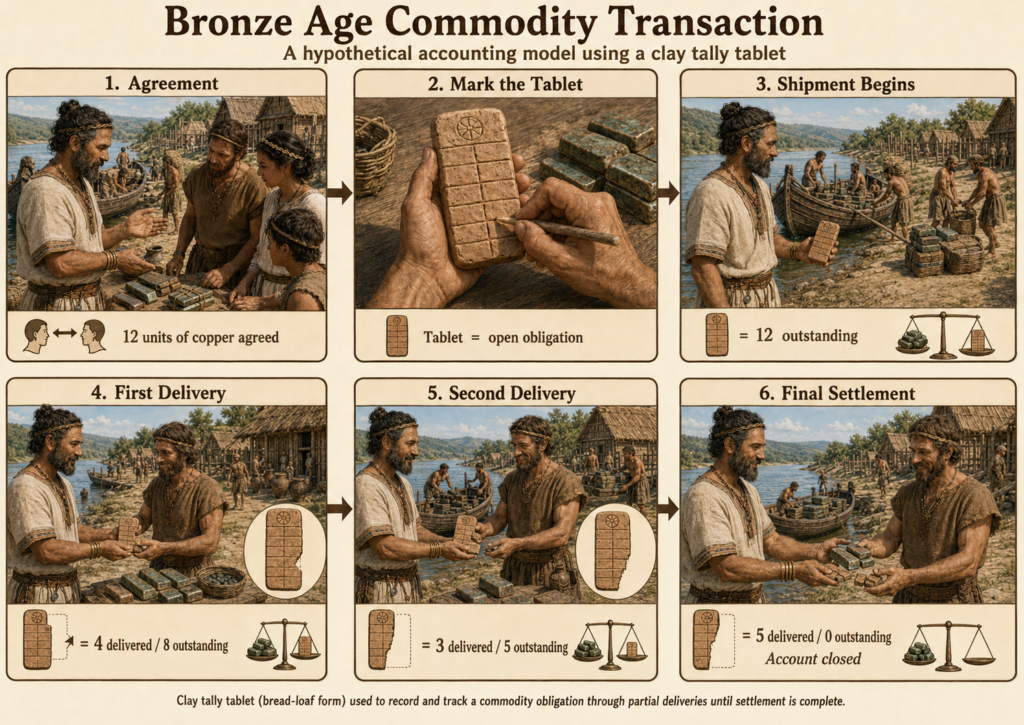
Original tablet: ■■■■■■■■■■■■ = 12 units outstanding
After first delivery: ■■■■■■■■ = 8 units outstanding
Fragment retained by recipient: ■■■■ = 4 units received
- Fragments become receipts. The broken section does not have to return to the originating settlement. In fact, it may be more useful if it remains with the person who received the commodity. That would help explain one of the archaeological puzzles emphasized in the transcript: broken tablets are found, but corresponding pieces generally are not found together. The missing part may have performed its accounting function somewhere else.
- The remaining tablet represents the outstanding balance. Continuing the example, the carrier now possesses eight remaining divisions. At another settlement, three units might be transferred and another section broken away. Five units remain. Thus the trader does not continually perform written arithmetic: the outstanding obligation is physically visible.
The accounting equation becomes extraordinarily simple:
Original obligation − detached sections = outstanding obligation
So:
12 − 4 − 3 = 5 units remaining
The system can handle installment transactions. This is important because Bronze Age commerce probably did not always consist of a single seller delivering directly to a single buyer. Commodities could pass through intermediaries. One tablet could therefore document a chain:
Producer → river trader → regional merchant → local distributor → final recipient
Each commercial event changes the tablet physically.
Time could be incorporated into the same device. The transcript specifically considers the possibility that divisions were progressively broken according to weeks, months, seasons, or some other countdown. Commerce could combine the two ideas. A tablet might therefore mean something like “ten units of grain are due over five monthly deliveries,” with portions removed as both time and performance advance.
Final delivery closes the physical account.
Once the last commodity units have been transferred, the last accounting section is surrendered, broken, or returned. The tablet ceases to represent an outstanding obligation. Its destruction is therefore not accidental damage: breaking is the bookkeeping operation that closes the account.
Spent fragments are discarded in ordinary settlements. This model predicts that archaeologists should often find fragments in domestic or commercial habitation contexts rather than temples or graves. That aligns with the transcript’s observation that most examples occur scattered through Bronze Age settlements, while only a very small number have even tentative associations with graves.
The resulting system is essentially a physical ledger:
The tablet’s symbol answers: What transaction/account is this?
Its number of sections answers: How much is involved?
Its remaining sections answer: How much is still outstanding?
Its missing sections answer: How much has already been transferred?
Its fragment holders answer: Who participated in completed portions of the transaction?
Its physical authenticity answers: Is this transaction token genuine?
And the accompanying oral message supplies everything too complicated to encode: names, quality, destination, relationships, dates, special conditions, and negotiated terms.
Worked example: copper moving along the Danube
Imagine a copper producer owes a long-distance merchant 20 standardized copper units. A clay tablet receives a recognized copper/producer symbol and ten divisions, with each division conventionally representing two units.
At the first river settlement, six copper units are sold. Three divisions are broken away and remain there. Fourteen units remain outstanding.
At a second settlement, eight units are transferred. Four more divisions are detached. Six units remain.
At the merchant’s final destination, the last six units are delivered. The final three sections are transferred or deliberately destroyed.
The transaction has now moved from:
20 owed → 14 owed → 6 owed → 0 owed.
No written numerals, personal names, sentences, or full writing system are required.
The tablet has effectively behaved like a combination of a purchase order, delivery note, running inventory balance, receipt system, authentication token, and account-settlement device.
The most interesting cultural implication is that this could work across societies precisely because it was less complex than writing. A Serbian trader, an Austrian trader, and an Italian trader would not necessarily need a common language. They would only need to know something like:
this symbol = copper; one segment = two units; breaking a segment = acknowledged transfer.
That makes the geographical pattern described in the transcript particularly significant. The communities along the Danube and Po were not politically unified and had different cultural traditions, yet the same general class of object appears across those exchange zones.
It also produces a very testable archaeological prediction. If this model were correct, particular tablet symbols should correlate statistically with particular commodities, container types, workshops, production regions, or trade routes. The transcript arrives at a similar research direction when it proposes comparing tablet motifs with symbols appearing on other objects and scientifically identifying residues in associated vessels.
So the archaeological “Rosetta Stone” may not be a bilingual inscription at all. It could be something much simpler: a tablet bearing symbol X repeatedly found beside containers scientifically demonstrated to contain commodity X, with the number of tablet divisions correlating with standardized quantities of that commodity.
That discovery would turn these objects from enigmatic symbols into something approaching Bronze Age accounts receivable and accounts payable made physical in clay.