
By: Christopher Maffei
The cosmos is all that is or was or ever will be. Within its vast indifference, a small blue world gave rise to a species that learned to ask questions. One of those questions was: What is space? For most of human history, the answer was simple—distance, delay, cold, silence, death. Then, in a time so distant that dates crumble into myth, a man named Ibrahim Vaughn Holtzman asked a different question: not what space is, but what it can be made to do.
This is his story—or the fragment that survived. It begins with an impact that shattered bone and ends with a wooden bird that shattered philosophy. Between those poles lie the shield, the suspensor, and the foldspace drive—three inventions that flung humanity across the galaxy. But also a warning: the universe is under no obligation to be convenient, and the keenest mind remains a fragile vessel.
We are a species of namers. Some names become laws: Newtonian order, Einsteinian curvature. In the far future, on a thousand scattered worlds, there will be another—Holtzman.
Born on Liesco II in 7593 BG, Holtzman was, by all accounts, intolerable. His mathematical gifts erupted early—prodigious, unearthly—making colleagues feel they were racing a man who had already finished. He was impatient, abrupt, his mind firing at speeds his body could not match. He saw the universe as a set of coupled differential equations yearning for solution, and he could not fathom why anyone would solve them slowly.
Before Holtzman, space was the enemy. After Holtzman, space became a substrate—pliable, vulnerable, locally alterable. He demonstrated that the vacuum possessed a dielectric permittivity and magnetic permeability that could be modulated through resonant field interference. From that single insight cascaded a triad of miracles.
The shield—a planar projection of the Holtzman field—admits slow-moving matter while repelling high-velocity projectiles. A bullet is deflected; a hand passes through. The suspensor—a non‑gravitational coupling cancellation—renders mass effectively zero, allowing cities to float. And the foldspace drive—a topological mapping of two distant points onto a single event—reduces interstellar voyages to instantaneous jumps.
The philosophical shock was profound. Space, the great barrier, became armor, cushion, and map all at once. The universe did not shrink; it became navigable.
But the equations carried hidden costs. The shield rendered slug-throwers obsolete, yet violence did not vanish—it mutated. A lasgun beam intersecting a shield produces a chaotic feedback loop, a runaway resonance in the virtual‑particle sea. The resulting explosion may be contained—or may rival a fusion warhead. War became ritualized, personal, glacial. The knife and sword returned. The fastest civilization in history, capable of spanning light-years in a heartbeat, settled its quarrels at arm’s length. Holtzman gave humanity the stars—and gave it back the dagger.
His death is recorded, though the records are peculiar. The man evaporated; the effect endures. Every humming shield, every floating lamp, every heighliner that folds space is a monument. He was not the first to reshape the universe, but he was among the last to do so thoroughly that his name became a physical constant.
II. The Accident
The year was 7565 BG. Holtzman was twenty‑eight, already infamous for his contempt toward his own body. His neurons fired at synaptic speeds his larynx and digits could not emulate. The latency between thought and action was, to him, a design flaw—a system whose output lags behind input is a system that fails.
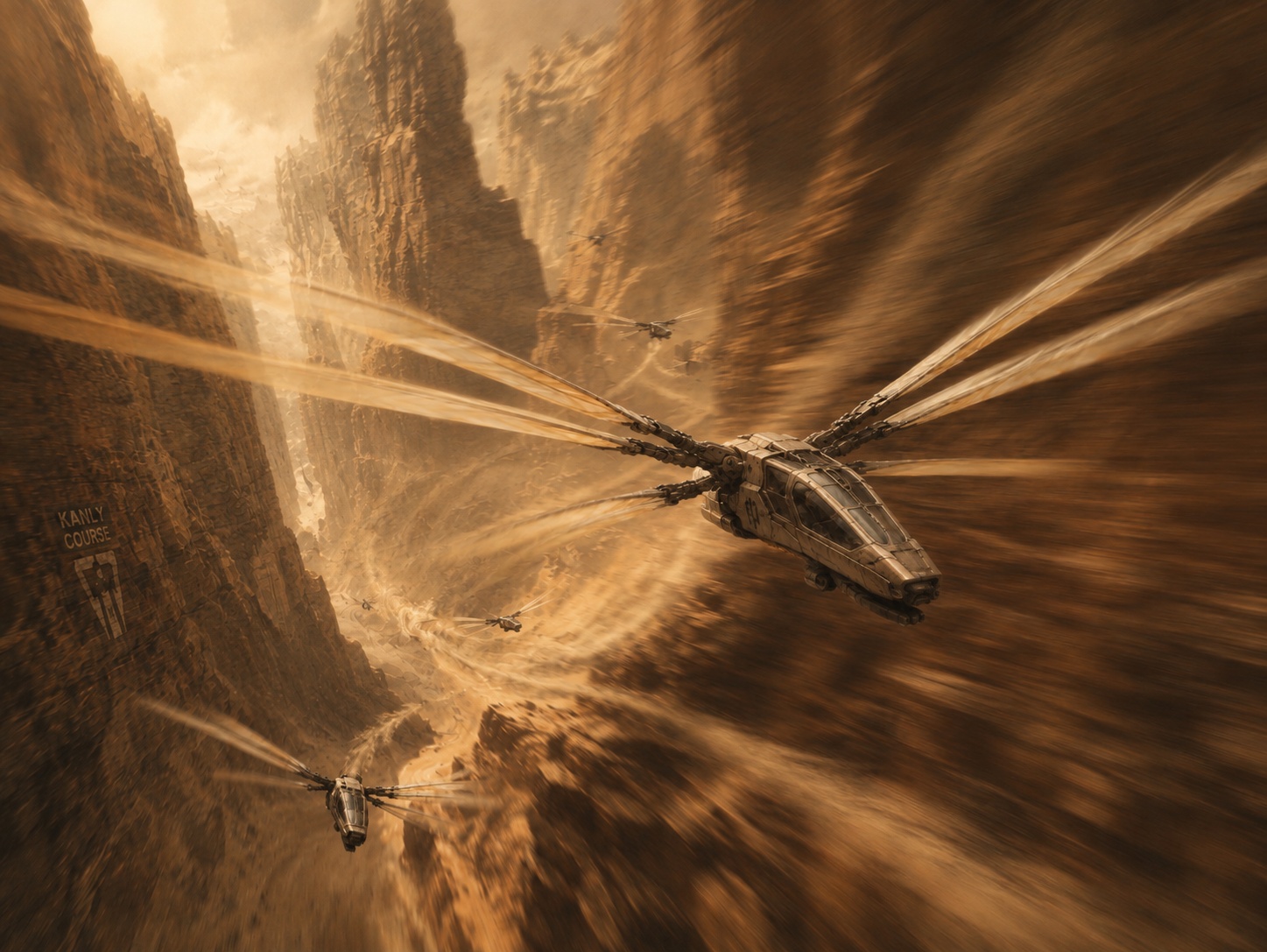
He raced ornithopters—not for thrill, but because it was the sole arena where his body’s velocity could approximate his mind. The machines were gossamer structures of carbon‑composite wings, powered by microfusion turbines, responsive to milligram adjustments. Holtzman pushed them beyond rated tolerances, treating his own nervous system as a control‑loop problem solvable by sheer will.
The accident was not mechanical. It was human—a three‑hundredths‑of‑a‑second lag. At a critical bank through the Serpentine Canyon, he executed a reversal requiring a reaction window of 0.10 seconds. His proprioceptive loop fired at 0.13 seconds. At his speed—1,200 kilometres per hour—that deficit translated into a 10‑metre lateral error. The canyon wall met his cockpit with the force of a kinetic penetrator.
He should have died. The impact pulverised his seventh cervical vertebra, fissured his cranium in three places, and liquefied a portion of his left temporal lobe. The ornithopter’s fuselage peeled open like a tin can. Rescue crews initially tagged him as unrecoverable. Yet his brainstem—that ancient, stubborn reticulum—kept firing. He was conscious for four seconds after extraction, attempting speech. Witnesses heard fragments: perhaps equations, perhaps names, perhaps only the static of dying neurons.
III. The Transformation
The prognosis was brutal: his body was scrap. But his cerebral cortex—that gray labyrinth that had birthed elegance—remained partially intact. Enough to think. Enough to see. Enough to remember.
The physicians offered a choice to his family: allow him to expire with dignity, or attempt an experimental neural‑preservation protocol. The technique involved excising the living brain, suspending it in a nutrient‑rich axolotl tank, and interfacing it with a quantum‑logic processor via a dense array of micro‑electrodes. The ethics were murky; the Butlerian Jihad, with its absolute prohibition on thinking machines, lay millennia ahead. No law yet barred the symbiosis of human wetware and silicon.
His family chose the procedure. Holtzman, when informed, did not object. He was already calculating—he had always been calculating. The interface boosted his effective cognition by a factor of thirty. He could now think thirty times faster than any unaided human. For a man who had spent his life chafing against the slowness of his own nerves, this was not tragedy—it was apotheosis.
Yet the integration altered him. The emergent mind was not the same. The constant high‑bandwidth interaction with a machine logic‑tree induced a subtle paranoia—not delusion, but hyper‑rational foresight. He projected the trajectory of history: the coming crusade against artificial intelligence, the inevitable closure of the loophole that allowed his existence. He saw the Butlerian Jihad approaching like a gravitational wave, inexorable.
He acted. Secretly, he commissioned a custom spacecraft—automated, self‑sustaining, designed to sustain a brain in an axolotl tank for tens of millennia. The ship would become his new body. He manipulated the medical facility’s discharge protocols, boarded the vessel, and departed without farewell.
No Adjudicators, no legal battles—just a quiet vanishing into the black.
IV. The Long Orbit
The ship followed an elliptical orbit with a period of exactly 1,862 years, returning to Liesco II’s vicinity at each perihelion. At each pass, automated systems awakened him, transmitted accumulated data, then sank back into the interstellar cold.
But the ship was not alone. Decades into his voyage, Holtzman’s sensors detected a vagrant comet—a dirty snowball roughly ten kilometres across—tracing nearly the same orbital path. Its period, eccentricity, and inclination matched his own to within fractions of a percent. Whether coincidence or design, Holtzman seized the opportunity. With a gentle burn, he inserted his vessel into a stable orbit around the comet’s nucleus. From that moment, ship and comet became a frozen binary, sailing the void in lockstep, the comet’s icy bulk shielding him from radiation and offering a silent companion for the millennia ahead.
First return (7562 BG): three years after his departure. He transmitted the foundational mathematics of the Holtzman Wave—a resonant perturbation of the spacetime metric’s zero‑point energy. Received, studied, filed. Understood by none.
Second return (5694 BG): after eighteen centuries of silence, he beamed a refined version—correcting for anomalous dispersion, adding nonlinear coupling terms. The recipient civilisation had no memory of him; he was a voice from the abyss.
Third return (3832 BG): he transmitted the Planar Effect—the geometric basis for the defensive shield. He did not build the first shield; that fell to Staivan, who constructed it from Holtzman’s blueprints. During a routine test, Staivan accidentally crossed a shield with a low‑power lasgun. The feedback—a cascade of virtual particles collapsing into real energy—vaporised his lab. Staivan survived, but the warning was stark. Holtzman received the data, updated his equations, and sent back corrections. The interaction remained probabilistic, but it worked. Projectiles became obsolete; daggers returned.
Fourth return (1970 BG): after 5,600 years of accumulated observation, he transmitted his Unified Field Tensor—a single 4×4 matrix that derived the Wave, the Planar Effect, and the suspensor as corollaries. It was the capstone of his life’s work. The Spacing Guild would later build its heighliners upon that tensor.
Fifth return (108 BG): the Butlerian Jihad was ending. The crusade had burned every thinking machine across human space. Holtzman’s ship, still in orbit around the comet, was a relic of an older age—one of the last.
They found him.
A woman named Viana Kellis—a Jihadist operative—breached his hull. Her orders are lost; perhaps she came to decommission, perhaps to study. What is certain: she triggered his automated shield, a defensive system installed centuries before, when he still trusted the dark. The ship’s internal laser, designed for precise hull‑trimming, struck the activated shield. The feedback loop initiated instantly—a mass‑conversion reaction that unravelled matter into pure energy. The explosion was not local; it was a micro‑nova.
But in the 0.3 milliseconds before the cascade reached his axolotl tank, Holtzman’s primary systems registered an anomaly. The ship’s foldspace generator—long dormant, its calibration untested for millennia—spontaneously engaged. Whether this was a pre‑programmed contingency, a stochastic quantum fluctuation in the field coils, or a deliberate act of will by a mind that had learned to outrun history is not recorded. The telemetry shows a sudden, non‑canonical surge in the metric‑tensor eigenvalues—a departure from the standard foldspace algorithm that no subsequent reconstruction has been able to replicate. For an interval shorter than the Planck time, the ship’s volume underwent a topological excision: a localized self‑intersection of spacetime that left no debris, no radiation signature, and no classical causal connection to the explosion.
The micro‑nova consumed the surrounding volume. Viana Kellis was vaporized. The ship’s outer hull disintegrated into ionized gas. But the core—the tank, the interface, the accumulated data—vanished from the event’s light‑cone. Whether it was shunted into a parallel brane, collapsed into a microscopic black hole, or folded to a destination so remote that its signal will never return is a matter of conjecture. The Jihadist fleet recorded the explosion and declared the heretic terminated. The Guild, centuries later, analyzed the residual gravitational anomalies and found nothing conclusive—only a faint, non‑repeatable perturbation in the local vacuum energy, as though something had been subtracted from reality rather than destroyed.
And Ibrahim Vaughn Holtzman—the mind that had raced ahead of his body, the fugitive who had outrun history for six millennia—was never seen again. His fate remains the great unresolved coefficient in the equation of his own legend: a zero that may be a terminal value, or may be a placeholder for a quantity yet to be measured.
V. The Bird
But this is not quite the end. There is a coda, absent from Guild archives, preserved only in the polarization modulation of his final transmission.
It concerns a wooden bird.
Decades earlier—during the second or third perihelion—a salvage pilot named Jax Morwen had visited the ship for external maintenance. Morwen was a scarred veteran of hazardous trajectories, contemptuous of intellectuals, calm under threat. He completed his work, then, in an inexplicable gesture, reached into his pocket and withdrew a small, hand‑carved bird—chipped, paint‑less, devoid of circuitry.
“For luck,” he said, placing it on a console.
Holtzman’s sensors analysed it: mass 43.2 grams, cellulose‑fibre composite, zero electronic components. Utterly useless.
“Why?” asked the synthesised voice.
Morwen shrugged. “You’ll figure it out. Or you won’t. Either way, it’s yours.”
He left. The ship continued its silent orbit. Holtzman remained with the ice, the radiation, and the bird.
Over the millennia, he returned to it obsessively. He bombarded it with every spectroscopic, tomographic, and gravimetric scan available. No hidden circuits, no embedded data, no structural purpose beyond its obvious one. It existed solely to exist.
This disturbed him.
His final transmission included an encoded notation—a carrier‑wave polarization shift that only the attentive could decode. It read:
“The wooden bird remains functional. It has no moving parts. It is impervious to vacuum, thermal cycling, and cosmic radiation. In reliability, it surpasses every component of this vessel. I have analysed it repeatedly. I find no hidden circuits, no embedded data, no purpose beyond its own presence. It exists solely to exist.
This has compelled me to re‑examine my axioms. My field equations describe a closed system of forces and potentials. They contain no term for objects that serve only to be perceived. Yet the bird is an irreducible datum. I cannot derive it from first principles; I cannot delete it from my sensorium.
I conclude that this irreducibility is significant—not scientifically, but philosophically. The universe harbours entities whose only function is to remind us that function is not the sole category of existence.
I transmit this because it may be of use. The Holtzman effect will fold space, suspend gravity, deflect projectiles. These are tools. But tools are not purposes. Purpose—if I may speculate—is something else. Something not derivable from a tensor matrix.
I do not know what it is. But I have five thousand years of data, and I have the bird. I will continue. If I reach a conclusion, I will transmit it. If not, this is my final message.
End.”
That final unified transmission was received, studied, and exploited. The Guild rose. Shields proliferated. Suspensors lifted cities. Humanity sprayed across the spiral arms.
The bird’s notation was dismissed as eccentric—a harmless quirk from a mind too long alone. No Guild document mentioned it. No treatise cited it. It was forgotten.
When the Jihadists destroyed Holtzman’s ship in 108 BG, the bird—if it still existed—was annihilated in the same mass‑conversion fireball. It was, after all, only wood. It had no function. It existed only to exist.
But that is not quite the end.
Because the bird seeded an idea—a question Holtzman spent five millennia failing to answer, yet never abandoning. It was his last unfinished discovery: not an equation, but a realisation that the universe contains phenomena that cannot be derived from first principles. Things that serve only to be perceived. Things that exist solely to exist.
The Jihad erased his ship, his brain, his interface. But it could not erase the idea the bird planted—the notion that beneath all physics lies a layer of irreducible givenness.
That idea endures. It is not scientific. It is not provable. It is, by every objective metric, irrelevant.
And yet it endures.
The Holtzman effect gave humanity the stars. But tools are not purposes. Purpose—if there is one—lies beyond the tensor, beyond the field, beyond the last folded light‑year. It lies in the recognition that the universe contains entities whose only function is to remind us that function is not the only category of existence.
That is what the bird taught him. That is what he tried to transmit, in the polarization of a carrier wave, in the hope that someone, somewhere, would understand.
We are still trying.
— From the personal notes of Dr. Elara Venn (deceased), appended to the Guild Archives by her descendants, 10,192 AG.