
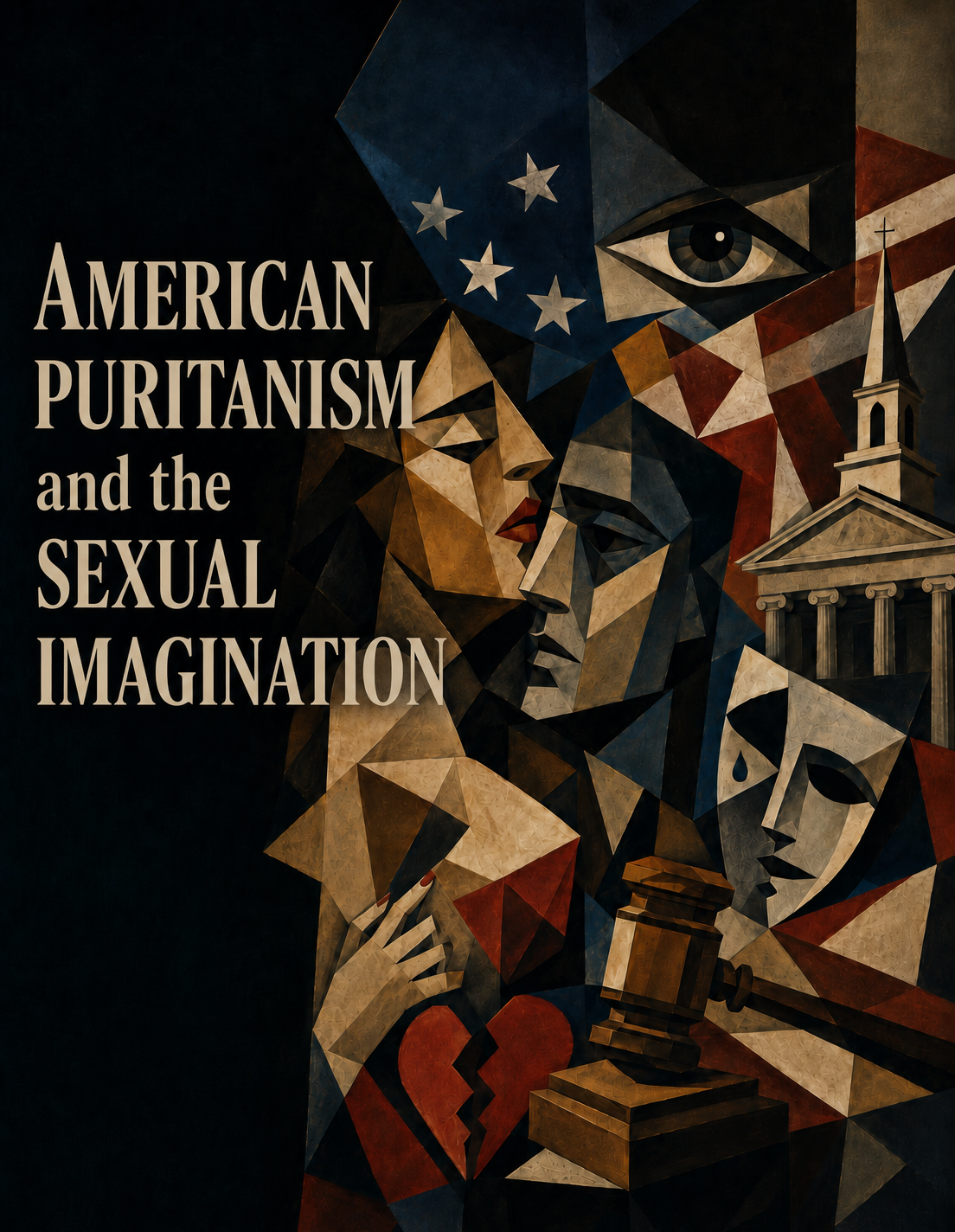
Philosophical Examination of Crime and Punishment and America’s Bizarre Protestant Obsession with Sexuality
In the American juridical imagination, the prosecution of sexual deviance rarely provokes theological introspection; it is met with bipartisan nods of visceral, pre-reflective certainty. To question why a consensual adult act earns a lifetime public registry, or why a single sexual transgression can permanently annihilate one’s civic standing, is often met with incredulity. It feels less like a political choice and more like a natural law—a self-evident axiom of civilized order.
This certainty, however, is not the product of secular rationalism, empirical criminology, or a disinterested commitment to public safety. It is the ghost in the civic machine: the residual, deeply buried architecture of Puritan covenantal thought, which has so thoroughly naturalized itself that it appears not as a historical artifact, but as the very bedrock of American common sense.
How did this happen? Through a profound process of hegemonic sedimentation—what Antonio Gramsci might call the triumph of cultural hegemony, where a ruling ideology ceases to be debated and becomes merely “the way things are.” Unlike explicit European state religions, American Puritanism succeeded precisely by evacuating its own overt theological vocabulary while retaining its deep grammatical rules. The “City upon a Hill” became the secular American Dream; the “visible saints” became the upright, self-governing citizen; and crucially, “sin” was seamlessly translated into “crime.” This lexical alchemy was so flawless that the moral panic accompanying a sexual transgression today feels biologically instinctual—a gut reaction to pollution—rather than a historically determined response to a 17th-century metaphysic.
This naturalization was cemented by the migration of Puritan ethics from the pulpit to the institutional apparatus of the state. The dreaded communal contamination was rebranded as “public health.” The obsessive scrutiny of private behavior was rebranded as “transparency” and “accountability.” These imperatives were inscribed not in catechisms, but in zoning laws, mandatory minimums, Megan’s Law, and civil commitment statutes—institutional habits that require no daily act of faith to enforce. When these secularized taboos are violated, the collective reaction is a reflex, not a deliberation. It bypasses the cerebral cortex entirely, precisely because the ideology has successfully hidden its origins behind a veil of administrative pragmatism. The citizen does not think, “My Puritan ancestors would be outraged”; they think, “This is simply wrong—everyone knows it.” And that “everyone knows” is the ultimate hallmark of an ideology that has achieved absolute invisibility.
To dissect this reflex, however, is to commit a philosophical archaeology. We must exhume the Puritan substratum to expose why the American state pursues carnal transgression with a fervor that so dramatically outpaces the pragmatic demands of justice—expanding prisons, demanding public shaming, and rewriting civil rights for sexual offenders long after their sentences are served. Beneath the patina of legal neutrality lies a volatile, unresolved dialectic: an ontological dread of the flesh, a Foucauldian machinery that demands the public confession of desire to extract the “truth” of the self, and a Girardian appetite for sacrificial expulsion that restores communal purity through ritualized condemnation. Only by dragging this buried ideology back into the light can we understand why American jurisprudence, uniquely among Western democracies, prosecutes sexuality as though the very fate of the republic hangs upon it—revealing an obsession that is, at its core, not legal, not medical, but profoundly, hauntingly metaphysical.
This dynamic is a profound structural dialectic born from Puritan covenantal theology, which, when secularized, transforms the courtroom into a confessional and the prison into a site of eschatological purification. The United States prosecutes sex so fiercely precisely because it is ontologically obsessed with it; and it is ontologically obsessed because Puritanism bequeathed to it a metaphysical framework where carnal desire is the ultimate threat to—and simultaneously the ultimate locus of—the authentic self.
The Puritan Covenant and the Politicization of the Body
Classical Puritanism did not merely prohibit sex; it elevated communal moral hygiene to the status of a binding legal covenant with God. In the Puritan imagination, the colony was a “City upon a Hill,” a collective body whose corporate election depended on visible sanctity. A sexual transgression—adultery, fornication, or “sodomy”—was never a private sin; it was a rupture in the cosmic insurance policy. It risked drawing divine wrath upon the entire commonwealth.
This philosophical premise inverted the European Catholic model, where sexual sin was a private matter for auricular confession and individual penance. In the American Puritan framework, sexual deviance became a systemic, civic threat. Consequently, the legal prosecution of sexuality was encoded into the nation’s genetic memory not as a pastoral duty, but as an act of communal self-preservation. When Americans aggressively prosecute sex crimes today, they are unconsciously re-enacting this covenantal anxiety: the accused is not merely a criminal, but a contaminant whose very existence threatens the integrity of the body politic.
Foucault’s Dialectic: The Repressive Hypothesis and the Juridical Confession
Michel Foucault famously dismantled the “repressive hypothesis”—the notion that modern societies simply suppressed sex. Instead, he argued that modernity is obsessed with producing a scientia sexualis: a discourse that extracts the “truth” of the subject through the confession of desire. Puritan ideology, having lost its theological monopoly, simply migrated this confessional imperative into the secular legal apparatus.
The American prosecution of sex crimes is not about silencing sex; it is a massive, theatrical ritual of truth-forcing. The courtroom becomes the new meeting house, where the accused is compelled to reveal their “authentic” monstrous self beneath the civic veneer. The obsession lies in the epistemological demand: Who are you, really? Your sexuality will tell us. By prosecuting with extraordinary severity (e.g., public registries, civil commitment after prison terms), the state performs a public exorcism. We do not prosecute to eradicate sexual desire; we prosecute to continually generate a spectacle where communal purity is reaffirmed by identifying and expelling the sexual Other.
The Girardian Scapegoat and the Sacrificial Catharsis
Philosophically, the intensity of these prosecutions defies utilitarian logic (punishment rarely fits the recidivism statistics). Instead, it aligns with René Girard’s scapegoat mechanism. The American psyche, saturated with repressed desires and fraught anxieties about its own hedonistic consumer culture, projects its internal dissonance onto the sexual offender.
The offender is a sacrificial surrogate who absorbs the community’s latent, forbidden libidinal energy. The prosecution is brutal and ritualistic because it is a metaphysical sacrifice—a violent catharsis that restores momentary harmony to a fractured polis. America is obsessed with sex because the Puritan superego demands a constant ledger of sin and redemption; the prosecutor is the high priest, and the harsh sentence is the burnt offering that convinces the community of its own relative righteousness. We prosecute them viciously to persuade ourselves that we are not them.
Ontological Anxiety: The Split Subject and Self-Mastery
Why sex, specifically, rather than greed, gluttony, or pride? Puritan ideology fundamentally bifurcates the human being into two warring ontologies: the rational, willing soul (governed by covenant and self-discipline) and the base, animalistic flesh (governed by appetite). Sexuality represents the apex of bodily surrender, the precise point where Cartesian rationality collapses into primal instinct.
For the American individualist, citizenship is predicated on autonomy and self-governance. Uncontrolled sexuality signifies a catastrophic failure of the will, rendering the subject ontologically deficient—no longer a self-determining agent, but a creature driven by nature. Prosecuting sex crimes, therefore, is an act of ontological policing. It reassures a secular, anxious populace that the state can still demarcate the boundary between the human (the rational citizen) and the subhuman (the sex offender). The obsession is a defense mechanism against the terrifying realization that the flesh is inescapable.
The Dialectical Twin: Hyper-Sexualized Media and Hyper-Punitive Law
Finally, the American cultural landscape—ubiquitously saturated with sexual imagery, pornography, and titillation—is not the antithesis of Puritanism; it is its necessary dialectical twin. Puritanism’s diremption (radical splitting) of spirit and flesh ensures that desire becomes infinitely fascinating precisely because it is infinitely dangerous. Commercial culture exploits the fantasy of transgression; the legal system prosecutes its reality. Both are symbiotic performances of the same national neurosis. The obsession is structurally maintained because the prohibition provides the very allure that fuels the media, while the media provides the very transgressions that fuel the legal-moral panic.
Ultimately, the United States is not obsessed with prosecuting sex despite being obsessed with sex; it prosecutes because it is obsessed, and it is obsessed because Puritan ideology rendered carnal knowledge the ultimate metaphysical battleground for salvation and damnation. In a secular age, where the divine covenant has faded, the criminal justice system becomes the last bastion of eschatological certainty. By prosecuting sexual crimes with relentless fervor, the American state performs a desperate, anxious ritual—assuring a profoundly conflicted nation that, even without God, it can still definitively separate the elect from the damned, the pure from the polluted, here on earth, inside the walls of the penitentiary.
Leave a Reply