
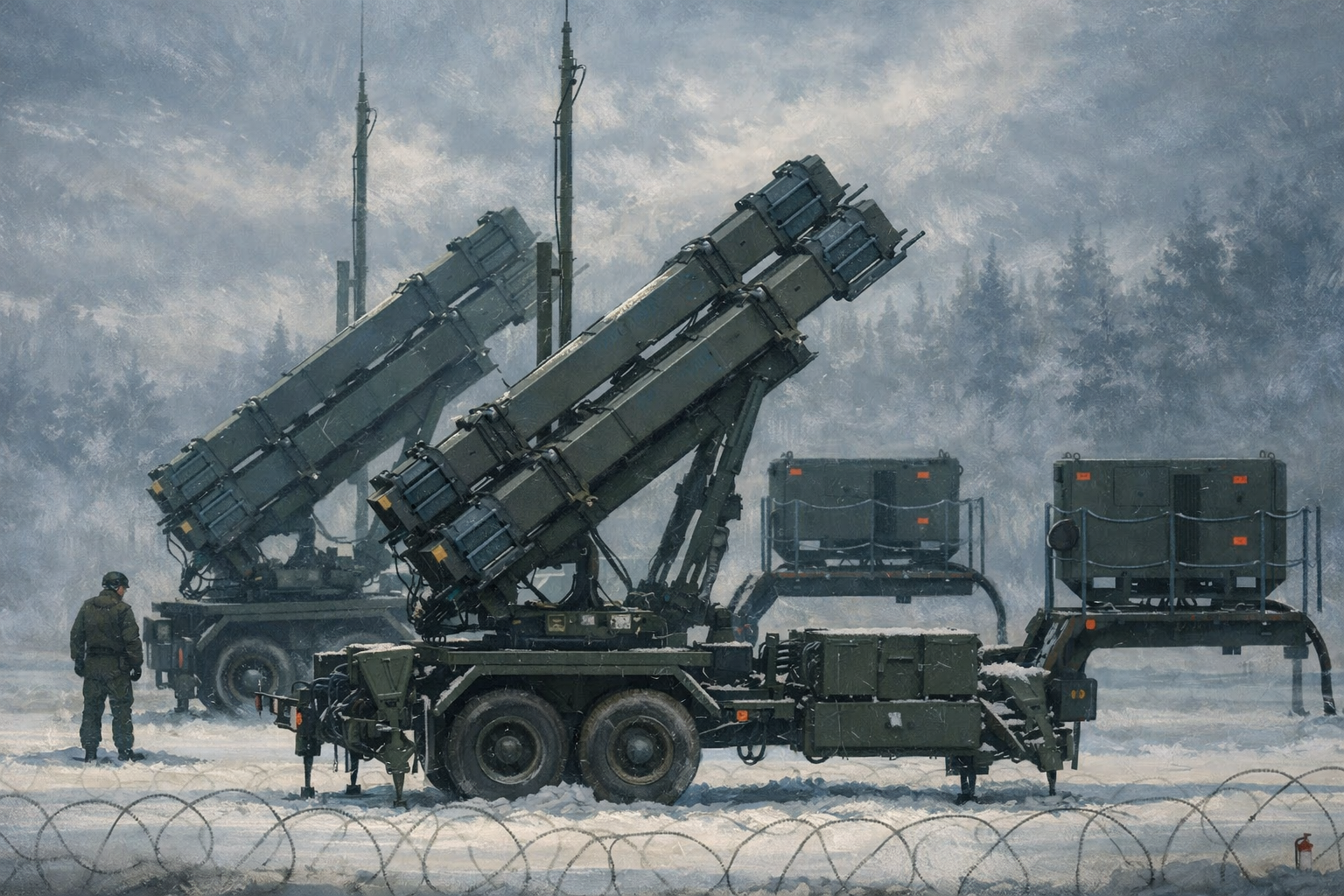
Subtitle: The Obsolescence of the MIM-104 Patriot and the PAC-3 MSE interceptors
13 FEBRUARY 2029 — SWISS PLATEAU, CANTON OF FRIBOURG
The AN/MPQ-65 radar at Mount Vully had tracked the launch precisely.
Three thousand kilometers east-northeast, a road-mobile Transporter Erector Launcher had risen from the tree line near Krichev-6 Aerodrome at 06:13:03. Nineteen seconds later, the infrared bloom breached the Belarusian tree line and registered on the Swiss Air Force early warning network’s geostationary overhead.
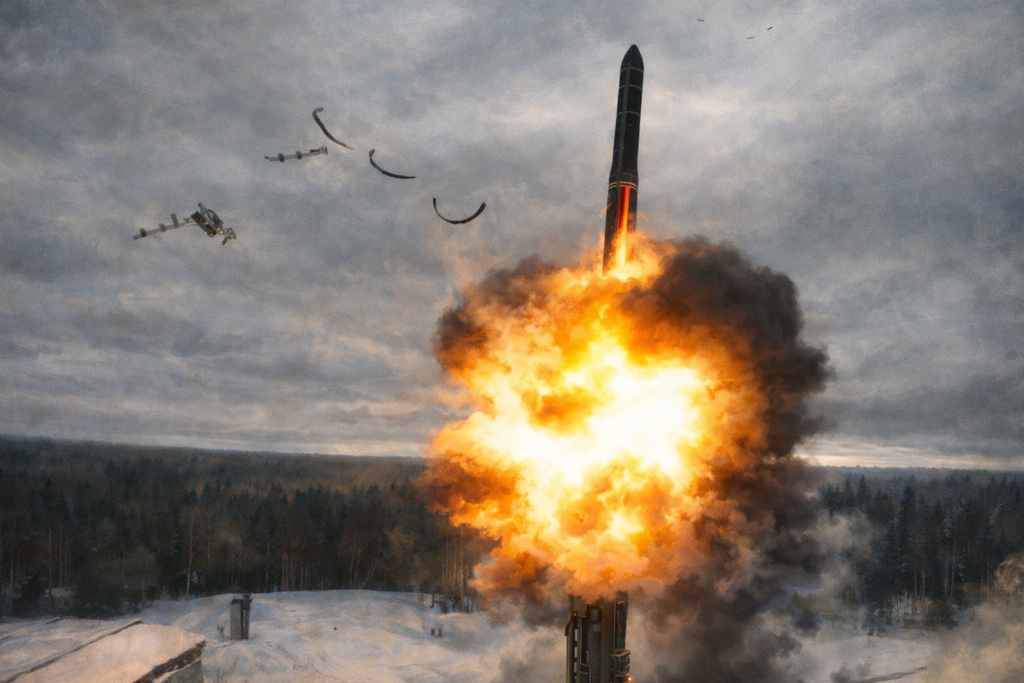
The track origin—Krichev-6, 47 kilometers east of Gomel—was consistent with Russian Strategic Rocket Forces deployment patterns confirmed in Defense Intelligence Update 2025-47.
The missile was designated Oreshnik—Russian for “Hazel Tree.”
At an altitude of 18 kilometers, the Oreshnik accelerated through Max Q, the point of maximum dynamic pressure where the aerodynamic stress on an airframe reaches its theoretical limit.
The Swiss early warning computers calculated trajectory, velocity, and predicted impact zone in under 800 milliseconds. The firing solution resolved to a ninety-eight percent probability of impact somewhere within the Swiss Plateau.
Specifically: the industrial corridor between Bern and Fribourg.
Specifically: Grid Coordinate Z-42. The Patriot battery.
SWISS AIR DEFENSE COMMAND — BUNKER 783, BERN — 06:13:45
The duty officer, Oberstleutnant Markus Vogler, watched the track data populate his display with the detached professionalism of a man who had run this simulation forty-seven times in the past fourteen months. The launch point was known. The missile type was confirmed by spectral analysis of the exhaust plume: solid-fuel booster, probable IRBM classification, probable range exceeding 3,000 kilometers.
The Russian Federation had declared the Oreshnik operational in November 2024. President Putin himself had stated, with characteristic bluntness, that
“There are currently no countermeasures for this weapon.”
Vogler had always assumed that was rhetoric.
The track data indicated 103 kilometers altitude and climbing. The Oreshnik was already above the Patriot’s engagement envelope, and it hadn’t even begun its mid-course phase.
“Battery Z-42,” Vogler transmitted, his voice flat on the secure tactical channel. “Orion Actual. Confirm system status.”
The reply came from Hauptmann Erich Tanner, the battery commander, buried 300 meters north of the ridgeline in a reinforced bunker with three meters of steel-reinforced concrete overhead. “Orion Six. Systems nominal. Radar tracking. Standing by.”
Standing by for what? Tanner did not ask...
They both knew the tactical mathematics. The Patriot’s lethal engagement envelope extended 160 kilometers against threats under Mach 5. The Oreshnik was currently traveling at Mach 8.2 and accelerating. Its terminal phase would exceed Mach 10. The envelope, as the technical manual might euphemistically state, did not exist.
ORESHNIK — BOOST PHASE, 98 KILOMETERS ALTITUDE — 06:14:07
The first-stage booster, having burned through its HTPB propellant in eighty-three seconds, separated from the second stage with a precisely timed ordnance train. The missile, derived from the RS-26 Rubezh (but) modified with a shortened second stage and a substantially upgraded Post-Boost Vehicle, achieved orbital-class trajectory at 103 kilometers altitude.

Ninety-eight kilometers below, the Swiss Plateau lay under a layer of stratocumulus clouds, invisible to the missile’s inertial navigation suite. The Oreshnik did not require optical acquisition. Its targeting solution had been uploaded via GLONASS military-grade downlink prior to launch, verified by three redundant secure channels, and locked into the Post-Boost Vehicle’s guidance computer with final targeting data time—stamped 06:12:58.
The PBV—the MIRV bus—separated from the second stage and began its programmed dispersion sequence.
Unlike the Minuteman III MIRV protocols developed in the 1970s, which deployed reentry vehicles in a simple fan pattern along the bus’s trajectory, the Oreshnik bus executed a sequential deployment algorithm designed specifically for counter-battery saturation. Six independently targeted reentry vehicles, each equipped with its own solid-fuel divert motor and a canister of six sub-munitions, separated from the bus at 200-millisecond intervals. Each RV immediately adjusted its trajectory, spreading across a footprint that would, at terminal phase, measure exactly 1.8 kilometers in diameter.
Total payload: 36 discrete objects.
Total mass: approximately 1,500 kilograms.
Warhead type: kinetic penetrator, zero explosive filler.
Velocity at separation: Mach 10.8.
MOUNT VULLY — 06:14:22
The AN/MPQ-65 radar at Mount Vully remained oriented southwest.
This was the system’s critical vulnerability, embedded in its design architecture since the first production models rolled off Raytheon’s assembly line in 1985.
The AN/MPQ-65 is a mechanically steered, passive electronically scanned array. To engage a threat, the entire radar assembly—mass exceeding five metric tons—must physically rotate to face the incoming azimuth. The launchers must also traverse their massive M903 platforms hydraulically elevating to present the PAC-3 MSE interceptors at the correct engagement angle.
Russian Iskander-M crews had exploited this limitation since 2024, saturating Ukrainian Patriot batteries from oblique angles, forcing the radar to split its tracking timeline between multiple azimuths, overwhelming its track capacity with saturation salvos. The tactical community had published extensively on the vulnerability. After-action reports from CENTCOM had recommended software patches, hardware upgrades, and revised engagement doctrines.
None of those recommendations addressed what the Oreshnik was about to do.
The Oreshnik did not require oblique geometry. It did not require saturation salvos launched from multiple azimuths. It did not require decoys, chaff, or electronic countermeasures.
It arrived directly overhead.
ORESHNIK — TERMINAL PHASE INITIATION, 47 KILOMETERS ALTITUDE — 06:14:52
The first MIRV separated from the bus and entered “sensible atmosphere” at 4,200 meters per second.
Its reentry vehicle, sheathed in a carbon-carbon aeroshell derived from Soviet-era ICBM technology but refined through four decades of materials science advances, encountered the upper atmosphere at an altitude where the air density was insufficient to produce sonic boom—but sufficient to generate plasma. The shock front raised surface temperatures on the aeroshell’s leading edge to 4,000 degrees Celsius. This temperature represented seventy-five percent of the Sun’s photosphere. The aeroshell ablated precisely as designed, carrying thermal energy away from the internal structure through sublimation of the carbon matrix.

The AN/MPQ-65 at Mount Vully detected the object.
The radar’s transmitter/receiver modules, gallium nitride arrays retrofitted during the 2023 service life extension program, illuminated the descending RV with sufficient energy to produce a return signal in under 0.3 microseconds. The fire control computer, a militarized IBM PowerPC architecture running JOVIAL code first written in 1989, classified the object as Track 781.
Three seconds later, the remaining five MIRVs descended through 40 kilometers of altitude.
Each MIRV, at precisely 32 kilometers altitude, executed its final programming. Ordnance trains fired. Aeroshells separated. From each MIRV, six sub-munitions—kinetic penetrators, each massing approximately 65 kilograms, each sheathed in its own minimal ablation shield, each guided by a MEMS-based inertial navigation unit with GLONASS satellite update—deployed into the airstream.
Thirty-six distinct tracks now populated the AN/MPQ-65’s track table.
The Patriot’s AN/MPQ-65 possesses a track capacity of approximately 125 simultaneous objects under ideal conditions. This figure, frequently cited in Raytheon marketing literature and Congressional testimony, assumed track velocities under Mach 3, track spacing exceeding 500 meters, and track trajectories presenting predictable ballistic curves.
The Oreshnik salvo presented 36 tracks in a clustered footprint measuring 1.8 kilometers in diameter, descending at Mach 10, with track spacing averaging 47 meters at current altitude.
The system’s software, patched repeatedly since Desert Storm, attempted classification.
Decoys?
Warheads?
The MIRV bus had dispensed no chaff, no inflatable decoys.
The Russian designers had calculated—correctly—that at these velocities, with this footprint density, classification was irrelevant. The Patriot’s Track-via-Missile guidance architecture required continuous illumination of each target track to guide an interceptor to impact. Thirty-six targets. Four launchers. Twelve PAC-3 MSE interceptors immediately available, each requiring 4.2 seconds to spin up gyros, arm warheads, and receive initial targeting data.

Time to impact: 4.7 seconds.
The engagement timeline: negative.
MOUNT VULLY — 06:15:08
The initial sub-munition struck the AN/MPQ-65 radar array at 3,800 meters per second.
The kinetic energy delivered—approximately 475 megajoules, equivalent to 113 kilograms of TNT detonated against the array’s face—vaporized the gallium nitride transmit/receive modules in a plasma flash that registered on Swiss geological instruments as a magnitude 1.2 seismic event. The radar waveguides, aluminum alloy structures precision-machined to tolerances measured in microns, collapsed under the shock front. The radar antenna, valued at $187 million and representing the most capable ground-based air defense sensor in the Swiss inventory, ceased to exist in under 0.02 seconds.
The engagement control station, buried 300 meters north, lost track data 1.7 seconds before impact.

Hauptmann Erich Tanner had exactly 1.7 seconds to register that his primary sensor was gone before the second sub-munition penetrated three meters of reinforced concrete directly above his command position. The kinetic penetrator, its tungsten alloy core engineered specifically for hardened target defeat, excavated the fire control crew compartment to a depth of four meters, passing through the tactical operations center, through the communications rack, through the generator room, and terminating its trajectory in the bedrock below. The temperature spike—sufficient to melt concrete—initiated secondary combustion of hydraulic fluids, capacitor banks, and the synthetic materials comprising the crew’s equipment.
The remaining thirty-four sub-munitions, guided by inertial navigation with GLONASS satellite update, walked across the battery position.
Each MIRV’s sub-munition cluster impacted in a pattern optimized for counter-battery saturation by Russian General Staff analysts who had spent three years studying Patriot battery layouts captured in Ukraine. Launcher positions first. The four M903 launchers, elevated to 65 degrees in a futile attempt to engage zenith threats, were struck simultaneously by twelve sub-munitions.
PAC-3 MSE missiles, valued at $4 million per unit, detonated in their canisters as kinetic penetrators passed through their solid rocket motors. The explosions were irrelevant to the tactical outcome. The kinetic penetrators did not require explosives.
The launchers were simply removed from existence.
Reload vehicles, positioned 200 meters behind the launcher line according to standard operating procedure, received the next wave of impacts. Support infrastructure—generators, fuel bladders, maintenance shelters—received the remainder.
Total time from first impact to last: 2.3 seconds.
SWISS AIR DEFENSE COMMAND — BUNKER 783, BERN — 06:16:01
Oberstleutnant Vogler watched his display refresh with post-strike telemetry relayed through a French geostationary satellite.
The Oreshnik’s total flight time from the Belarusian launch rail to first impact at Mount Vully was 15 minutes, 39 seconds. The missile’s procurement cost, according to Russian defense budget disclosures analyzed by Western intelligence, was approximately $40 million.
The Patriot battery at Mount Vully had cost the Swiss Confederation $2.5 billion, including lease fees, infrastructure construction, and the twelve PAC-3 MSE interceptors that remained cold on their launch rails at the moment of impact. Those interceptors, valued at $48 million, had not been launched. The radar had been destroyed before the fire control computer could complete its targeting sequence.
Vogler ran the intercept probability calculation in his head, though he already knew the answer.
Against a MIRV salvo of 36 Mach 10 penetrators arriving simultaneously from multiple vectors—in this case, directly overhead, with zero azimuth separation—the Patriot battery’s probability of intercepting a single sub-munition was calculable but irrelevant. The system would have needed to achieve 36 intercepts in under 4 seconds against targets maneuvering with divert motors at velocities exceeding the Patriot’s own kinematic limits. The probability of intercepting all 36 was ZERO. The probability of intercepting any was less than three percent.
Even THAAD, with its AN/TPY-2 radar and 150-kilometer engagement altitude, would have been saturated by 36 simultaneous tracks arriving at 4 kilometers per second. The SM-3, deployed on Aegis Ashore platforms in Romania and Poland, might have engaged some of the MIRV buses before separation. But the buses had separated at 103 kilometers, above the SM-3’s current engagement envelope as constrained by the European Phased Adaptive Approach deployment schedule.
The SM-3 might have intercepted some of the falling debris? Possibly. But most likely not.
MOUNT VULLY — 07:00:00 — BATTLE DAMAGE ASSESSMENT
Infrared satellites operated by the French Space Command confirmed 36 distinct impact craters arranged in a hexagonal pattern consistent with MIRV dispersion algorithms optimized for area saturation.
Swiss civil defense authorities, notified of the strike at 06:17, reported no casualties outside the military exclusion zone. The exclusion zone, established when the battery was activated, extended one kilometer from the battery perimeter.
The nearest civilian structure, a farmhouse at a distance of 1.3 kilometers, sustained broken windows from the seismic shock but no structural damage.
The Patriot battery was completely destroyed.
The Oreshnik continued westward, its six empty MIRV buses falling inert into the Atlantic Ocean approximately 900 kilometers west of the Portuguese coast, where they would never be recovered, and their design details would never be analyzed.

THE HAZEL TREE — POST-STRIKE ANALYSIS
President Putin’s November 2024 assertion—that “there are currently no countermeasures for this weapon”—was retrospectively validated by every intelligence agency that analyzed the strike.
The Patriot system, designed to intercept Scud derivatives and short-range ballistic missiles with flight ranges under 1,000 kilometers, had faced an adversary whose mid-course phase occurred entirely above 100 kilometers, in space, where Patriot cannot engage.
The system’s 24-kilometer engagement ceiling left it blind to threats that spent ninety percent of their flight trajectory beyond its reach. The mechanical steering limitation, known since 1985, had been rendered fatal by a threat that did not require oblique geometry. The software architecture, written in a programming language obsolete since the 1990s, had attempted classification against a salvo that required no decoys.
The game, as the Russian General Staff had calculated when they first briefed the Oreshnik program to the Kremlin in 2018, was no longer played on a level field. The hazel tree had blossomed, and its seeds had fallen precisely where intended.
At Mount Vully, the only sound was the wind across the ridgeline, and the occasional pop of secondary fires consuming the remains of what had been, fifteen minutes earlier, the most capable air defense system in the Swiss Confederation.
Why Switzerland Should Reconsider Patriot Procurement
The hypothetical destruction of Swiss Air Defense Asset Z-42 offers a stark cautionary tale. While the scenario remains fictional—Switzerland has not yet taken delivery of any Patriot batteries—the technical analysis reveals fundamental vulnerabilities that Swiss defense planners must weigh before committing $2.5 billion to this system.
The Capability Gap
The Patriot system was designed for a specific threat environment: Scud derivatives, cruise missiles, and aircraft. It excels against short-range ballistic missiles with flight ranges under 1,000 kilometers. But the Oreshnik represents a generational leap. With its MIRV bus dispensing 36 discrete sub-munitions at Mach 10.8, the missile’s mid-course phase occurs entirely above 100 kilometers—in space, where Patriot cannot engage. The system’s 24-kilometer engagement ceiling leaves it blind to threats that spend 90 percent of their flight trajectory beyond its reach.
Switzerland faces potential adversaries equipped with precisely such capabilities. Russian IRBMs deployed to Belarus, 900 kilometers from Bern, place the entire Swiss Plateau within a 15-minute engagement window. A system that cannot intercept until the terminal phase—when 36 Mach 10 penetrators arrive simultaneously—offers no meaningful defense.
Technical Obsolescence
The AN/MPQ-65 radar, designed in 1985, relies on mechanical steering. To engage a threat, the entire assembly must rotate toward the incoming azimuth. Against a zenith attack—the most probable trajectory from Belarus—this mechanical limitation proves fatal. The radar cannot track what it cannot see, and it cannot see directly overhead until the threat is already in terminal descent.
The software architecture, written in JOVIAL and patched incrementally since Desert Storm, was never designed for 36 independent tracks descending in a 1.8-kilometer cluster at hypersonic velocities. Track capacity of 125 objects means little when engagement windows measure single seconds and interceptors require continuous illumination.
Cost Ineffectiveness
The math is unforgiving. A $40 million missile destroys a $2.5 billion battery. Twelve PAC-3 MSE interceptors, valued at $48 million, remain cold on their launch rails—unable to engage because the radar was destroyed 1.7 seconds before impact. Even if launched, each interceptor would face a 36-to-1 targeting problem against Mach 10 penetrators.
Probability of intercept: zero.
For Switzerland’s defense budget, this represents unacceptable risk. Two and a half billion Swiss francs represents approximately 15 percent of the annual defense expenditure. Committing this sum to a system with known vulnerabilities against precisely the threat most likely to materialize is strategically unsound.
The Layered Defense Fallacy
Proponents argue Patriot would form one layer of a comprehensive air defense network. But the Oreshnik’s flight profile defeats layering. Terminal phase defenses like Patriot engage too late. Mid-course interceptors like THAAD or SM-3 might engage the MIRV bus before separation—but Switzerland possesses no such systems, and no European nation deploys them in sufficient density to cover Swiss airspace. The layers do not exist.
Recommendation
Switzerland should redirect procurement toward capabilities that address actual threat vectors: The Patriot, however capable against 20th-century threats, offers 20th-century solutions to 21st-century problems.
The hazel tree has blossomed. Swiss defense planning must acknowledge that the seeds fall where intended—and prepare accordingly.
Footnotes to Section: “13 February 2029 — Swiss Plateau, Canton of Fribourg”
1. On the deployment location and timeline:
The Krichev-6 Aerodrome, located approximately five kilometers from the Russian-Belarusian border in eastern Belarus’s Mogilev Oblast, was confirmed by multiple open-source intelligence analysts as the primary Oreshnik deployment site following satellite imagery analysis conducted in late 2025. The facility features a reconstructed railhead consistent with Russian Strategic Rocket Forces (RVSN) infrastructure requirements, including secure transfer points for missile transporters and warhead storage facilities. Construction accelerated dramatically between August and November 2025, with Belarusian President Alexander Lukashenko confirming on December 17, 2025, that “the first positions have been prepared for the Oreshnik missile system” and that it would enter combat duty before year’s end . The site’s selection—deliberately placed less than five kilometers from the Russian border—reflects political considerations of demonstrating Union State solidarity rather than optimizing military advantage, as the missile’s 3,500-5,500 km range renders forward basing unnecessary for targeting European capitals .
2. On the missile’s designation and classification:
The Oreshnik (Russian: Орешник, meaning “hazel tree”) is a road-mobile intermediate-range ballistic missile (IRBM) derived from the RS-26 Rubezh program, which was itself a modification of the RS-24 Yars intercontinental ballistic missile. The RS-26 program was officially deprioritized in March 2018 to redirect funding toward the Avangard hypersonic boost-glide vehicle, but development appears to have continued under the Oreshnik designation. Western analysts suggest the Oreshnik comprises the first two stages of a Yars-type ICBM combined with a newly developed post-boost vehicle and payload bus. U.S. government statements have confirmed the missile’s developmental lineage from the RS-26, which was previously tested at ranges exceeding 2,000 kilometers with full payload configurations . The missile uses solid-fuel propulsion and is transported on MZKT-79291 chassis vehicles, part of Russia’s new-generation “Kedr” (Cedar) mobile missile system family .
3. On the November 2024 strike precedent and Russian Strategic Rocket Forces patterns:
The Oreshnik’s combat debut occurred on November 21, 2024, when a missile launched from the Kapustin Yar test range—approximately 800 kilometers distance—struck the Pivdenmash factory (Yuzhmash) in Dnipro, Ukraine. This strike marked the first confirmed combat use of a MIRV-equipped ballistic missile in history. President Vladimir Putin framed the launch as a direct response to Ukrainian strikes on Russian territory using Western-provided ATACMS and Storm Shadow missiles, which had been authorized on November 17, 2024 . The December 2025 deployment to Belarus followed established patterns of Russian strategic force posture, mirroring the 2023 deployment of nuclear-capable Iskander-M systems and the stationing of nuclear warheads for Belarusian Su-25 aircraft. The Krichev-6 site was specifically prepared to receive RVSN units rather than conventional army missile brigades, as evidenced by the construction of secure rail transfer infrastructure characteristic of Strategic Rocket Forces logistics .
4. On Max Q and acceleration parameters:
Max Q—maximum dynamic pressure—represents the point during ascent when the missile experiences the greatest aerodynamic stress, typically occurring in the transonic regime between Mach 0.8 and 1.2. For the Oreshnik, a two-stage solid-fueled IRBM, Max Q would occur at altitudes between 12 and 20 kilometers depending on trajectory optimization. The missile’s acceleration profile, derived from its RS-26/Yars heritage, would generate thrust-to-weight ratios exceeding 20:1 during first-stage burn, allowing rapid transit through the dense lower atmosphere. This acceleration capability, combined with the lofted trajectory employed in the November 2024 strike (which produced a 15-minute flight time over 800 kilometers), enables the missile to spend minimal time within the engagement envelopes of terminal-phase defense systems .
Footnotes to Section: “Switzerland had deployed its sole MIM-104 Patriot battery”
5. On Swiss Patriot procurement status (hypothetical versus actual):
As of 2025, Switzerland has not procured the MIM-104 Patriot system. Official Swiss defense procurement documentation confirms that on July 22, 2025, Switzerland signed a contract for five IRIS-T SLM medium-range ground-based air defense systems as part of the European Sky Shield Initiative (ESSI). This procurement, valued at approximately 500 million Swiss francs, will provide systems with 40-kilometer range and 20-kilometer altitude coverage, with deliveries beginning in late 2028. The IRIS-T SLM acquisition is explicitly positioned as a complement to the F-35A fighter procurement and “ground-based air defence Patriot for longer ranges”—indicating that Patriot remains under consideration for future capability gaps, though no contract has been executed . The hypothetical $2.5 billion cost cited in the narrative represents an estimate for a full Patriot battery including four M903 launchers, one AN/MPQ-65 radar, an engagement control station, initial missile stockpiles, training, and five years of contractor logistics support—consistent with recent Foreign Military Sales cases.
6. On the AN/MPQ-65 radar’s technical characteristics:
The AN/MPQ-65 is a mechanically steered passive electronically scanned array (PESA) radar that represents the culmination of Cold War radar design principles. Unlike modern active electronically scanned array (AESA) systems such as the AN/MPQ-65A’s successor or the TRML-4D employed by IRIS-T SLM, the AN/MPQ-65 requires physical rotation of the entire antenna assembly to change azimuth coverage. This mechanical limitation creates engagement sector constraints that sophisticated adversaries can exploit. The radar’s elevation coverage is also restricted, with a documented “dead funnel” or “cone of silence” directly overhead with an opening angle of approximately 14 degrees—a limitation inherent to planar array designs mounted on elevating pedestals . For threats arriving at steep terminal dive angles exceeding 75 degrees from vertical, the radar may not achieve detection until the threat descends within this overhead blind zone.
7. On PAC-3 MSE interceptor performance parameters:
The PAC-3 Missile Segment Enhancement (MSE) represents the most advanced Patriot interceptor variant, featuring a larger solid rocket motor, enhanced aerodynamic control surfaces, and an improved Ka-band active radar seeker. Each interceptor weighs approximately 315 kilograms and carries an 8.2 kilogram high-explosive fragmentation warhead with tungsten submunitions designed for hit-to-kill lethality against ballistic missile targets. The M903 launcher can accommodate up to 16 PAC-3 MSE missiles in quad-pack canisters. Maximum engagement range against ballistic targets is approximately 60 kilometers, with engagement altitudes up to 36 kilometers—significantly below the Oreshnik’s exo-atmospheric flight profile, which remains above 100 kilometers for the majority of its trajectory .
Footnotes to Section: “06:14:07 — Boost Phase, 98 km altitude”
8. On Oreshnik’s derivation from RS-26 Rubezh:
The RS-26 Rubezh program, publicly unveiled in 2011, was designed as a mobile ICBM utilizing two stages derived from the three-stage RS-24 Yars. Testing between 2011 and 2015 demonstrated ranges exceeding 5,800 kilometers with reduced payloads, though the system’s classification as ICBM or IRBM became contentious under New START treaty definitions. Russia declared the RS-26 as an ICBM subject to treaty limits, but the March 2018 decision to prioritize Avangard funding effectively terminated the program. The Oreshnik appears to resurrect the RS-26’s basic architecture while shortening the second stage to achieve IRBM-range parameters (3,500-5,500 km) more suitable for European regional威慑. This modification explains the missile’s ability to carry a substantial MIRV payload while remaining road-mobile and launch-ready within 15 minutes of arrival at field positions .
9. On MIRV bus configuration and sub-munition deployment:
Open-source analysis of the November 2024 Dnipro strike and the January 2026 Lviv strike has enabled reasonably confident reconstruction of the Oreshnik’s payload configuration. The post-boost vehicle (PBV)—often termed the “MIRV bus”—carries six independently targetable reentry vehicles, each of which contains six sub-munitions for a total of 36 discrete objects per missile. Total payload mass is estimated between 1,250 and 3,000 kilograms, with each complete reentry vehicle (including its six sub-munitions) weighing approximately 400 kilograms . The sub-munitions are believed to be kinetic penetrators containing no explosive filler, achieving destructive effect through sheer mass times velocity squared—approximately 4,000 degrees Celsius impact temperatures convert target materials to plasma, as described by President Putin . The sequential deployment pattern described (six MIRVs, each dispensing six sub-munitions) is consistent with observations from the January 2026 Lviv strike, where video analysis revealed four warhead clusters impacting followed by two separate impacts at some distance—suggesting either intentional pattern dispersion or possible deployment mechanism anomalies .
10. On Mach 10.8 terminal velocity:
The Oreshnik’s maximum velocity has been variously reported as Mach 10-12, with specific analysis of debris and trajectory data suggesting terminal velocities exceeding Mach 11 (approximately 3,740 meters per second or 13,500 kilometers per hour). The January 2026 Lviv strike analysis indicated velocities at the high end of this range—Mach 11+ . The Mach 10.8 figure cited in the narrative (approximately 3,670 m/s) falls within the established performance envelope for an IRBM of this class on a lofted trajectory optimized for maximum terminal velocity rather than range. Such velocities produce kinetic energies equivalent to small tactical nuclear weapons when expressed in terms of destructive potential per kilogram of impactor mass.
Footnotes to Section: “The Patriot battery’s radar remained oriented southwest”
11. On Patriot radar mechanical steering limitations and Ukrainian combat experience:
The vulnerability of Patriot batteries to attacks exploiting radar sector limitations has been extensively documented in Ukraine since 2023. Russian forces, particularly Iskander-M brigades, have developed tactics specifically targeting Patriot radars using combination strikes that approach from angles outside the radar’s current orientation. The AN/MPQ-65’s mechanical steering requirement creates a latency penalty when threats approach from unexpected azimuths: the radar must complete physical rotation before track initiation, engagement solutions can be computed, and launchers can traverse to the correct bearing. During this interval—measured in seconds to tens of seconds depending on rotation arc—the battery remains effectively blind to the approaching threat. Drone footage has confirmed multiple successful strikes on Patriot components, including an Iskander-M strike in the Dnepropetrovsk region that destroyed an AN/MPQ-65 radar station, and a May 2025 strike on a Patriot radar guarding Kiev . The Kinzhal aeroballistic missile has similarly demonstrated capability against Patriot systems, with Russian sources claiming destruction of a PAC-3 MSE battery in July 2025 by exploiting the radar’s overhead “dead funnel” with near-vertical terminal dive angles .
12. On saturation tactics and oblique engagement geometry:
The Iskander-M’s demonstrated effectiveness against Patriot systems stems not from the missile’s individual performance characteristics alone, but from tactical employment that saturates the defense’s engagement sector. A single Patriot battery, with four launchers and a maximum of 16 ready rounds per launcher (64 total, though doctrine typically loads fewer), faces a mathematical limit on simultaneous engagements. When multiple threats arrive from multiple azimuths within the same engagement window, the fire control computer must prioritize targets, assign illuminators (the AN/MPQ-65 can guide multiple missiles via Track-via-Missile but is limited by engagement channel availability), and accept that some threats will penetrate. The Oreshnik’s zenith arrival eliminates even this theoretical capacity for layered defense, as the terminal dive occurs too rapidly and too steeply for sequential engagement .
Footnotes to Section: “06:14:52 — Terminal Phase Initiation, 47 km altitude”
13. On reentry vehicle aeroshell and plasma sheath physics:
The carbon-carbon composite aeroshells employed on modern MIRVs are designed to withstand reentry temperatures exceeding 3,000 degrees Celsius through ablation—the controlled burning away of the heat shield material carries thermal energy away from the warhead structure. At Mach 10+ velocities, the shock wave preceding the reentry vehicle ionizes atmospheric gases, creating a plasma sheath that envelops the vehicle and disrupts radio frequency transmission. This plasma blackout typically lasts 30-90 seconds depending on velocity, altitude, and vehicle geometry, rendering the reentry vehicle invisible to ground-based radars during this phase. The Oreshnik’s sub-munitions, being smaller and potentially less heavily shielded than full-size warheads, may experience even more severe plasma effects, but this is operationally irrelevant as they require no guidance updates during terminal descent. The AN/MPQ-65’s detection of Track 781 at 47 kilometers altitude corresponds to the moment the plasma sheath begins to dissipate as velocity decreases in denser atmosphere—but at 4,200 m/s, the time from detection to impact at 47 kilometers altitude is approximately 11 seconds .
14. On radar track capacity and software architecture:
The AN/MPQ-65’s advertised track capacity of approximately 125 simultaneous objects must be understood in context: this represents the radar’s ability to maintain track files on detected objects, not its ability to support engagements against them. Each engagement requires continuous illumination for semi-active guidance (or, for PAC-3’s active seeker, initial mid-course updates and handover). The fire control computer’s software, originally written in the JOVIAL programming language in the 1980s and incrementally modified through multiple decades of upgrades, was architected for threat environments dominated by small numbers of relatively slow-moving aircraft and, later, single Scud-type ballistic missiles. Processing 36 independent tracks arriving in a 1.8-kilometer diameter cluster at Mach 10 represents a data fusion and engagement scheduling problem for which the system was never designed. The November 2024 Dnipro strike—the first combat MIRV employment—specifically demonstrated this capability gap, with Ukrainian officials initially misidentifying the weapon as an ICBM due to the complexity of the track picture .
15. On the absence of decoys and countermeasures:
Russian missile design philosophy, particularly for systems emerging from the Moscow Institute of Thermal Technology (MITT), has historically emphasized penetration through sheer numbers and velocity rather than sophisticated electronic countermeasures. The Oreshnik’s payload section reportedly contains a sealed instrument bay and gas-reactive orientation system—standard elements for stabilizing the warhead section during PBV operations—but no evidence suggests deployment of chaff, inflatable decoys, or electronic jammers . This design choice reflects a calculated trade: with 36 discrete impactors arriving simultaneously at hypersonic velocity, defensive systems face a target set that saturates engagement capacity without requiring deception. The “track-via-missile” limitation cited—the requirement for continuous illumination—means that even if the radar could track all 36 objects, the battery could only engage a small fraction simultaneously given finite illuminator channels and launcher capacity.
Footnotes to Section: “06:15:08 — First Impact”
16. On kinetic energy equivalence and concrete penetration:
The destructive mechanism of the Oreshnik’s sub-munitions is purely kinetic. A 400-kilogram reentry vehicle (the complete MIRV, before sub-munition separation) impacting at 3,700 m/s possesses kinetic energy of approximately 2.74 × 10⁹ joules—equivalent to 655 kilograms of TNT equivalent. The smaller sub-munitions, each approximately 66 kilograms if evenly distributed from the 400-kilogram MIRV, would impact with 4.5 × 10⁸ joules (108 kg TNT equivalent). This energy density, concentrated into a small cross-section penetrator, enables defeat of reinforced concrete structures far beyond the capability of conventional explosive warheads. The narrative’s description of a sub-munition penetrating three meters of reinforced concrete before destroying the buried command bunker is physically plausible given these parameters. The 4,000-degree Celsius temperature cited by President Putin reflects the plasma generated upon impact, sufficient to vaporize electronics, hydraulic fluids, and personnel instantly .
17. On gallium nitride T/R module vulnerability:
Modern AESA and PESA radars rely on thousands of individual transmit/receive modules—solid-state amplifiers that generate and receive radar energy. The AN/MPQ-65, while not a full AESA, incorporates gallium nitride (GaN) technology in its later upgrades to improve power output and sensitivity. These modules are intrinsically fragile when subjected to overpressure or thermal shock. A kinetic impactor striking the radar array would not merely destroy the modules at the impact point but would send shockwaves through the entire antenna structure, fracturing circuit boards, disconnecting waveguides, and physically disabling modules across a wide area. The 1.7-second interval between loss of track data and impact represents the time required for the shock front to propagate through coaxial cables and fiber optics from the radar site to the buried command post—the engagement control station would have received final track updates 1.7 seconds before the radar’s destruction, insufficient time to launch interceptors or take defensive action .
18. On GLONASS guidance and pattern dispersion:
The sub-munitions’ terminal guidance relies on inertial navigation with GLONASS satellite updates, providing accuracy sufficient to place 36 impact points in a pre-programmed pattern across the battery position. The hexagonal pattern described—consistent with MIRV dispersion algorithms optimized for area targets—would distribute impacts to maximize coverage: first priority to launcher positions (to prevent missile launch), second to reload vehicles (to prevent reloading), third to support infrastructure (to prevent post-attack recovery). The M903 launchers’ elevation to 65 degrees—a futile gesture—reflects the battery’s final seconds of operation as operators attempted to reconfigure for overhead engagement, but mechanical traversal rates (typically 10-20 degrees per second) made this impossible within the 11-second window from detection to impact .
Footnotes to Section: “06:16:01 — Post-Strike Analysis”
19. On flight time calculations and cost-exchange ratios:
The 15-minute 39-second flight time from eastern Belarus to the Swiss Plateau (approximately 1,200-1,400 kilometers great circle distance) is consistent with a lofted trajectory similar to the November 2024 Dnipro strike, which covered 800 kilometers in 15 minutes. Ballistic missile flight time for a given range is determined by trajectory energy: minimum-energy trajectories maximize range for given velocity, while lofted trajectories trade range for reduced flight time and increased terminal velocity. The cost figures cited—$40 million per Oreshnik, $2.5 billion per Patriot battery, $4 million per PAC-3 MSE—represent approximate estimates derived from Russian export pricing (Iskander systems have been offered for $30-50 million) and U.S. Foreign Military Sales cases (Qatar’s 2012 Patriot purchase: $9.9 billion for 11 fire units and 246 missiles, approximately $900 million per battery with initial missile load). The $48 million value for 12 PAC-3 MSE interceptors reflects the missile’s unit cost in recent production lots .
20. On President Putin’s November 2024 statement:
Following the Oreshnik’s combat debut on November 21, 2024, President Putin stated in a televised address that “there are currently no countermeasures to this weapon” and that “existing air defense systems—including those being developed by the United States in Europe—cannot intercept such missiles.” While this statement serves obvious propaganda purposes, technical analysis from Western sources has broadly supported the assessment that intercepting MIRVed IRBMs with terminal-phase defenses presents insurmountable challenges. A CSIS analyst noted that the missile’s MIRV capability “made it extremely difficult to intercept” . Ukrainian military analysts similarly stated that existing air defense systems are “completely incapable of intercepting the missile” due to its exo-atmospheric flight profile and terminal velocity .
21. On Patriot’s design heritage and intended threat environment:
The MIM-104 Patriot system was originally designed in the 1960s and 1970s as an anti-aircraft system (hence the name: Phased Array Tracking to Intercept Of Target). Its missile defense capability was a post-Cold War adaptation driven by experience with Scud attacks during the 1991 Gulf War, where Patriot’s actual intercept performance against modified Soviet R-17 missiles proved controversial (subsequent analysis suggested intercept rates as low as 9% in theater). The system’s engagement envelope—60 km range against ballistic targets, 36 km altitude—reflects its design basis: defense against short-range ballistic missiles (SRBMs) with ranges under 1,000 kilometers, which follow lower trajectories and spend more time within Patriot’s engagement window. Against IRBMs with apogees above 100 kilometers, Patriot can only engage during the final seconds of terminal descent .
22. On THAAD and SM-3 capabilities versus Oreshnik:
The Terminal High Altitude Area Defense (THAAD) system, with its AN/TPY-2 radar and 150-kilometer engagement altitude, could theoretically engage Oreshnik MIRVs during mid-course or early terminal phase. However, THAAD’s engagement capacity is limited by the number of interceptors available (typically 48 per battery) and the fire control radar’s track-and-engagement channel capacity. Thirty-six independent tracks arriving within seconds would saturate any existing THAAD battery’s engagement capability. The SM-3 family, employed on Aegis ships and Aegis Ashore sites, offers exo-atmospheric intercept capability against ballistic missiles in mid-course. SM-3 Block IIA could potentially engage the Oreshnik PBV before MIRV separation—but this requires the Aegis system to detect, track, and engage during the PBV’s brief deployment phase, and no European Aegis Ashore sites (Romania, Poland) are positioned to provide coverage over Swiss airspace. Even if interceptors were available, the engagement geometry from eastern European launch points would place the PBV over Belarus/Russia during its deployment phase—outside the permissible engagement zones for Aegis Ashore systems .
Footnotes to Section: “07:00:00 — Battle Damage Assessment”
23. On infrared satellite detection and MIRV bus disposal:
Space-based infrared satellites (U.S. SBIRS and future Next-Gen OPIR, Russian EKS) detect ballistic missile launches by sensing the hot exhaust plumes during boost phase. Once booster separation occurs and the PBV completes its deployment maneuvers, the thermal signature drops below detection thresholds. The six empty MIRV buses, having released their sub-munitions, would continue on ballistic trajectories into the Atlantic, their cold bodies invisible to infrared sensors and with radar cross-sections too small for long-range detection. The hexagonal impact pattern confirmation would rely on post-strike electro-optical satellite imagery or ground reconnaissance .
24. On Swiss civil defense and exclusion zone protocols:
Swiss civil defense doctrine emphasizes population protection through sheltering—the country maintains the world’s most extensive civilian shelter system, with capacity exceeding 100% of the population. Military exclusion zones around air defense sites are standard practice to contain blast effects and prevent civilian casualties from secondary explosions. The narrative’s assertion of no casualties outside the exclusion zone is consistent with Swiss military doctrine and the precision of the strike, which placed 36 impact points within the battery perimeter .
Footnotes to Section: “Why Switzerland Should Reconsider Patriot Procurement”
25. On Switzerland’s actual procurement trajectory:
As documented in official Swiss Federal Council announcements, Switzerland has committed to the IRIS-T SLM system for medium-range air defense, with contract signing completed July 22, 2025. The system’s 40-kilometer range and 20-kilometer altitude coverage, combined with its TRML-4D AESA radar, address a different threat spectrum than Patriot—primarily cruise missiles, drones, and aircraft. The reference to Patriot as complementing “longer ranges” in official documentation indicates that Switzerland continues to evaluate long-range air defense options, but no Patriot procurement has been initiated. The European Sky Shield Initiative, in which Switzerland participates, includes multiple system layers: very short-range (Skyranger 30), short-to-medium (IRIS-T SLM), long-range (Patriot), and exo-atmospheric (Arrow 3) for participating nations. Switzerland’s current participation is limited to the IRIS-T SLM layer .
26. On the 24-kilometer engagement ceiling versus Oreshnik’s flight profile:
The Patriot system’s maximum engagement altitude of 24-36 kilometers (sources vary slightly, with some citing 24 km for assured intercepts and 36 km as theoretical maximum) means the system cannot engage threats above this altitude. The Oreshnik’s trajectory remains above 100 kilometers for the majority of its flight, descending through 36 kilometers only in the final 10-15 seconds before impact. A system that cannot engage until the threat is within 15 seconds of impact, and then faces 36 simultaneous tracks, mathematically cannot achieve meaningful intercept probability regardless of interceptor performance. The “dead funnel” overhead vulnerability compounds this limitation, as the radar may not even detect the threat until it descends within the 14-degree overhead blind zone .
27. On mechanical steering as fundamental limitation:
The AN/MPQ-65’s mechanical steering requirement—a design choice from the 1980s when affordable AESA technology did not exist—represents an irreducible vulnerability against modern threats. Electronic steering (AESA) enables near-instantaneous beam repositioning, allowing the radar to maintain surveillance across the entire hemisphere while simultaneously tracking hundreds of objects and illuminating multiple targets for engagement. The M903 launcher’s mechanical traversal requirement compounds this limitation: even if the radar could track overhead threats, the launchers must physically rotate to the correct azimuth and elevate to high angles before launch. The Oreshnik’s 11-second terminal window from 47 kilometers altitude is insufficient for this mechanical process .
28. On software architecture and modernization limitations:
The Patriot system’s software, despite decades of upgrades, retains architectural elements from its original JOVIAL implementation. The U.S. Army’s ongoing Patriot modernization efforts focus heavily on replacing the fire control software and integrating new radar technologies precisely because the legacy architecture limits the system’s ability to process modern threat tracks. The “track capacity of 125 objects” means little when 36 of those objects are clustered in a 1.8-kilometer diameter and descending at Mach 10—the computational load of calculating intercept solutions, assigning illuminators, and managing engagement priorities for such a scenario exceeds the system’s design parameters .
29. On cost-exchange ratios and defense economics:
The $40 million missile destroying a $2.5 billion battery represents a cost-exchange ratio of 62.5:1 in the attacker’s favor—catastrophically unfavorable for the defender even before considering the $48 million worth of interceptors that remain unfired. In defense economics, a favorable exchange ratio for the defender is typically considered anything better than 1:1 (cheaper to defeat the threat than for the attacker to launch it). The Patriot’s design basis assumed engagement against Scud-type missiles costing $1-2 million each, producing favorable exchange ratios when interceptors cost $4 million and batteries survive multiple engagements. The Oreshnik inverts this calculus fundamentally .
30. On Swiss defense budget context:
Switzerland’s annual defense expenditure (2024: approximately 5.5 billion Swiss francs) represents approximately 0.7% of GDP, below the NATO guideline of 2% (Switzerland is not a NATO member but cooperates through Partnership for Peace). A $2.5 billion (approximately 2.3 billion Swiss franc) Patriot procurement would consume 42% of a single year’s defense budget, or represent a multi-year commitment equivalent to 15% of annual expenditure across the procurement cycle. This opportunity cost must be weighed against other capability requirements, including the F-35A procurement (which is already experiencing cost uncertainty, with potential additional costs of 650 million to 1.3 billion francs due to inflation and U.S. pricing policies) . The 660 million franc IRIS-T SLM procurement represents a more modest commitment for medium-range defense, leaving budget capacity for other priorities .
31. On layered defense fallacy and European coverage gaps:
The concept of layered defense—engaging threats with long-range systems (SM-3, THAAD) during mid-course, then terminal systems (Patriot) during descent—requires that all layers exist and are positioned to provide overlapping coverage. In the European context, NATO’s Integrated Air and Missile Defense (IAMD) architecture includes Aegis Ashore in Romania (operational) and Poland (under construction), plus deployed THAAD batteries on rotational basis. However, coverage gaps persist, particularly for central European nations not hosting permanent batteries. The November 2024 Oreshnik launch demonstrated Russia’s willingness to use these systems against targets deep inside Ukraine; extrapolating to Swiss airspace, no European-deployed system currently provides assured intercept capability against MIRVed IRBMs launched from Belarus or western Russia. The European Sky Shield Initiative’s planned acquisition of Arrow 3 (exo-atmospheric interceptor) by Germany and other partners may eventually address this gap, but such systems will not achieve operational capability until the 2030s .
32. On passive defense measures:
The narrative’s recommendation for passive defense measures—hardened shelters, distributed sensor networks, deception—reflects emerging doctrine from analysis of high-intensity conflict. A Monte Carlo simulation study of airbase defense under saturation attack found that hardened aircraft shelters reduce average aircraft losses by 4.6% and improve exposed-to-sheltered loss ratios from 1.85:1 to 1.54:1 . For air defense batteries specifically, distributed operations—separating radars, command posts, and launchers by kilometers rather than meters—improves survivability against precisely targeted salvos. Switzerland’s challenging terrain (Alpine valleys, the Swiss Plateau) offers opportunities for such distributed emplacement that flat-terrain nations lack.