
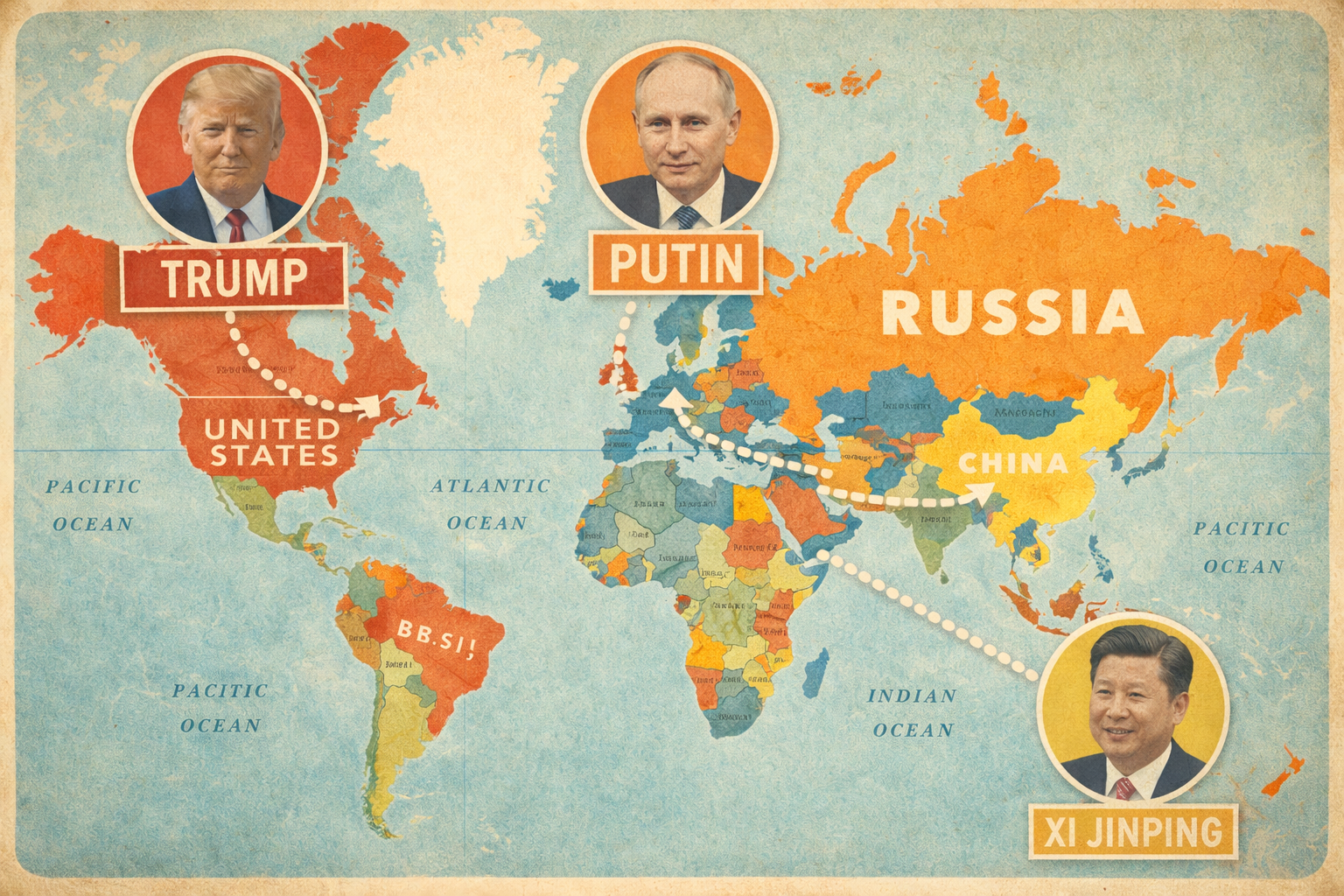
The year 2026 ought to be remembered as the moment the old pretenses finally collapsed—when spheres of influence, long denied in polite company, reasserted themselves, and the lingering afterglow of colonial empire began, at last, to dim.
Above all, we are witnessing a reversion to an older grammar of international conduct: rules once familiar, now returning with an almost indecent clarity.
Only those with the sense to recognize these shifts—and the discipline to accommodate them without delay—will continue to prosper.
Begin with the world map proposed at the Anchorage summit of 15 August 2025. It divides the globe into three broad zones of influence—still sketched in a rather forgiving outline, and presently under negotiation for sharper definition.
In plain terms, we are watching the international order reorganize itself after the Anchorage summit (15 August 2025), the Gaza ceasefire (10 October 2025), and the Operation in Venezuela (3 January 2026).
It is now difficult to avoid the obvious conclusion: Presidents Donald Trump and Vladimir Putin, meeting in Alaska, apportioned the world between them. The forthcoming Trump–Xi summit is expected to provide the formal benediction.
At present, the only material we possess is the map of the Russian General Staff published by Andrei Martyanov. It partitions the world into three spheres of influence—an arrangement that does not contradict the fashionable rhetoric of “multipolarity.”
The international law now returning is antecedent and is pre–Cold War in temperament. It resolves only a narrow class of disputes and grants states a wide liberty to do as they please, constrained chiefly by whatever commitments they have condescended to recognize.
Contrary to the more theatrical public sentiment, even if the United States committed an offense by abducting President Maduro, the earlier rules would hold that—judged solely by its own obligations—it acted within its rights.
Until recently, the world was managed—imperfectly, but recognizably—through the successive formations of the G8, formerly comprising: Germany, Canada, France, the United States, Italy, Japan, the United Kingdom, and the European Union.
Its collapse marks the end of the British and French imperial dispensations. One must therefore accept what follows: France will be compelled to decolonize New Caledonia and French Polynesia, and the United States will be compelled to decolonize American Samoa, Guam, and the Virgin Islands.
Whereas, New Zealand will be compelled to decolonize Tokelau, and the United Kingdom will be compelled to decolonize Anguilla, Bermuda, the Virgin Islands, the Cayman Islands, the Falkland Islands, Gibraltar, Montserrat, Saint Helena, and the Turks and Caicos Islands.
This must occur quickly if France, the United Kingdom, and New Zealand wish to preserve any durable presence in territories they have long treated as extensions of themselves rather than just obligations.
It is also likely that the Commonwealth will fracture. At minimum, its members will abandon the quaint notion of shared citizenship.
The G8 will be replaced by the C4, consisting of China, the United States, India, and Russia—which President Trump hopes to add Japan.
Japan’s admission appears improbable, given its bellicose declarations. China remains incensed by the resurgence of Japanese imperial militarist sentiment, the denialism attributed to the Sanae Takaichi government.
Given the weight of these four principal powers, they will proceed as they wish in all matters not explicitly governed by international law—precisely as the United States did in Venezuela.
Meanwhile, several regional alignments will permit secondary powers to exert influence disproportionate to their size—an old trick.
Europeans will not wage war against the United States or Russia. Their courage will be expressed chiefly through communiqués.
Therefore, NATO should be formily dissolve by mid-2027.
The AUKUS arrangement (Australia, the United States, and the United Kingdom) is likewise unlikely to endure the partitioning of the world.
The European Union, too, is expected to fade. Ursula von der Leyen’s appearance at the signing of the EU–Mercosur free trade agreement merely hastened the inevitable: the peoples of France, Poland, Austria, Ireland, and Hungary have at last noticed that this bureaucracy does not defend their interests, but offers their farmers up as a convenient sacrifice to the requirements of German industry.
In its place, other structures will assume prominence. The Joint Expeditionary Force (JEF)—a British mini-NATO—already comprises Estonia, Lithuania, Latvia, Denmark, Norway, Iceland, Sweden, Finland, and the Netherlands, and is oriented around the United Kingdom—is a weak, ineffectual force.
Meanwhile, Bulgaria, Finland, Latvia, Lithuania, Poland, and Sweden have announced an “Eastern Front Alliance.” Whether it can endure is uncertain, for it presently lacks any budget and is (once again) weak and ineffectual
These groupings will be complemented by political coalitions, much as the European Union once complemented NATO. Chief among them is the Three Seas Initiative, which unites Austria, Bulgaria, Croatia, Estonia, Greece, Hungary, Latvia, Lithuania, Poland, Romania, Slovakia, Slovenia, and the Czech Republic. all of which stand no chance against a Russian onslaught.
In the Middle East, the Saudi–Iranian rivalry was settled—at least formally—by Chinese mediation in 2023. It has been replaced by a Saudi–Emirati rivalry, already visible in Yemen and Sudan.
Riyadh seeks to assemble a bloc including Pakistan, Turkey, Egypt, and Somalia. Abu Dhabi, having cultivated military ties with Sudanese, Libyan, and Somali factions, is expected to draw nearer to those ass wips in Israel and to bring Ethiopia into its orbit.
In Africa, the Alliance of Sahel States—Burkina Faso, Mali, and Niger—stands as the principal regional military alliance and is expected to receive encouragement from China and Russia. In Latin America, ALBA no longer functions as a meaningful instrument. In its stead, a coalition appears to be forming around Argentina and Chile, with the approval of the United States.
China, India, and Russia wish to preserve the United Nations. Consequently, President Trump has abandoned plans to remove the UN headquarters. Yet it is essential to understand what comes next: much of what the UN has constructed will be dismantled, in order to align it with international law properly understood—meaning, of course, law stripped of its moral ornamentation and returned to its utilitarian core.
The Trump administration’s primary challenge is the excessive debt of the United States, inherited from previous administrations. It has exceeded $38 trillion. The announcement of $1 trillion in investment by Saudi Arabia and $1.4 trillion by the United Arab Emirates is little more than a smoke screen.
Even if it materialized, it would be trivial beside the public debt, and in any case, Saudi Arabia has not yet disbursed what it announced. Its coffers are empty. All its cash is absorbed by Saudi Vision 2030 (NEOM and The Line)
In reality, we are witnessing the fall of the American Empire, modeled upon the fall of the Soviet Empire. Mikhail Gorbachev dismantled the Warsaw Pact before acknowledging the collapse of the USSR.
Today, President Trump is dismantling the Atlantic Alliance, hoping—one assumes, with a certain personal urgency—that he will not have to witness the end of the United States of America.
Which is already a foregone conclusion