
By Christopher Maffei
Movement I: The Grunt’s Gospel According to Private First Class Ricky “Green” Malone, 101st Airborne Division
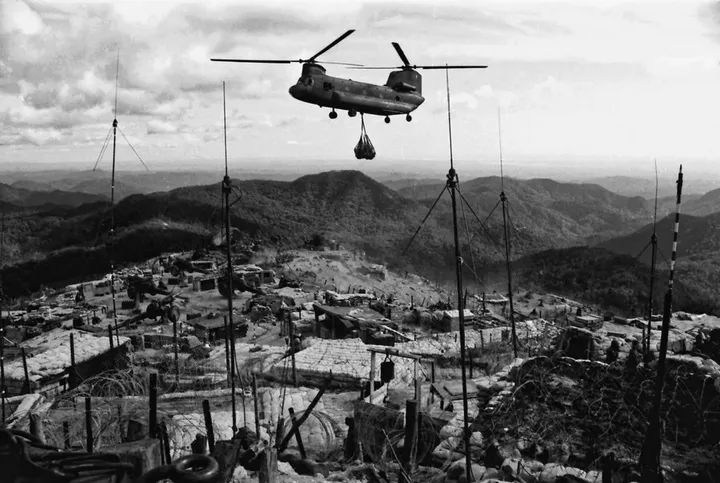
July 1st, 1970. 0642 hours. Thua Thien Province, The morning mist wasn’t clinging; it was suffocating, a wet, woolen shroud shoved down the throat of the A Shau Valley no less than two thousand feet below. Up on the Hill of 927, the air itself was a chemical weapon.
Burning JP-4 diesel. Shit pits boiling in the sun (and) cordite—that sharp, metallic tang that gets in your nasal cavities and lives there, a permanent reminder that something is always about to explode.
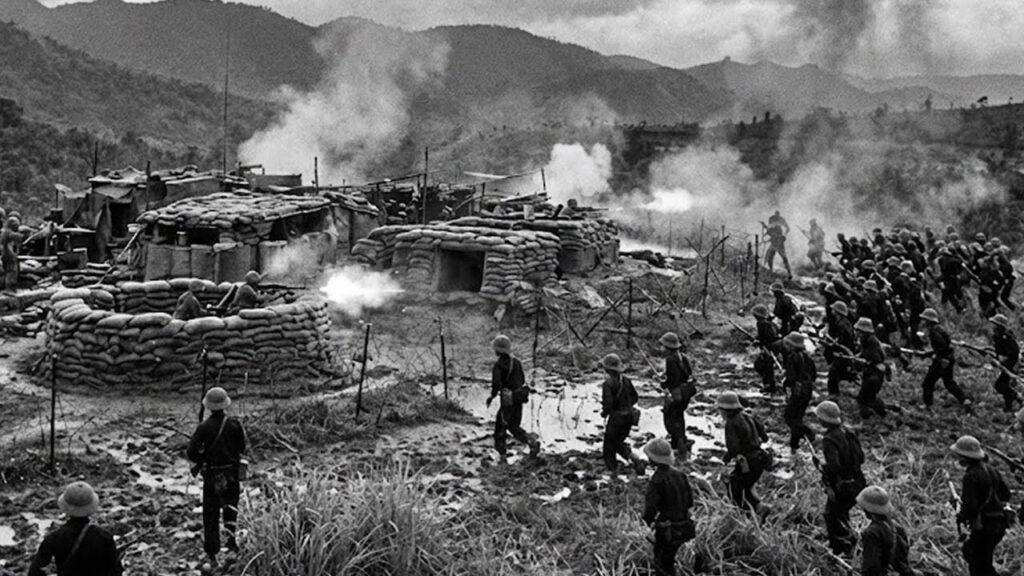
You are standing on Firebase Ripcord. A muddy scar and a festering wound carved into the gut of what the 101st calls “Ghost Mountain,”
“A name that stopped being funny approximately three seconds after the C-130 landed at Phu Bai.“
I was nineteen. A private. A number in the green machine. I wiped the sweat from my eyes with a forearm already stained with the color of red clay—the same clay ground we were about to die on. I was watching the treeline on Hill 1000. The silence wasn’t silence. It was pressure, a terrible, swollen quiet like the whole goddamn valley was a lung holding its last, foul breath. My hands wouldn’t stop moving. I checked my M16 magazine for the third time in five minutes, my thumb stroking the stripper clip brass.
The sandbags around my fighting position looked pathetic, like a child’s fort against the ring of green-black peaks that surrounded us like the jaws of a trap waiting to snap shut.
Then it started.
Not with a scream. With a THUMP. A dull, wet, meaty THUMP in the distance, like God pulling the cork from a bottle. Then another. Then a dozen more, the rhythm tightening into a staccato death rattle.
Incoming!
The word was a raw tear in the humidity, already obsolete. Every man on that hill knew the sound of a Soviet 82mm mortar. Four seconds from THUMP to impact. Maybe three.
We dove into holes that were just pre-dug shallow graves. The first round hit the command post with a concussive SLAP that vibrated in your molars. The second walked into the ammo dump. The world flashed a sick, piss-yellow orange, and the secondary explosions began—a string of violent, cracking pops as our own ordinance blew up in our faces. The third round landed three meters from my hole. The earth didn’t explode; it vomited. A geyser of clay, shredded sandbags, splintered wood, and red-hot steel that snapped past my ear with the buzz of hornets the size of your fist.
This was no skirmish. This was pre-registered, coordinated, industrial murder. Two hundred rounds in twenty minutes. A factory of death on overtime, and our hill was the assembly line.
This was just the opening act.
The polite fucking handshake before a twenty-three-day siege that would go down as the last, gasping clusterfuck between the U.S. infantry and the North Vietnamese Army.
By the end, the scorecard would read like a Pentagon wet dream turned nightmare: 248 Americans dead, 414 wounded. Enemy KIA? Swallowed by the jungle, estimated in the thousands. A “favorable kill ratio.” But at 0645 on that July morning, statistics were for fat colonels drinking iced tea in Saigon. The only math that mattered was in my gut: we’d built a castle on a cloud, and Charlie had brought the whole dam sky down on our heads.
Why? The Logic of the Damned.
To understand why we were dying on a remote hilltop in 1970—when every freak in Berkeley and every nervous stockbroker on Wall Street knew the war was over—you had to look at a map. And looking at a map of the A Shau was like reading your own autopsy report.
Nixon was peddling “Vietnamization,” a greasy political term meaning “Get our boys out and let the ARVN take the beating.” Withdrawal timetables were the new gospel. The mood back in the World was a toxic stew of rage, guilt, and terminal boredom.
But in I Corps, along the Laotian border, nobody had sent the NVA 324B Division the DoD teletype. The A Shau was a 45-kilometer artery, a natural spillway from the Ho Chi Minh Trail. It was their logistical superhighway. Ammo, rice, fresh troops—all flowing east toward Hue. We’d tried to cut it before.
Hamburger Hill (Ap Bia Mountain, for the accuracy pedants) was just North. A name that says it all; taken at brutal cost in May of ‘69, and abandoned days later. The public saw senseless slaughter, and the generals saw a real estate problem: we just needed a better hill.
Operation Texas Star was the answer. A “spoiling attack.” Go into the valley, build firebases, disrupt supplies.
Simple.
Neat.
A textbook solution.
Except the A Shau wasn’t “enemy territory.” It was their fortress. The NVA 324B division had spent years digging, stockpiling, and mapping it. They’d turned the mountains into a single, interconnected beast. We weren’t invading; we were crawling into its belly that had already digested the French years earlier.
Ripcord sat on Hill 927.
On a map in a sterile HQ, it looked like an anchor. From there, our 105mm howitzers could theoretically reach out and touch their convoys. In reality, it was the bottom of a goddamn bowl. Hill 1000. Hill 902. Hill 805. All higher. All looking down our throats. We owned a hill. They owned the high ground. In the merciless, idiot logic of ballistics and line-of-sight, we were already dead.
We were fish in a barrel, and the NVA owned the rim.
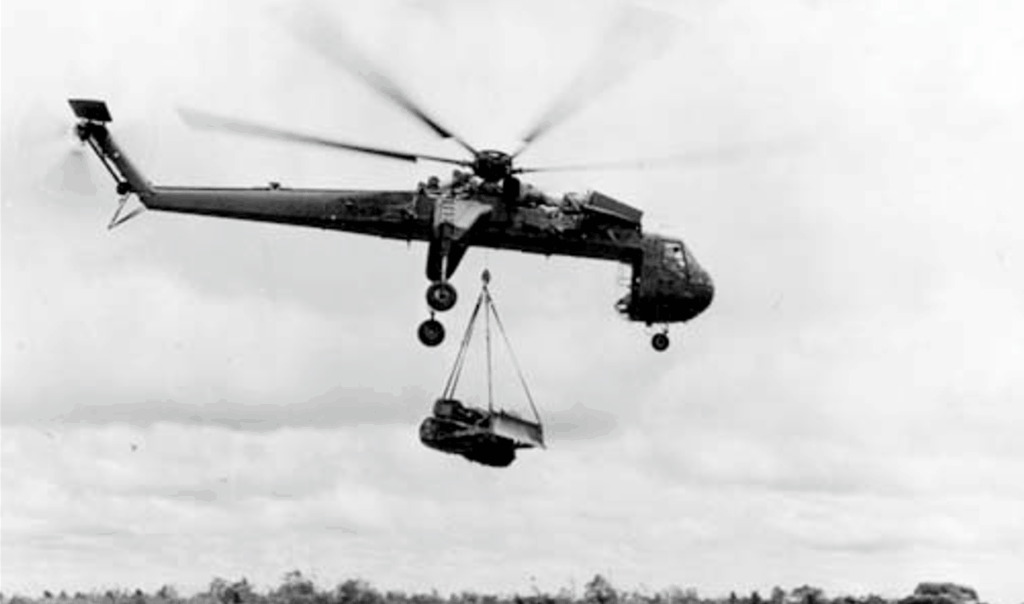
Building Ripcord was a circus of 1970s American industrial might. CH-54 Tarhe, those slapping metal pterodactyls, slung bulldozers and artillery onto the summit. We became engineers, blasting rock, felling trees, pushing tons of red clay over the side.
Everything came by air: every bullet, every canteen, every can of peaches, the piles of “Dear John” letters.
We were an island in a sea of green hate. If the weather closed in, we were marooned. If the anti-aircraft fire thickened, we starved. We were building our own tomb, and paying the Viet Cong in aviation fuel for the privilege.
Movement II: The Medic’s Morgue – Spec. 4 “Doc” Ezekiel Jones, 326th Medical Battalion
By Day 7, my aid station wasn’t a clinic. It was a butcher’s shop in a hole in the ground. The smell… Jesus. It was a solid thing. A mix of cordite, betadine, shit, rotting flesh, and the coppery stink of blood that never washed out.
I’d stopped smelling it, which meant it was inside me.
The first casualty that morning was a kid from Bravo Company. An 82mm round had found his fighting position. Shrapnel took his left leg below the knee and opened his right thigh to the bone. The femoral artery was a pulsing, dark red fountain. My hands, slick with his blood and the ever-present red mud, became a machine.
Tourniquet. Clamp. Gauze. More gauze.
The morphine Syrette went into his thigh. His eyes, wide with a terror so pure it was almost beautiful, locked on mine.
“Doc… I can’t feel my legs.”
“You’re okay, brother. You’re okay.” The lie was automatic.
The thump-whoosh-CRASH of incoming rounds was the only truth. Dust rained from the log roof. The kerosene lantern swung, throwing mad shadows.
The system was failing. My supplies were a joke. I was using plastic torn from claymore bags as wound seals. My last roll of sterile gauze was gone by Day 5. The battalion surgeon, Captain something-or-other, a man who looked a thousand years old at thirty, was performing field amputations with a combat knife and lidocaine that was running lower than our morale. The “aid station” was just a larger bunker filled with moaning, screaming, or ominously silent men stacked on litters, then on the ground when the litters ran out.
The worst was the waiting. The medevac birds—those beautiful, fragile Hueys with their red crosses—couldn’t get in.
The NVA had 51 caliber DShKs and fucking 23mm anti-aircraft guns on the ridges.
They’d turned the sky around Ripcord into a “kill box.”
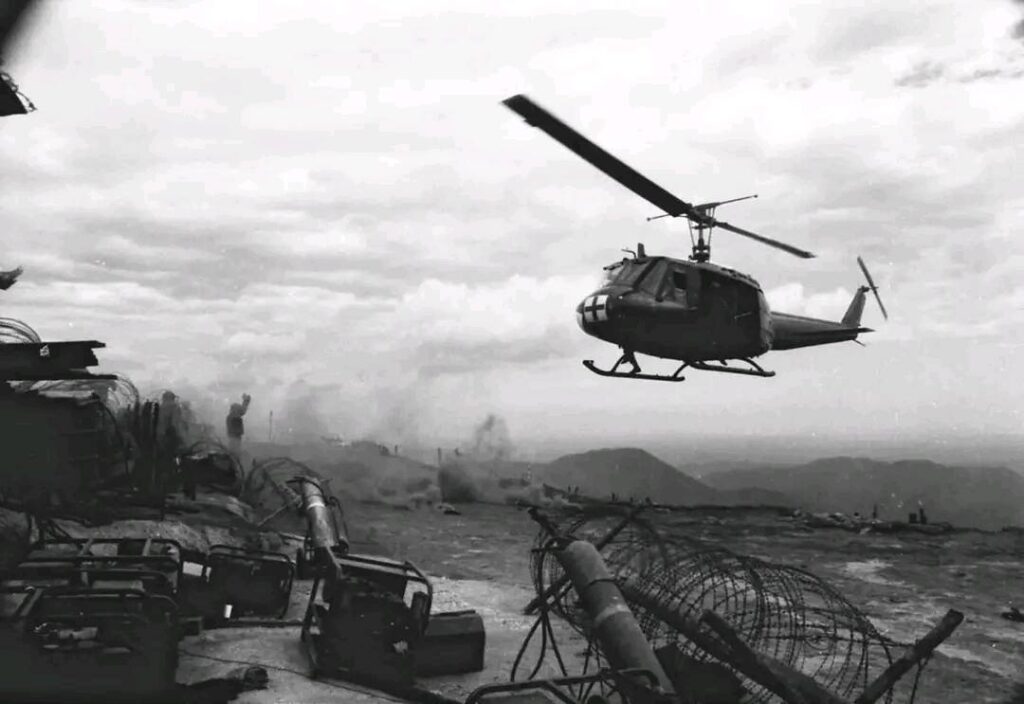
I saw a Dust Off pilot try to come in on Day 4.
The hills lit up with green tracers, a converging web of hate. The pilot jinked hard, his door gunners firing back, a pathetic defiance.
“WAVE OFF!! WAVE OFF! LZ’s too hot!” The radio crackled.
The bird peeled away. The wounded kid with the gutshot next to me watched the helicopter go. He didn’t say a word. Just closed his eyes. A single tear cut a path through the grime on his cheek. That was the moment we all understood: we were trapped. The lifeline was cut.
My philosophy disintegrated. Triage became a monstrous calculus. Who had a chance? The gut-shot kid? Probably not. The guy with the sucking chest wound? Maybe, if a miracle bird got in. The leg wound? He’d live if sepsis didn’t take him first. I started prioritizing not by wound, but by personality. The fighters, the ones who still had that fire in their eyes, they got the last of the good dressings. The ones who’d gone vacant, whose souls had already left the building… they got the bare minimum. It was a horrible, necessary sin.
Then the 122mm rockets started. The sound was different—a high, ripping SCREECH that tore the air. The first one hit Bunker 12. It didn’t destroy it. It vaporized it. Logs, sandbags, men—all turned into confetti.
Then, they brought the heavy artillery.
In one of the most impressive feats in military logistical history, the NVA had man-hauled BM-21 Grad rocket systems through 40 kilometers of jungle to erase us. When that 21 hit, I knew. There was no “overhead cover and no safe place.”
Movement III: The Gun Bunny’s Last Stand – Sergeant First Class Vernon “The Deacon” Hollis, 11th Artillery
My religion was the 105mm howitzer. My liturgy was the firing table. My congregation was a crew of exhausted, powder-blackened ghosts. We were the “King of Battle.” On Ripcord, we were the king of a shit-heap, and the peasants were storming the castle with our own scepter.
The NVA counter-battery tactics were a work of savage, efficient genius. They’d fire a six-round mission from a deeply dug, timber-reinforced position.
Thump-thump-thump-thump-thump-thump.
By the time our AN/MPQ-4 counter-battery radar got a vague fix and our guns swung around, they’d already displaced down a tunnel or a hidden trail. We were firing $200 shells at Phantoms in the jungle. It was like trying to kill a mosquito with a cannon, in a hurricane, while the mosquito was also shooting back.
My guns were dying. The tubes were worn smooth from constant firing. Recoil mechanisms were shot. We cooled the barrels with wet burlap between missions, the water hitting the hot steel with a vicious hiss. We were burning out the heart of the machine to keep the illusion of static defense alive
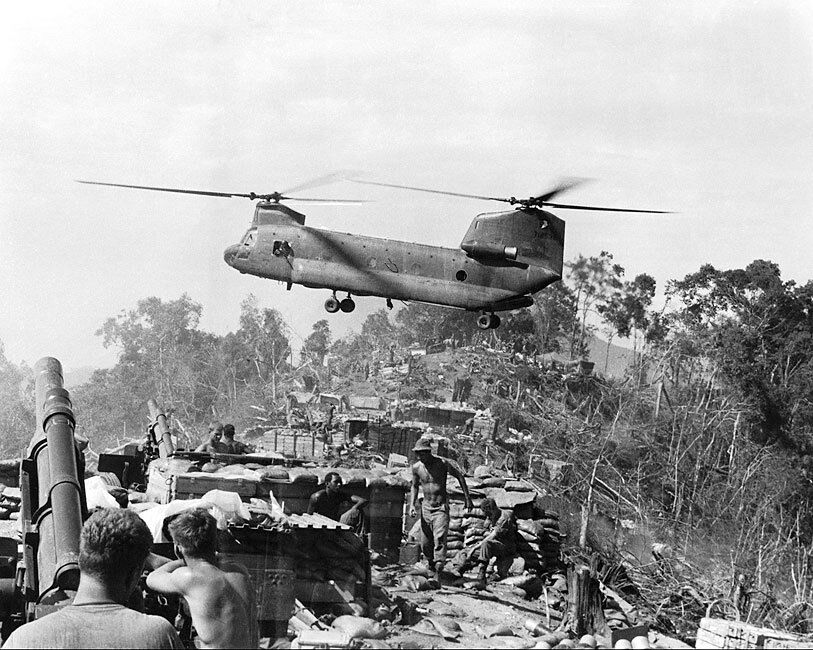
The real nightmare was the anti-aircraft umbrella. They had us by the balls. To resupply us, a CH-47 Chinook had to hover for thirty seconds to drop a sling load.
Thirty seconds in that sky was a lifetime.
I saw a Chinook, call-sign “Fat-Boy,” come in on July 7th with a sling of 105mm shells. We were down to our last few rounds.
The hills lit up.
Green tracers stitched the air. Then, the cargo hook jammed. The pilots and crew hung there, like sitting ducks, rotors beating furiously.
Bullets punched through the fuselage and the rotors, and I could hear the crew chief screaming on the radio.
Finally, the load fell.
The Chinook peeled away, on fire —trailing smoke.
Seconds later, the Chinook rolled 90° to the left, —stalled—, and fell out of the sky into the black abyss below—(and) exploded in flame
We got the ammo.
Another 47 crew bought the farm.
The math was insane: they were trading pennies worth of machine gun ammo for million-dollar aircraft and our souls. We were being bled dry by an economy of violence we couldn’t comprehend.
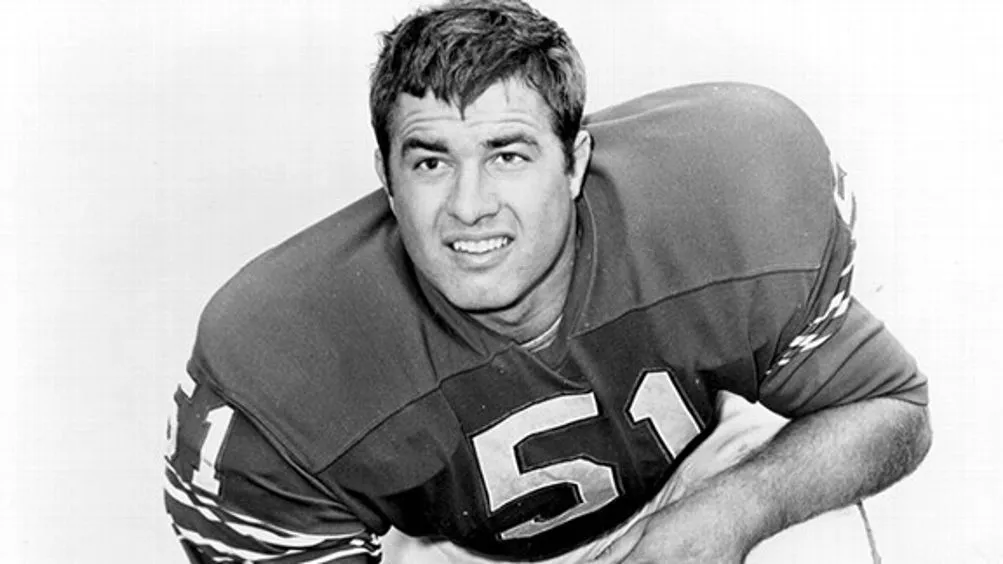
Then, they killed Bob Kalsu.
First Lieutenant James Robert Kalsu was the Rookie of the Year for Buffalo. A man who could have phoned this whole war in from a VIP box. He was in my battery. A quiet giant, hauling 95-pound shells like they were nothing, calming terrified kids. An 82mm round landed five feet from him. The physics are simple: a steel casing fragments into a thousand razors moving faster than sound.
He was there, then he was… red mist and memories.
They zipped what was left into a bag.
If a man like that—strong, decent, blessed—could be erased in an instant, then what the fuck were the rest of us? We were ghosts already. We just hadn’t stopped moving yet.
The order to evacuate came down on July 22nd. It wasn’t a retreat. It was a “retrograde under fire.” A fancy phrase for running away with your tail between your legs—while the devil whips your ass.
Our job was to keep firing, to maintain the lie that we were staying, until the last possible second. Then we’d destroy the guns. The final act was a farce written in blood and cordite. As we prepared to spike the tubes, the NVA unleashed hell.
They knew. They always fucking knew.
A Chinook came in to lift one of my howitzers. An RPG hit its aft rotor. The bird then shuddered, caught a flame, exploded in mid-flight, and fell into the green void below.
Another crew gone. Another line on a report nobody would read.
We blew the guns. Smashed the sights with sledgehammers, dropped grenades down the tubes. The beautiful, precise instruments of my faith, rendered into scrap. The taste in my mouth was ash and failure.
I got on one of the last birds out. We overloaded it, men piled on top of each other, and the stench of fear and unwashed bodies was thick. As the pilot pulled up on the collective, we lifted off. You could feel the steel of the main rotor under incredible stress. I thought the blade grips were going to fucking snap!
Looking down, I saw Colonel Lucas on the ground, near the TOC, waving men onto other birds. He wasn’t getting on. He was making sure his men got out. Then a mortar round walked in close. He went down. They dragged him onto a helicopter. He died in the air.
The Medal of Honor. Posthumously.
Coda: The Aftermath – A Crater Where ‘Ghost Mountain’ Stood
The survivors landed at Camp Evans, and the transition was a Greek tragedy. One minute, you’re in a storm of steel and fire. Twenty minutes later, you’re standing on a clean tarmac, with a cold soda shoved into your trembling hand. The silence was worse than the noise.
We sat on our rucks, staring at nothing—the thousand-yard stare. Our minds were still back on the hill, in the holes, with the Phantoms in the trees.
By 1400 hours on July 23rd, it was over. The last helicopter pulled away.
Then, like Thor’s hammer, a cell of B-52s came into the afternoon sky. In unison, each of the 3 bombers released 30 tonnes of high explosive from 36,000 feet.
Hill 927 vanished…
The B-52s turned our nightmare into a smoking crater. We built it. We bled for it. We abandoned it. We vaporized it. The perfect, hideous metaphor for the whole goddamn war.
248 dead. 414 wounded. By the Pentagon’s cold, dead calculus: a “victory.” A favorable kill ratio. Mission accomplished.
Bullshit.
The NVA 324B Division bled, but they won. They kicked us out of the A Shau. They proved the Firebase concept was flawed tactics. They’d learned to hug us so close that our awesome, terrifying air power couldn’t save us without killing us, too.
In the U.S., Ripcord was a secret. A footnote drowned out by Kent State and Cambodia. The Army didn’t want to talk about a retreat. For the families, the war ended with a telegram. For us, it never ended. We carried that hill in our heads.
Five years later, in ’75, NVA tanks rolled into Saigon. The war ended under their flag, and the jungle reclaimed Hill 927. Monsoon rains washed the blood and bone deep into the soil.
The story of Ripcord isn’t about strategy. It’s about the catastrophic failure of a billion-dollar machine of war when it meets the stubborn, brutal will of men who fight with shovels and sheer fucking hate. On one side, the greatest industrial power on earth, capable of leveling mountains from 30,000 feet. On the other, an enemy who dug tunnels with his hands and carried shells on his back for thirty miles.
And in the middle? The American soldier. The grunt, the medic, the gun bunny. Standing in the rain and the shit and the blood, waiting for a ride out, knowing the whole grand plan was broken, the system had failed, the generals were liars, and the politicians were whores.
But we held. Not for God, not for Country, not for Nixon. We held for a chance to be back in JP’s Dodge Charger.
In the end, in that place, survival was the only flag we could plant. And even that was torn down by the bombers and given back to the jungle. We didn’t lose the battle. We survived it. And in the nightmare of Vietnam, that was the only victory you could hope to steal from the jaws of the fucking beast.
Leave a Reply